
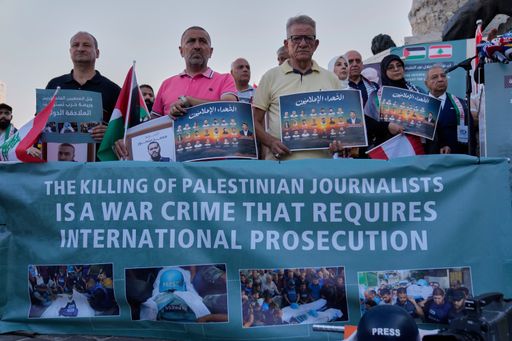
I wake every morning to the sound of drones circling overhead and wonder if this will be the day my name is added to the growing list of Palestinian journalists killed in Gaza.
More than 245 of my colleagues have been murdered since October 2023. Some were shot while wearing press vests. Others were crushed under rubble at home with their families. I knew many of them. They weren’t just statistics but friends who believed in the same sacred mission: to show the world what is happening here.
The closest friend I lost was journalist Ismail Abu Hatab. We used to meet at Café Al-Baqa—the very place where he was later killed. We laughed there, we dreamed of futures that now feel impossible. Just two weeks before his assassination, I interviewed him about his exhibition Between Heaven and Earth, where he showed the world fragments of obliterated Gaza, displayed in a tent in Los Angeles.
When news came of his death, I had no words. I could not even cry. What I felt instead was a vast emptiness, as if part of me had been buried with him.
Today, as I write these words, newsrooms across the world are staging something unprecedented. Nearly 200 media outlets from 50 countries have blacked out their front pages, homepages, and broadcasts in solidarity with us, demanding an end to the killing of journalists in Gaza and calling for international press access.
Reporters Without Borders, Avaaz, and the International Federation of Journalists coordinated this global editorial protest, the first of its kind.
For a brief moment, our profession speaks with one voice, saying: enough.
The message is stark, as RSF’s director put it, this is not just a war on Gaza—it is a war on journalism itself. Yet from where I sit under Israeli bombardment, I cannot help but see this solidarity as nothing more than a passing fad. Black front pages and banners may last a day; the war and the killing of my colleagues never stops.
In Gaza, journalism has become a death sentence. Israel has deliberately pursued a policy of silencing Palestinian reporters, ensuring the world sees only its version of events.
The latest massacre came at Nasser Hospital on August 25, when Israeli forces struck what they knew was a media hub for journalists.
First came the initial strike, then a second, the “double-tap”, which killed those who rushed for cover or to help the wounded. Among the dead were Reuters photographer Hussam Al-Masri, independent photographer Mariam Abu Daqqa, and Al Jazeera’s Mohamed Salama.
This was not the first time, nor will it be the last.
In two years of war, the names are too many to count: Aya Khodoura, Ahmed Al-Louh, Anas Al-Sharif, and hundreds more. Each carried a camera or a notebook, not a weapon. Each told a story Israel wanted buried.
Muted responses and double standards
When a Palestinian journalist dies, international organisations issue statements, then silence follows.
Reuters’ response to its own contractor Hussam Al-Masri’s killing was heartbreakingly timid; they expressed devastation, but made no demand for accountability.
Compare this with Ukraine, where the deaths of journalists such as Viktoria Roshchyna and Tatiana Koliuk triggered international investigations, high-profile coverage in Western media, and urgent demands for justice.