
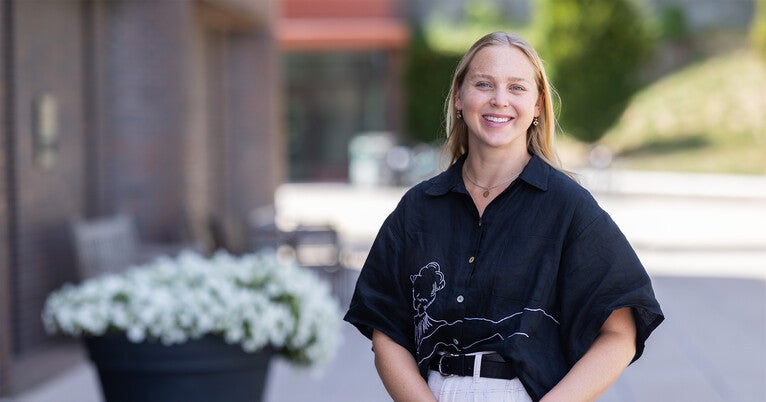
Before joining YCNCC in July, Kitch led marine carbon dioxide removal (mCDR) research for the National Oceanic and Atmospheric Administration (NOAA). Her work has included building partnerships between government and the private sector and coordinating scientific research efforts among public and private entities. Her academic specialties include ocean chemistry and paleoclimatology — studying climate change periods in the distant past.
In an interview with Yale News, Kitch discussed what drew her to work in climate science and described YCNCC’s plan for the new initiative. The interview has been edited for length and clarity.
What led you to this career and your deep interest in marine systems and climate change?
Gabby Kitch: I grew up in San Diego and watched both of my parents fight wildfires in Southern California, including two huge wildfires when I was in high school. That’s what spurred on my initial interest in climate science. And as I got older, I pushed to learn more.
I fell in love with research. I started with geochemistry, to understand the geologic past and how organisms responded to ocean acidification. Then I realized that I wanted to find more applicable solutions to the climate crisis, which led me to a fellowship focused on marine science policy, and then to NOAA, and eventually here to Yale.
What appealed to you about rejoining academia after your public policy work?
Kitch: YCNCC is a unique program in that it speaks to many different carbon dioxide removal approaches — from more natural approaches to ones that are more technology oriented. This holistic perspective allows YCNCC programs to serve as a bridge between different approaches.
Blue Carbon OAE is one of those “bridge” programs, correct?
Kitch: Yes. It starts with the idea that there are some marine ecosystems along coastlines that “breathe in” a lot of carbon dioxide, known as blue carbon ecosystems. We are now looking at how restoring blue carbon ecosystems can enhance ocean alkalinity, enabling oceans to absorb a greater amount of carbon dioxide.
How do blue carbon ecosystems enhance alkalinity?
Kitch: At this time, we are focusing on restoration of one such blue carbon system, mangrove systems, because they are highly productive. Mangroves produce organic matter that, when broken down, changes the chemistry of nearby waters. This change dissolves nearby sediment and generates alkalinity. Added alkalinity in the ocean allows the waters to take up more carbon dioxide.
We’re doing deep research with ongoing mangrove restoration projects around the world, in a careful assessment of what regions might be most suitable for this work. We’ll also need to bring in partners and supply restoration partners with accurate measurements of alkalinity and other carbon system measurements so we can understand the amount of carbon dioxide removal occurring in these systems.
We’ll continue our monitoring and, hopefully within the next 12 months or so, we’ll be ready to scale up with a commercially viable project that will reproduce our results on a much larger scale.