
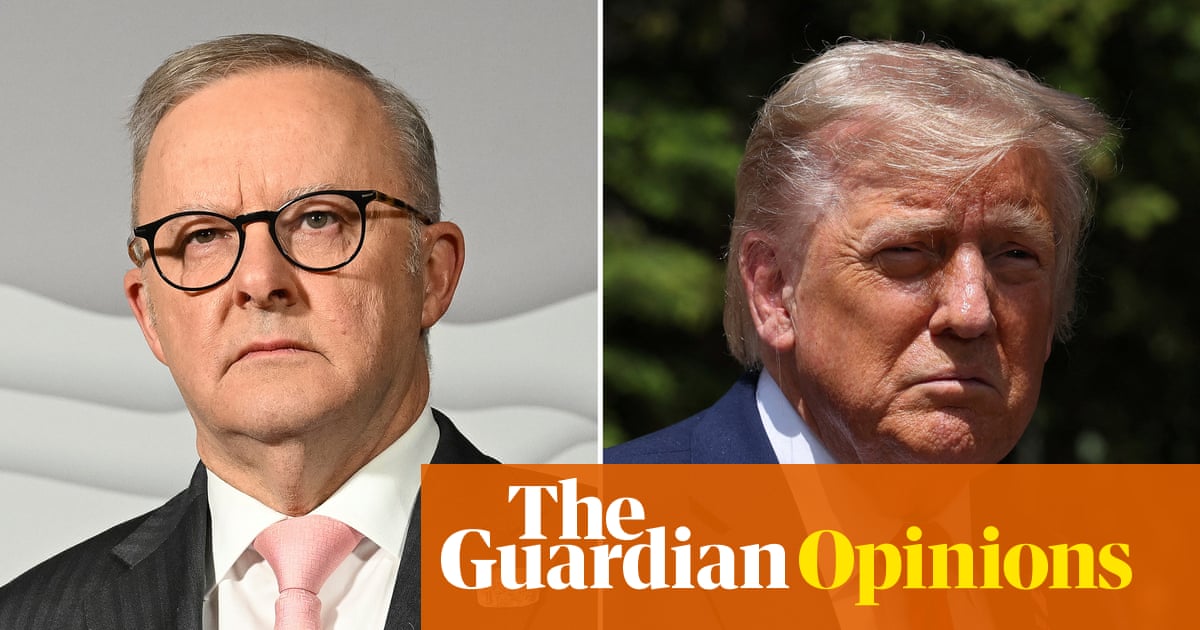
Within much of Labor – and particularly the Albanese government – the suggestion that Australia could untether its foreign and defence policy from the United States is an idea that dare not speak its name.
Even amid the Trumpian maelstrom, Labor is mostly unwilling to consider a different reality for Australia’s position in the world.
That’s why a contribution from the strategist and former Kevin Rudd staffer Lachlan Harris stands out this week.
Responding to Hugh White’s recent Quarterly Essay, Hard New World, Harris, a businessman and student of political communications, makes the case that the next great prime minister will be the person who shifts Australia’s gaze away from the US.
Like White, Harris argues America no longer has the means or desire to maintain strategic primacy in Asia, ending the security Australia has enjoyed since European settlement, first under Britain and then the United States.
Harris’s assessment is that Australia now faces its “post-American future” and must pivot to self-reliance in the Indo-Pacific. The last prime minister to undertake such a shift was the Labor legend John Curtin in December 1941, just a few weeks after the Japanese attack on Pearl Harbor, when he declared that “Australia looks to America, free of any pangs as to our traditional links or kinship with the United Kingdom”.
Sign up: AU Breaking News email
Albanese spoke to Trump on Thursday night, the latest signal that efforts in Canberra and by Harris’s old boss Rudd in Washington to secure an invitation for a face-to-face meeting at the White House may bear fruit ahead of Albanese’s visit to New York for the UN general assembly.
The two leaders talked about economic cooperation, trade and Australia’s push to grow exports and processing of critical minerals, helping key partners diversify away from Chinese supply. A readout of the call, distributed by Albanese’s office, said the pair discussed the strength of the relationship and “the importance of our shared security interests”.
Those interests almost certainly include US demands for Australia to spend as much as 3% of GDP on defence and the Pentagon review of the Aukus nuclear submarines agreement, a deal some within Labor do not believe is in Australia’s national interest.
Could there be a greater symbol of over-reliance on the US than Australia paying $1.6bn so far to boost America’s defence industrial capability while openly acknowledging that, under the terms of the deal, the promised Virginia class submarines may never arrive? The price tag for Aukus is at least $370bn, and Australia currently has no plans for where radioactive spent fuel from the subs will go.
Earlier this week Albanese called the US “our most important partner” and the rushed trip to the White House by the defence minister, Richard Marles, suggests the government could accede to Trump’s demands to spend more. Albanese has framed that challenge artfully as the government providing sufficient investment to maintain the country’s defence capability, as well as working to “lift” the relationship with Washington.
Even Trump’s biggest supporters in Australia – including the former Liberal prime minister Tony Abbott – acknowledge America doesn’t mean what it used to for key partners around the world. In his new Substack, Abbott wrote this week that Trump’s administration isn’t bothered with global leadership or showing up for allies. Abbott concedes Trump wants to impose his will on the world’s hotspots, working in pursuit of supposed “deals”.
“The postwar global order has endured largely because of the assumption that America would fight for its allies and vice versa,” he wrote. “What’s so currently unsettling is that this can no longer be taken for granted.”
Labor grandees Paul Keating and Bob Carr have argued against Aukus, suggesting the review being led by the influential US under secretary of defense, Elbridge Colby, could save Australia from itself. Keating calls the deal signed by the Morrison government and quickly agreed to by Labor “the most poorly conceived defence procurement program ever adopted by an Australian government”. Back in January 1996, it was Keating who said that Australia’s mature engagement with the region had helped change the country’s thinking about its defence, declaring “Australia needs to seek its security in Asia rather than from Asia”.
More recently, the Lowy Institute’s Sam Roggeveen has outlined a similar thesis in his book The Echidna Strategy, arguing Australia will need to defend itself without American help, and should prepare to do so through bold changes to foreign policy and increased leadership in the Pacific.
For critics of the US alliance, the unwillingness of the Australian government to consider a different approach is only made worse by the treatment we receive from Trump.
Albanese has been left hanging by the delay in scheduling a first meeting, and Marles was left open to mockery when a government spokesperson downplayed his talks with the vice-president, JD Vance, and secretary of state, Marco Rubio, as “a happenstance encounter”. Despite saying the government would not increase defence spending because of Trump’s demands, Labor could still fold under pressure. Albanese will be hoping to avoid Trump turbulence in the Oval Office.
At the same time, Australia is an active participant in the Coalition of the Willing, the European-led group planning for peace in Ukraine and trying to secure Trump’s backing for a security guarantee to keep Vladimir Putin at bay. Albanese has pledged to consider any request to contribute Australian troops if and when a ceasefire is agreed. The grouping is being led by Emmanuel Macron of France and the UK prime minister, Keir Starmer, working in concert in part to build an alternative power source to the isolationist and myopic Trump.
The talks came in the same week China made a huge show of its military might, as Xi Jinping plans his own new world order, deriving power from Beijing, Moscow and New Delhi.
Albanese is a cautious and methodical politician, focused on delivery of election promises, while chasing some larger domestic reforms. A gargantuan shift in foreign policy does not seem to be in his constitution. In his John Curtin Oration, delivered in July, he said the stability and prosperity Australia builds for itself would be defended with the help of partners.
Making the case for bold change, Harris writes that when strategic necessity and political opportunity align, elected leaders can rise to the occasion.
But in the shifting status of the Australia-US alliance, it remains to be seen just who that bold leader might be.