
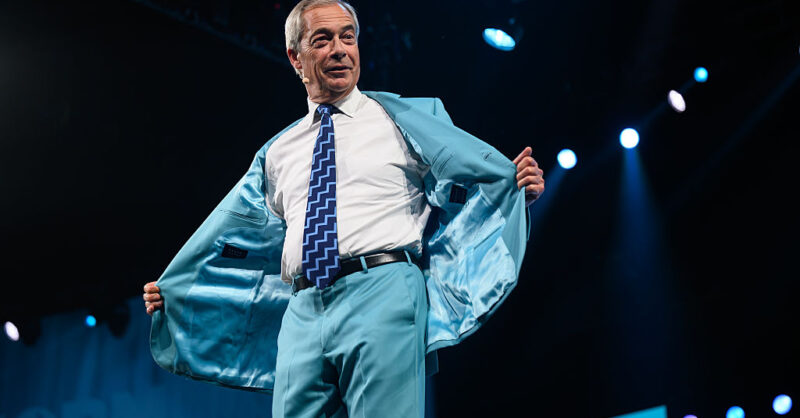
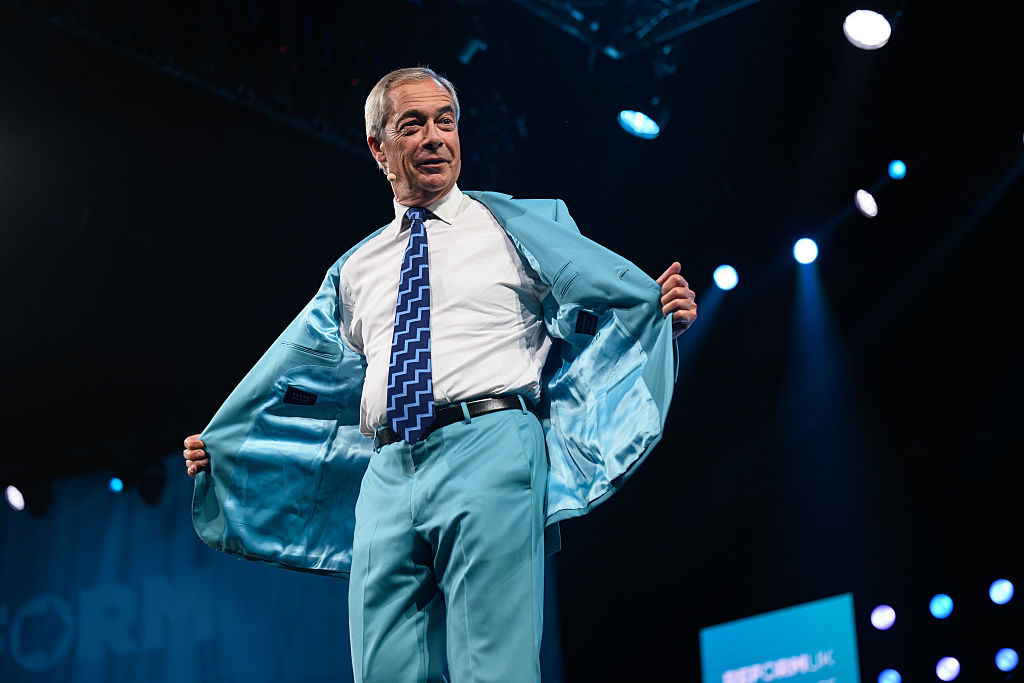
Photo by Leon Neal/Getty Images
There is a comforting myth in liberal England that Nigel Farage is a political opportunist. That he’ll say anything to get elected, that he doesn’t care, that he’d sell his grandmother for a Fox News gig. This always seemed off the mark to me: 15 apprentice years touring village halls and pub attics and carrying the can for golliwog-owning MEPs never seemed much of an accelerating political career path. But for those who still cling to the idea, this year’s Reform conference was the proof that it’s so much worse than that: he really means it.
There’s another myth going around about the conference itself: that it was a carnival of camp, a long squiffy weekend for the eccentric and the paranoid. Admittedly, there were the 10:23am pints, the anti-vax physician and a man in a cut-out Keir Starmer mask booming at by-passers. Andrea Jenkyns even sang a song. But, compared to last year, everything about the conference was grander, airier, more controlled. Rather than a lap of bars, there were just two modest lager huts. The lugubrious figure of Paul Nuttall, momentary leader of Ukip in the 2010s, was the only reminder from the shoestring days of purple and pound signs. The new party leadership now moves in packs of security, marching forcefully around the conference floor.
And while the only commercial interests to truly benefit from Conference 2024 were tobacconists and the people who make Madri beer, Reform has also become an important marketplace for political patronage. Strolling around the hangar of the Birmingham NEC this year I found a Heathrow lounge and an army of lobbyists dispatched from the highest offices of commercial Britain (one I chatted to was there on behalf of Microsoft and Vodafone, and was going to a party hosted by TikTok later in the evening). In the corner of the hall there was a totemic JCB PotholePro, arguably the most patriotic machine in the country and part of the combustion-engine empire of Lord Anthony Bamford, historically a major Conservative donor. On the second day of the Conference, Lord Ashcroft, the Tory peer who has done more than most to keep Kemi Badenoch in her job, sidled up beside me.
Powerbrokers aside, this was a weekend for the punters. There were said to be 10,000 people at the conference, the spear-tip of a 240,000-person membership. And these individuals are bound not just by party but by media. Reform has its own tabloid (at the conference’s Daily Express pub quiz, the first prize was a Daily Express subscription). It has its own broadsheet (one of the event’s star attractions, Lucy Connolly, was interviewed by the Daily Telegraph’s Liam Halligan and Alison Pearson). And it has its own TV channel. The GB News tent stood like a landed alien mothership in the middle of the arena, and party members said that they had watched Farage on the channel in the years before they joined up. Several mentioned they saw joining Reform as the solution to just “yelling at the telly”.
This might also tell you something of the party mood, which swung wildly from furious to inspired. One of the first things attendees talked about was immigration. John, who was volunteering at the stand selling Reform football shirts, said we had to go the same way as Trump and deport illegal immigrants to achieve a deterrent. “It sounds awful, people say you’re a racist,” said Linda, a retired nurse down from Sheffield, but she feared we “might end up to be a Muslim country”.
But these confessions came garbled alongside more familiar sentiments about work and fair play, morose and indignant. “They get so much in benefits, they don’t want a job,” said Linda. “The work ethic’s gone,” said her husband, Robert. Another couple, Sharon and Gary, who were down from St Helens, ricocheted from migrant hotels to the tax burden and back again, asking why their GP appointments were only ten minutes long when asylum seekers get half an hour. Another man jealously compared a long post-holiday passport queue to the speedy collection of small boat arrivals. Val, an activist from South Wales who had dyed her hair a shock of teal, asked why there were no four-star hotels for military veterans.
Proud and petty in equal measure, this is the “producerism” that, as the sociologist Dan Evans has written for the New Statesman, runs through Reform “like a stick of rock”. And more than an ideology or a language, it is a litany: “decent graft”, “tough love”, “no complaints”. It is the temper of Thatcherism, inherited by Reform and stitched onto its migration policy without a visible seam. And Farage personifies it to the point of near religious dedication. On the second day of the conference, he set up a dais of artificial grass to sign Reform football shirts on. A line of over a hundred people immediately and patiently formed. I watched as they stepped forward awkwardly to greet him, receiving a whispered reply, a proud handshake, a smile, even a wink. There was a creepy poignancy to the ceremony, which, with every signed shirt costing £100, probably netted Reform around £10,000.

Subscribe to The New Statesman today from only £8.99 per month
But these are the most dedicated party cadres. And even if it was a shock to see Lucy Connolly treated like Joan of Arc, the straight, numbing, cheddar cheese normality of Reform UK in 2025 cannot be understated. In post-war British history, the most revolutionary political potential has come from the middle classes of Middle England. And according to More in Common polling, Reform now leads among people who, this summer, were looking forward to holidaying abroad, watching the women’s rugby, having a barbecue and sitting in a pub garden. The difference between 15 per cent and 30 per cent in the polls is worth more than votes alone. It’s a major victory for the party’s familiarity, and its sanitisation.
A rare political sanitisation that has been accompanied by radicalisation. In the conference arena, you could look around the turquoise Reform battle bus. Last year, it served as the VIP area for the conference after-party. But now the slogans on its side – “slash immigration, slash the cost of living, boost wages” – look positively banal. In its talk about “fighting age” immigrants and mass deportations, Reform is now emulating the language of its exiled MP, Rupert Lowe.
On the conference fringes, however, Lowe’s allies and ideas were still to be found. James Orr, who invited Lowe to speak at his “Now and England” conference in June, spoke on a panel which asked, “Is the country really ready for Reform?” The next day, alongside Jacob Rees-Mogg (and, weirdly, his teenage daughter Mary, who’s already a Reform member), David Starkey lectured on the Blairite coup of 1997, which he compared to a “slow burn French Revolution”. He condemned “the catastrophe of human rights”, the Supreme Court and the European Convention on Human Rights, and said that “Nineteen Eighty-Four turned out to be the Blairite textbook”. The pair competed on historical analogies for the coming Reform takeover: the 1832 Reform Act, the Glorious Revolution, the Stuart Restoration. “We have to restore,” said Starkey, twice. Starkey has given a version of this speech before, to YouTube subscribers and decaying Thatcherites, but not to a mass political movement as a retained intellectual. He told the crowd their job was now “evangelising” for the narrative he’d set forth.
After his removal as Conservative Party leader in 1975, Ted Heath embarked on what became known as “the incredible sulk”. Nigel Farage’s demeanour, at this conference and on television in recent days, could be styled as the incredible gloat. His party has achieved every goal they set out at their conference last year: a bigger membership, a genuine regional operation and electoral success. He remains free from the ministerial code or the expectation of propriety – his bedroom proclivities were on the News of the World front page in 2006. People feel they know him, so they don’t look too close. He deflects scandals that would fell other politicians. And his opponents continue to fall before him: after this weekend, Starmerism, as a political creed and a historical era, appears to have entered its ebb tide without ever crashing onto the beach.
But far more impressive is the party operation that has materialised beneath Farage. In recent years, the left has become adept at analysing the “associative institutions” and “party structures” that they’ve failed to build. Through the confluence of big money, big claims and big appeal, Reform UK is building one, armed with activists, intellectuals, broadcasters and industrialists. In this context, Nigel Farage’s personal motivations matter less and less. The forces behind him are marching out of his grasp.
[See also: Is Lucy Connolly a normal person?]
Content from our partners