
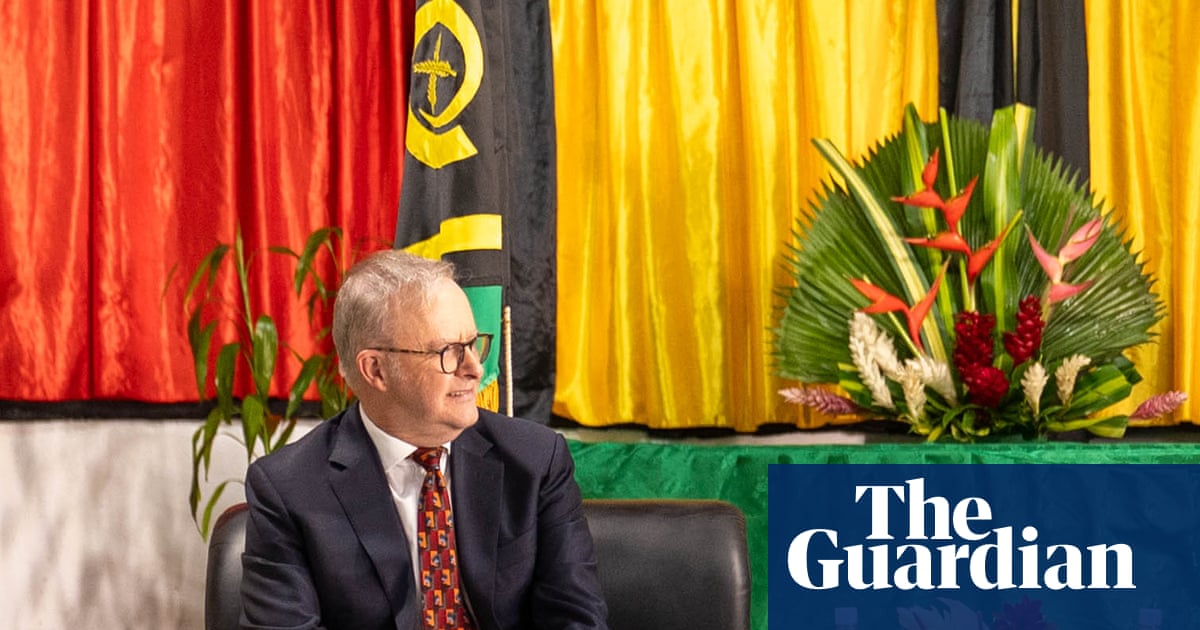
The federal government is racing to save a major new agreement with Vanuatu, after Anthony Albanese’s plans to sign the deal were rebuffed over concerns about infrastructure funding from China.
Speaking alongside Vanuatu’s prime minister, Jotham Napat, on Tuesday, Albanese said he was confident the Nakamal agreement will be “able to be signed soon”, talking up cooperation and proper process with Vanuatu’s governing coalition.
The Australian prime minister travelled to Port Vila before this week’s Pacific Islands Forum, hoping to sign the agreement, which would see Australia spend up to $500m over a decade on climate change resilience, security services and the economy.
Sign up: AU Breaking News email
It is designed to lock in Australia as Vanuatu’s primary security partner and to push back against China’s efforts to build ties across the Pacific, including through funding for major infrastructure projects.
“It’s important that processes be respected and I respect the prime minister’s processes,” Albanese said.
“We have our own, respectively. This is an agreement that will also, importantly, respect sovereignty of Vanuatu, but one as well that respects sovereignty of Australia.”
But Napat said more work was needed before the deal could be signed.
“Some of my ministers, and my MPs, they feel that it requires more discussions to particularly on some of the specific wordings in the agreement … when it comes to the critical infrastructure.”
Asked if the concerns related to Vanuatu’s ability to seek infrastructure funding from other countries, Napat said: “Yes.”
Last month, senior Australian ministers including Penny Wong, Richard Marles and Pat Conroy visited Vanuatu to celebrate the conclusion of negotiations.
Albanese said there was in-principle agreement but both sides had more work to do. He stopped short of a specific timeframe, saying only he was confident the agreement would be completed “soon”.
A previous security agreement struck with Vanuatu in 2022 was never formally ratified by the country’s parliament, amid concerns over a lack of consultation and whether it was consistent with Vanuatu’s philosophy of non-alignment in foreign policy.
“I’m reassured by the discussion that I’ve had with the prime minister,” Albanese said.
“Australia was a great supporter of independence with Vanuatu. We respect its processes, we respect its sovereignty, which is why we respect the discussion that we’ve had together today.
“If that means people going through processes for a short period of time, then that is absolutely fine by us, and we don’t want to either do or be seen for anything to occur that undermines the sovereignty of Vanuatu.”
Nakamal is the Bislama word for a traditional meeting place.
China has funded road projects in Vanuatu, as well as building new government ministry buildings, the country’s parliament, a sports stadium, a convention centre and a wharf.
To counter China’s influence, Australia is spending $200m to train Pacific police recruits in Brisbane, and signing agreements with countries including Papua New Guinea and Solomon Islands.
Albanese will fly with Napat to Honiara on Wednesday for the start of the Pacific Islands Forum.
China’s presence in the region risks overshadowing that event too. The lead-up to the talks has already seen significant tensions after Solomon Islands’ prime minister, Jeremiah Manele, excluded external partners – including China, the US and Taiwan – from the event.
Solomon Islands is China’s biggest security ally in the Pacific and Manele’s decision to block external partners fuelled speculation he was trying to keep Taiwan out.
Manele said the exclusion of partners was justified because a review of regional architecture in the Pacific was not yet completed.
The forum is expected to endorse a Pacific resilience facility and a declaration calling the Pacific an “Ocean of Peace”.