
As previously revealed by this masthead, a permanent First Peoples’ Assembly with powers to advise government on any matters that affect their communities and to be consulted on proposed laws directed to them, will be the decision-making body within Gellung Warl, a new statutory corporation intended to play a “central party in the democratic life of the state”.
Gellung Warl will also include a standing truth-telling body, to be known as Nyerna Yoorrook Telkuna, and an accountability body, known as Nginma Ngainga Wara, which will hold the state government to account for its commitments to closing the gap in social, economic and health outcomes between black and white Victorians.
The first stated objective of Gellung Warl is to “deliver improved and enduring outcomes for First Peoples”. Premier Jacinta Allan said treaty was necessary because previous government policies had failed.
“Governments are spending significant amounts of money, huge amounts of money, seeking to close the gap, a gap that has existed for a very long time,” Allan said. “But it’s not working.
“None of these changes are about taking anything away from anyone. It’s simply about improving services, improving the lives for Aboriginal Victorians.”
Minister for Treaty and First Peoples Natalie Hutchins said the success of an Aboriginal-run kindergarten program was an example where involving First Peoples designing and delivering programs for their own community had led to better outcomes.
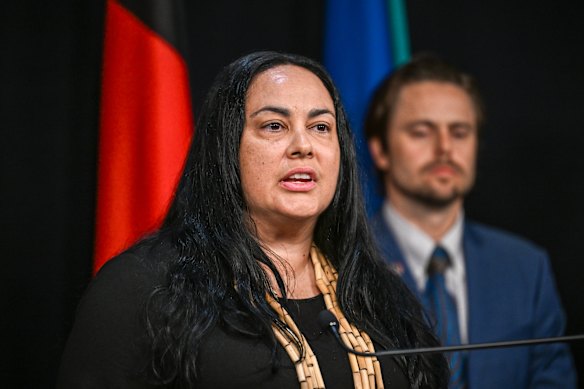
Murray with Treaty Authority lawyer Jidah Clark.Credit: Justin McManus
“Quite frankly, if the Liberal Party wants to stand against it, then they need to have a good hard look at themselves,” Hutchins said.
The Liberal-led opposition has reaffirmed its intention to vote against the treaty legislation. Nationals MP Melina Bath, the opposition’s spokeswoman for Aboriginal affairs, said she shared the First Peoples’ Assembly’s desire to close the gap but didn’t believe a treaty was the best way of achieving this.
She acknowledged that the status quo was not working and said the opposition would release policies in the near future setting out an alternative to a treaty.
“The Liberals and Nationals are absolutely committed to closing the gap,” Bath said. “We believe there are alternative approaches that avoid division and race-based distinctions and will deliver real and positive outcomes for Aboriginal Victorians.”

Nationals MP Melina Bath, the opposition’s spokeswoman for Aboriginal affairs.
The Victorian Farmers Federation greeted with caution the tabling of the legislation and publication of the treaty agreement.
“The introduction of this legislation today will be the first time it’s been seen by many stakeholders,” federation president Brett Hosking said. “It is critical that such a significant piece of policy and legislation is considered through an open and transparent consultation process as it moves through parliament.”
A lengthy preamble to the treaty agreement proclaims “the dawn of a new era in Victoria – the era of treaty-making”, in which future agreements are expected to be negotiated by Gellung Warl, the state government and the state’s 38 traditional owner and language groups.
Loading
“The colony of Victoria was established without the consent, negotiation or recognition of the Traditional Owners of these lands and waters,” the preamble reads. “What followed was violence, destruction and dispossession – a rush to take land, lives, and resources, leaving lasting scars on families, communities and Country itself.
“The harm of colonisation has not ended. Its legacy – dislocation, grief and trauma – still ripples through families and communities today.
“Treaty is one of the most important steps Victoria has ever taken – a renewed and enduring relationship between First Peoples and the state, grounded in the inherent right of First Peoples to self-determination.”
The tone and content of the preamble echoes the findings of the Yoorrook Justice Commission’s final report and indicates how a treaty will reshape the school curriculum.
The agreement states that curriculum changes will be co-designed by Gellung Warl, the Victorian Curriculum and Assessment Authority, the Victorian Aboriginal Education Association Incorporated and the responsible government department.
The Yoorrook Justice Commission’s official public record, a narrative account of Victoria’s history since colonisation as told by First Peoples, will be included as a foundational text to inform truth-telling in schools.
The Victorian parliament will deliver a formal apology to First Peoples for the state’s part in this history, with the final wording to be negotiated. It will also approve an annual operating budget of $70 million for Gellung Warl, indexed to inflation, and a further $37 million in capital expenditure to provide “ongoing premises” to house the new body.
Gellung Warl, a Gunaikurnai phrase meaning “tip of the spear”, will be given use of a dedicated room within Parliament House from which to advise and consult lawmakers.
Loading
Professor Lee Godden, acting director of the Melbourne Law School Indigenous Law and Justice Hub, said the legislation draws on international human rights law and treaties already in place in other common law countries but goes further.
“Through Gellung Warl, the bill empowers the First Peoples’ Assembly to strengthen the relationship that have been built with the institutions of Victorian government, including with the parliament, but to remain accountable to its constituent Aboriginal communities,” she said.
“The bill has parallels with elements of treaties in other common law jurisdictions such as Canada and Aotearoa New Zealand, but it transcends those models in its emphasis on representativeness, self-determination empowerment in governance, accountability and truth-telling.”
The treaty agreement gives the First People’s Assembly extraordinary access to government, with the power to make representations to the cabinet, individual ministers, departmental secretaries and both houses of parliament. This is balanced by the proviso that nothing in the agreement limits the authority of parliament to make laws and conduct its business.
Get alerts on breaking news as it happens. Sign up for our Breaking News Alert.