

“So they’re often 15 to 20 kilometres offshore within the next 24 hours after release. All the other shark species, the little whalers, the duskies, the sandbars, the black tips, are all released on site.”
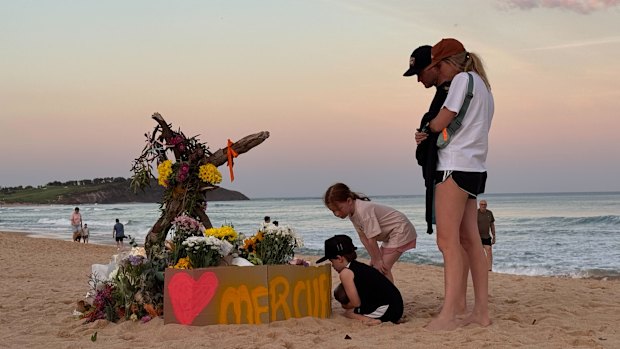
Locals pay tribute to Mercury Psillakis at Dee Why Beach.Credit: Danielle Smith
The department’s drumline program has now gathered one of the largest databases on the behaviour of its target species on Earth. Much of the information it gathers on potentially dangerous sharks is made available in near real time via the government’s SharkSmart app and website.
Loading
The app showed that on Tuesday, target sharks were active all around Sydney. At 12.31am, a great white identified as shark #2361, which had been caught and tagged at Evans Head in August, was detected by a receiver at Avoca Beach. At 1.07am, another white that had been tagged in Newcastle in November alerted a receiver at Hawks Nest.
Throughout the day, the system kept sharing its alerts. A white tagged in Terrigal last June visited Killcare after 1am, while another that had last been detected at Forster in October was pinged at Maroubra at 5.07am, half an hour before dawn. At 8.40am, a drumline signalled to contractors that a tiger shark had been caught at Port Macquarie. They tagged and released the 2.44-metre-long animal. An hour later a 3.93-metre tiger was released at Gerringong, followed by a 2.63-metre white shark at Coffs Harbour.
So far, says Butcher, more than 300,000 people have downloaded the app, and the system has detected tagged animals around 400,000 times.
The system shows that white sharks are particularly active in NSW waters at this time of year and many will return to Victoria as the waters warm towards summer. This is when the receivers will start to detect an uptick in bull shark movements as the sharks move south from Queensland.
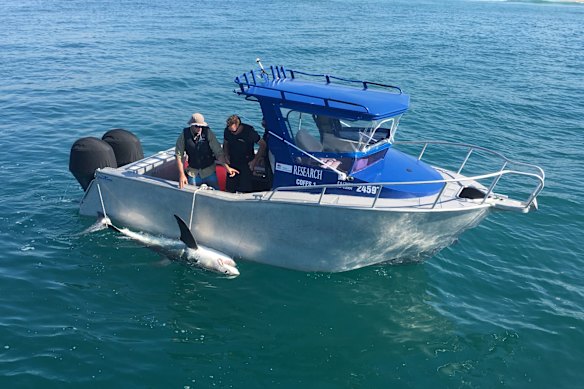
A shark being tagged and checked after being caught on a drum line.
It also shows, says Butcher, that despite the tragedy that unfolded at Dee Why on Saturday, the target sharks overwhelmingly ignore the human swimmers they regularly come across as they travel the coastline.
Anyone who regularly swims at Sydney beaches is likely to unknowingly swim alongside these animals, he says.
Loading
“We’re currently writing up some research about using our video from drones and also citizen science to show that white sharks and other sharks are swimming past us more often than what we actually think,” says Butcher.
“We know that they swim at sort of three to five kilometres an hour. They swim just outside the wave break at the back of the beach, and they’re really inquisitive, especially white sharks. They’ll have a look at a bit of plastic or a bit of seaweed in the water, but they’ll certainly swim in straight lines along those beaches and they won’t do laps around and around and around – they keep on moving up and down the coastline.”
Mouth swabs show the sharks tend to prefer benthic animals – those that live on or near the seafloor, such as stingrays and mullet, Butcher says. Most tagged around the NSW coast tend to be juveniles or sub-adults, ranging in size from around 1.5 metres to four metres.
On Tuesday, Agriculture Minister Tara Moriarty confirmed the government would scrap its trial of removing shark nets at three beaches across NSW following Psillakis’ death.
“In light of the tragedy that has occurred at Dee Why on the weekend, we need to be sensible about what the community would accept at this time,” she said.
“We need to allow time for the Department [of Primary Industries] and our government scientists to collect information on what happened and then provide a report to government that will inform future considerations for the shark management program.”
The government had initially indicated it would wait for the release of a DPI report into the Dee Why incident before deciding on the trial, but it has now opted not to wait, instead committing to keeping all 51 shark nets in place along the NSW coast.
As part of a trial to remove nets from three beaches, the Northern Beaches, Waverley and Central Coast councils were asked to each nominate one location.
Loading
Dee Why had a net in place when Mercury was attacked.
In its statement on Tuesday, the Psillakis family said Mercury loved the ocean and was deeply connected to the community of surfers.
“Unfortunately, this was a tragic and unavoidable accident.”