
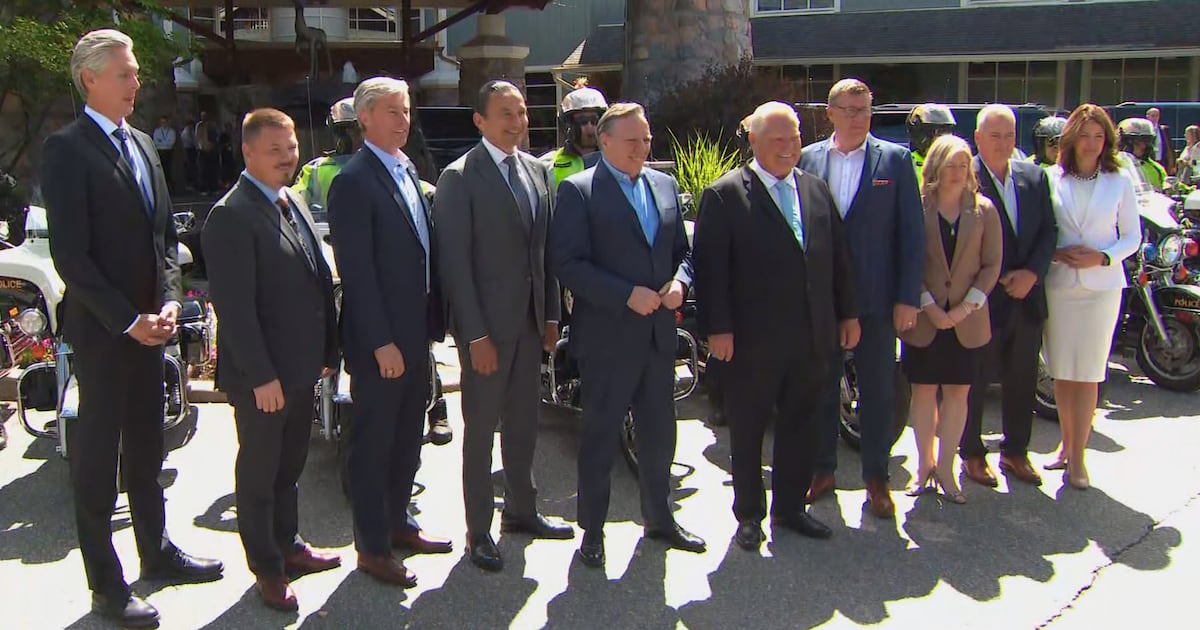
As Canada-U.S. trade talks intensify, Canada’s premiers kicked off three days of meetings in Muskoka Monday focused on building up the Canadian economy and breaking down trade barriers.
Ontario Premier Doug Ford is hosting the three-day meeting, and kicked the gathering in good spirits, focused on coming out of the talks on the same page.
“We may differ on a few views, which is fine, but we walk out of here united as a country, as a strong, solid country,” he said.
Ford also called for a revived buy-Canadian push in every province and territory as one way to push back on intensifying tariff pressure from Canada’s closest ally and largest trading partner, the United States.
“Start buying Canadian-made everything. That will hurt them more than anything at all. We’re their number one customer,” Ford said as he arrived at the Deerhurst Resort. “We are an economic powerhouse, and we don’t have to take a backseat to anyone.”
Beyond buying local, premiers on their way in spoke about the need for Canada to build by advancing nation-building projects and boosting internal trade by breaking down barriers, as the trade war with Canada’s closest ally and largest trading partner continues.
Met first with Indigenous leaders
To kick off this conversation about moving new major energy and infrastructure projects forward, premiers met with the leaders of national Indigenous organizations on Monday “to have focused discussions on economic development, economic reconciliation and other key priorities.”
“We have to diversify our trade. We have to start building pipelines, west, east, north and south,” Ford said. “We need to get rid of the regulations that are taking 15 years to get critical minerals out of the ground… We have to unleash Canada, unleash Canadian industry resources. And we can be stronger and more resilient and wealthier than any country in the world if we do that.”
This push, to get to a “yes” on new pipeline projects or mineral extraction efforts faster, comes on the heels of Prime Minister Mark Carney’s summit on his major projects law, where the federal government confirmed plans to have the related projects approvals office up and running by Labour Day.
“I think its always good to be at the table,” said President of the Métis National Council Victoria Pruden ahead of the meeting.
In a radio interview on Monday, New Brunswick Premier Susan Holt told CTV News’ Vassy Kapelos that in her view, the conversation got off on the wrong foot with the federal government’s now-passed Bill C-5, the Building Canada Act.
“I think it’s clear from the comments from the Indigenous leaders that they did not feel sufficiently consulted with,” she said. “Let’s get the projects on the table, and let’s make sure that those conversations and those partnerships are worked out with Indigenous peoples across Canada.”
Talks come amid looming trade deadline
The Huntsville meetings were originally set to take place during the same week Canada and the U.S. aimed to finalize a new trade deal, as Carney and U.S. President Donald Trump agreed to on the sidelines of the G7 Summit in Kananaskis last month.
However, the two countries look set to blow past the initial July 21 deadline and are now working towards a revised Aug. 1 target, as that’s the date the U.S. administration has said it plans to raise tariffs on Canadian goods to 35 per cent.
When the goalposts shifted, Carney announced he’d be coming to cottage country, to host a First Ministers meeting, during the Council of the Federation’s summer session. And so, on Tuesday, the prime minister will join the premiers and provide a face-to-face update to all 13 of them, on the state of talks and the U.S. administration’s threat of escalating tariffs.
With Carney conceding that a tariff-free trade pact is likely off the table, Quebec Premier Francois Legault confirmed Monday that the prime minister is poised to face some pressing questions about what this could mean for jobs and industries in their respective regions.
“I want to talk to Mr. Carney tomorrow about it to have a duration, if we have an agreement on August 1, because right now our economy in all of Canada suffers because of the uncertainty,” Legault said, adding that companies need to know for investment confidence purposes, whether any incoming agreement is for say, three, or five years.
As trade talks with the U.S. administration have largely been handled by the federal government, premiers have been busy issuing memorandums and inking new trade agreements across provinces, in an effort to bring down domestic trade barriers, while also aiming to expand their respective international trade markets, work that premiers say they plan to continue this week.
“These are all steps. They’re steps in the right direction. We need to have free and open trade between our provinces,” said Saskatchewan Premier Scott Moe. “We need to have free and open trade on our continent with the U.S. and Mexico. And I would say that we’re always a supporter of the freest and open trade that we can have globally.”
Other national issues on agenda
Trade uncertainty isn’t the only item on the agenda. Premiers are also expected to discuss energy security, public safety concerns such as bail reform, emergency management as provinces face wildfire season, as well as immigration and health care.
“Everyone will bring their perspective view to the table,” said former Nova Scotia premier Stephen McNeil in a Sunday interview on CTV News Channel. “I think it’s all that more important for Canadian premiers to focus on the things that they can change inside of our own country.”
“I think they’re all walking in the same direction, and I think they need to stay that way,” McNeil said. “It will be important, though, that they send a signal to the economy of Canada that they’re continuing to push forward, not only on opening up the boundaries, but what will these nation-building projects look like? And can each respective province have a piece of those projects?”
Talks will wrap up Wednesday, with a closing press conference scheduled for that afternoon.
While the high-level leaders are in town, local residents have been told to expect traffic delays and heightened security.