
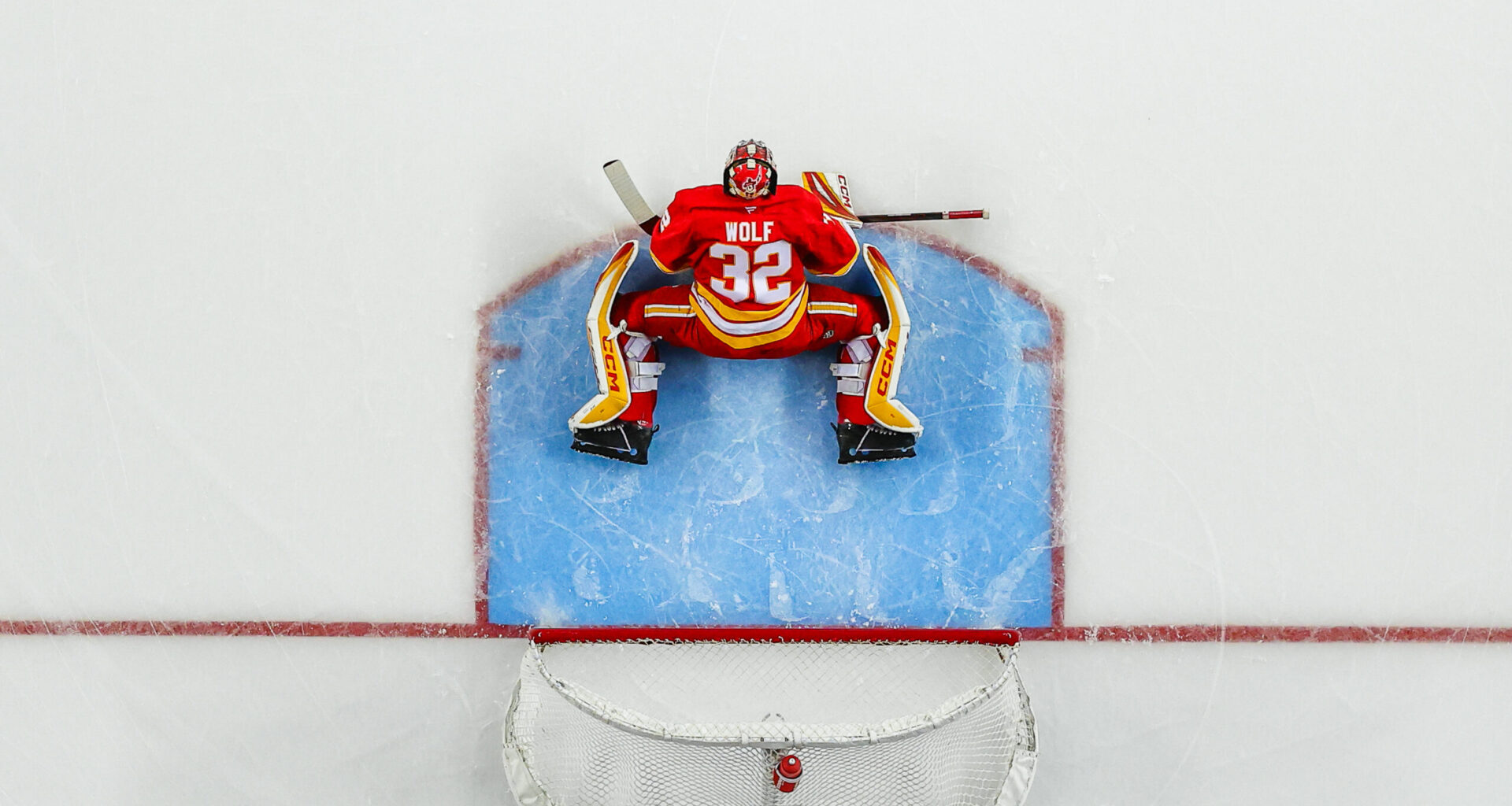
Dustin Wolf has been the top goalie on our Cap League Goalie Rankings list for a little while now, but come next season he’s now due for a little slip down the list due to his big new extension. For the upcoming year, he’s still the best goalie bargain around on his small bridge contract, and he’ll be looking to build upon his wildly successful rookie season.
One interesting note about Wolf’s 2024-25 campaign, was that he had a fantastic first quarter, and in every successive quarter, his save percentage dropped, and his GAA rose. His quality start percentage dropped almost linearly as well, though funnily enough the number of wins remained almost constant from quarter to quarter. As he gains experience, and with a few full offseasons of training, the drop-off through the season should be less pronounced.
That means that by the time the $7.5 million cap hit kicks in for the fall of 2026, he may already be a bargain at that number, and the Flames have him locked up at that number until the spring of 2033. He may drop a little on the Cap League Rankings list, but it won’t be very far.
For non-cap leagues, this doesn’t change much for his outlook, though the major contract is very rare for a goalie, as we don’t often see them make this kind of jump in how much they make in one contract over the previous. What that may tell us is that the Flames are looking at those next seven years as being a big part of their next competitive window, so they won’t be looking to completely sell off and bottom-out anytime soon.
*
Sticking with goalies for a minute, former DobberHockey writer Tom Collins brought up a fun trivia question in one of my fantasy leagues yesterday, asking who the goalie is with the most all-time games played without recording a shutout. I’ll give you a hint, that the goalie was born in 1964. Answer will be at the bottom of the Ramblings.
If that isn’t an era that you’re familiar with, then maybe you could get the active leader, who is entering the 2025-26 season with 86 career games played without a shutout.
*
Yesterday the final summer Fantasy grade came out for the Winnipeg Jets, which was written by yours truly. Check it out here if you want to find out what I think about your fantasy relevant Jets players, or you can find the full list of articles for each team here.
*
In working on draft prep, and inputting some offseason trades into Yahoo over the last week, I had a few more abstract concepts come to mind that I thought were worth sharing.
I don’t know about all of you, but there are times when I feel there’s just too many details available on which players are going to improve, which to target, which to avoid, and list of draft orders, rankings, and more. I have my trusted sources, starting with the Dobber Hockey Fantasy Guide, but past those sources I like to do a little of my own diving, and then from there trust my instincts, and the fantasy concepts that distinguish me from those who are just someone behind a screen with a rankings list but no strategy.
The idea that stems from that, is ranking and drafting players who are going to make a difference between winning and losing. That sounds so intuitive that it borders on ridiculous, but there are plenty of times where we get caught up drafting players that we like, or that we feel we need to have, and that causes issues with losing value at the draft table. This idea builds on top of the fact that while players might provide similar value overall, a difference in position, or what stats they actually bring to the table.
Does that sound familiar? Well that’s generally the basis of the zero-G strategy (or zero-RB in football) because as much as there is a narrow group for you to find and have thrive on your roster instead of someone else’s, the variability of these players makes it almost as likely that you can still win while picking the next guy in line instead of the top of the list in any given round of the draft.
This is why the unicorns like Cale Makar, Brady Tkachuk, and for now Connor Hellebuyck, are going in the top-10 in drafts alongside players who put up 100+ points, because those are all of the players who give your team a way to win.
In looking at who I might want to start targeting as my D2 a few rounds into the draft, I had started to zero-in on Mackenzie Weegar as someone who might fit that bill, because of the high level of peripherals, in addition to a power play profile, and no real weak categories. However, in the last day or two I’m having doubts about that due to the arrival of Zayne Parekh, who might turn Weegar from a 20+ PPP player, to someone who is only mopping up secondary PP minutes from December and on, meaning he ends up in the five-to-eight PPP range. That’s a big difference, and not someone you want to be spending a top-50 pick on.
One of the other things I had to catch myself on in the last few days was not spending too much capital for what players used to be. It’s a similar thought, but more about name value and projection, versus game theory on player values.
In ranking players for a very tough Roto league that I am in yearly, I find it difficult to compete in this league without heavy peripherals from my defensemen. In running down the list in Yahoo, my eyes stuck on Rasmus Ristolainen for a moment, as he used to be a must-own in leagues that counted peripherals. Nowadays though, the minutes and the per-minute rates are down. Bangers players just don’t peak for very long, and the ones that do look like they can maintain it for longer very often miss a lot of time or just wear down.
Players like Jeremy Lauzon, Tanner Jeannot, or Luke Schenn, never seem to peak as big hitters for multiple years in a row. That’s why this year I’m not going to be reaching for Kiefer Sherwood, and I’m going to be cautious with possibly grabbing Mathieu Olivier or Martin Pospisil as well.
The last hypothetical lesson today comes from one of my buddies who was mentioning he has an offer of his Evan Bouchard on the table for the other GM’s Tage Thompson. Now, I don’t know all the league details, but it sounded like my friend had an excess of defensemen and could have really used a piece like Thompson up front to round out his roster. However, the other GM apparently had an absolutely loaded roster but has holes on defence.
Without any context, I think Bouchard is the more valuable piece in most leagues, but in many it’s probably pretty close. I imagine that’s the case here, where wanting one over the other then comes down to who’s team needs what, and how this affects the smaller tiebreaker features such as roster construction and more. How does that tie into our lessons? Well, this is the kind of deal that might make sense to make with a team below you in the standings, as it might be a tiny loss in overall quality for your team, but if it leads to a more well-rounded roster and your team is better off for it, then it’s a win-win. However, since this trade would have been also making the main title contender much better as well, it’s a hard “no” in response.
As much as trades are about trying to get the better player, the main reason to make a trade is to give your team a better chance to win in whatever given contention window you are aiming for. Trading a younger Bouchard who is the more valuable asset to the biggest contender for Thompson, has no redeeming value from that angle. For that reason, top teams should be paying a bit of a premium on trades, while you shouldn’t be afraid to overpay just a little with a bottom team if it gets you a piece that your team really needs.
*
The answers for the goalie trivia:
The most games all time without a shutout – Pokey Reddick (132)
The most games among active goalies without a shutout – Arvid Soderblom (86)
*
Next week we should be back to real hockey, and really getting into draft season!
See you next Wednesday, and if you have any fantasy hockey questions or comments you can find me on BlueSky @alexdmaclean.