
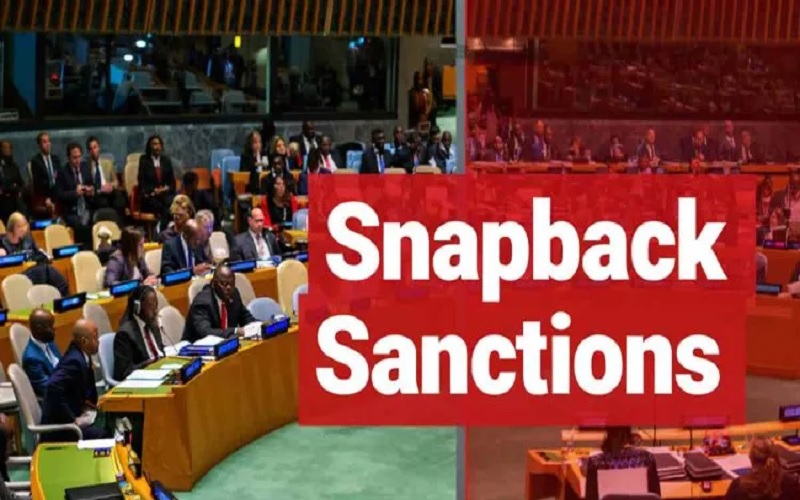
Iran’s Islamic Revolutionary Guard Corps (IRGC), fearing the possible activation of the snapback mechanism, has called for “psychological preparation of society” instead of “hope-building.”
As speculation increases over the potential activation of the snapback mechanism by the three European signatories to the Joint Comprehensive Plan of Action (JCPOA), Iran’s state-run media have simultaneously warned of a severe reaction to this possible Western move and also pointed to its internal consequences.
Tasnim News Agency, affiliated with the IRGC, on Sunday, July 20, recalled the position of Iran’s regime Foreign Minister Abbas Araghchi, expressed in an interview with a French publication conducted on July 10.
IRGC Spy’s Secret Trip to Iran After Spying on Jewish Targets in Germany Exposed
Tasnim wrote: “In response to the European officials’ threats regarding the activation of the snapback mechanism, the foreign minister considered it equivalent to a military attack and warned that this action would mean the end of Europe’s role in Iran’s peaceful nuclear program.”
The 10-year JCPOA agreement is set to expire in October 2025. If Iran’s regime had complied with its commitments under the deal by that date, the snapback mechanism would have become void. However, based on UN Security Council Resolution 2231 (adopted in 2015 to implement the JCPOA), any party to the agreement may trigger the snapback mechanism at any point during the 10-year period before October 2025.
Currently, most of the economic pressure on Iran’s regime comes from U.S. sanctions. However, if the snapback mechanism is activated, all previous UN sanctions will automatically be reinstated without the need for a vote at the UN Security Council. In a scenario where new sanctions were proposed for voting, allies of the Iranian regime such as China and Russia might veto them. But with the snapback mechanism, this is not possible because it is structured in a way that allows Security Council members to veto “non-reimposition” of sanctions, but not to veto their “reimposition.”
Now, the JCPOA members—Germany, the United Kingdom, and France—who are currently at odds with the Iranian regime, each have the authority to request the reimposition of international sanctions before October.
Consequences of the Reimposition of International Sanctions
In Tehran, widespread concerns have emerged over the activation of the snapback mechanism—concerns that officials of Iran’s regime equate with a “military attack.”
The daily publication of the IRGC’s Political Department wrote about the severe shock of the snapback mechanism—even before it is implemented—and stated: “It is clear that in the absence of a rational and swift response, public distrust will intensify and second and third waves of inflation will emerge with greater intensity.”
The publication proposed several measures for managing society in the event the snapback mechanism is activated, including imposing new taxes, restricting foreign transactions to control capital flight from the country, and limiting dollar-based transactions.
In the political section, the IRGC publication suggested that the “tone of policymaking” should shift from “absolute hope-building” toward “psychological preparation of society and economic actors.”
It is rare for a publication affiliated with the IRGC’s Political Department to make such a proposal.
The state-run daily Donya-e-Eqtesad wrote: “The words of that complex legal document [the JCPOA] still shape the fate of Iran’s policy. The snapback mechanism now stands at the center of regional geopolitical developments.”
The newspaper emphasized: “For Iran, the reimposition of UN sanctions through the snapback mechanism is not merely a legal or diplomatic development. This change directly affects the country’s economy and impacts currency exchange, trade, and financial dynamics.”
The paper warned that, under a pessimistic scenario, even China and Russia might go along with the reimposed sanctions and predicted: “The economic pressure will be such that its primary goal will be to alter Iran’s political calculations and force it to accept new conditions at the negotiating table. In other words, the snapback mechanism will become a tool for engineering Iran’s political behavior—at a very heavy cost to the country’s economy.”