
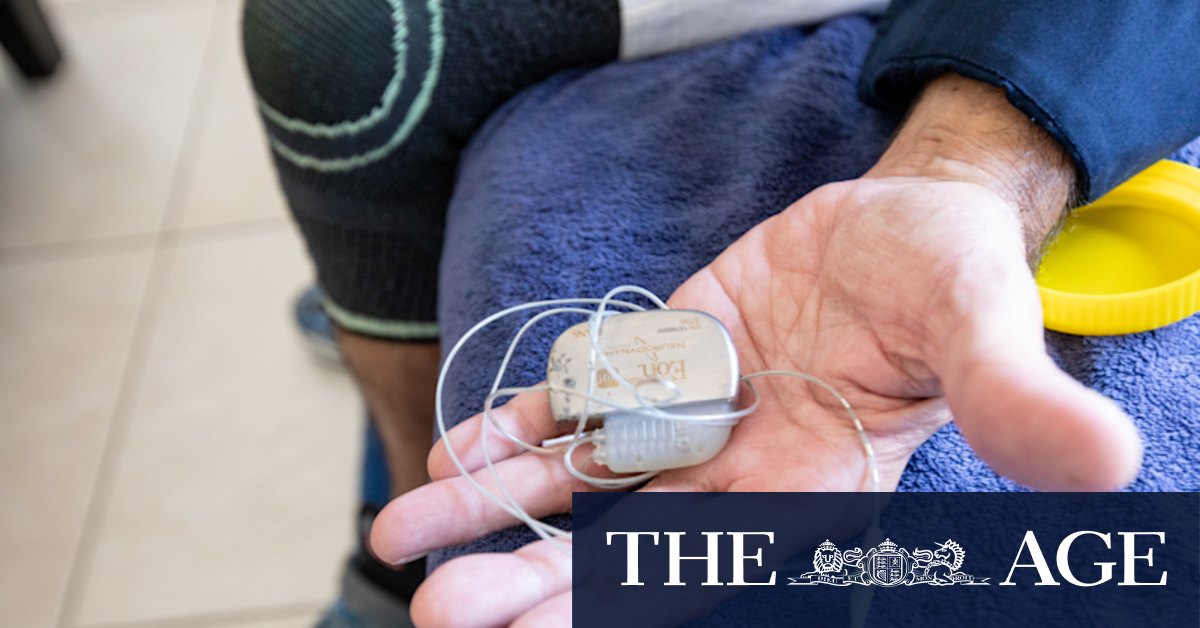
“With the advent of National Pain Week upon us, it would be a cruel irony and frankly inhumane to remove spinal cord stimulation as an available option for a small number of patients for whom other options have not helped and their intractable pain negatively impacts their lives,” said Dr Michelle O’Brien, president of the Neuromodulation Society of Australia and New Zealand.
A study published in the Medical Journal of Australia last week, based on private health insurance data, found 23 per cent of patients who receive a stimulator will need revision surgery – most within 18 months. In comparison, total knee replacement operations have a lifetime reoperation rate of about 2 per cent.
Loading
Private Healthcare Australia facilitated the provision of the data but did not fund the study or the researchers.
The University of Sydney’s Dr Caitlin Jones, who led the study, said that on the basis of the evidence her team had collected she would support a ban on new stimulation implantations outside clinical trials.
Associate Professor Adrian Traeger, a University of Sydney academic who led a review of spinal cord stimulators for lower back pain, also supported a ban.
“Given the substantial risks, I’d want to see clear benefits over placebo from rigorous clinical trials before these surgeries were offered to patients,” he said. “We expect this standard of evidence for drugs – why should it be different for surgical procedures?”
Personal injury lawyers Gerard Malouf & Partners have been investigating a potential class action since late last year against stimulator makers, and have been interviewing patients, this masthead can reveal.
Michael Ferraro, a researcher at medical research institute NeuRA who co-authored a review of stimulation for general chronic pain, said a ban would be useful if it pushed the industry towards conducting high-quality, placebo-controlled trials to prove the devices worked as claimed.
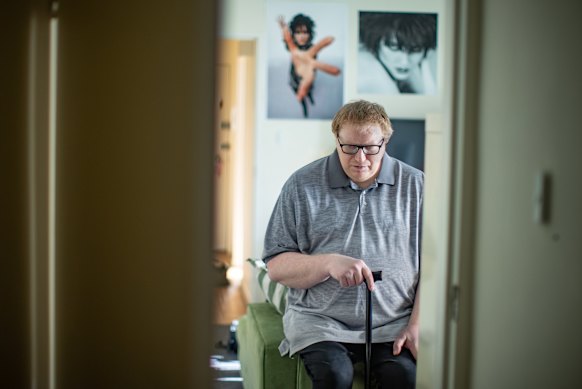
Marcus Barlow found a stimulator made his pain worse.Credit: Simon Schluter
Marcus Barlow, who received a spinal cord stimulator in 2019 and found it dramatically worsened his pain, said the devices “absolutely” should be banned.
“I am happy to lend my support to anything that could get these vile devices banned once and for all,” he said.
Ian Burgess, CEO of the Medical Technology Association of Australia, which represents device manufacturers, said there was robust clinical trial and real-world data proving stimulators’ effectiveness and safety.
“We must not allow insurers to dictate clinical care, patient outcomes or to block access to therapies that can be life changing and restore dignity and function to people living with chronic pain.”
In response to questions about the ban proposal, the association connected this masthead with Kaleena de Voigt, a patient who received a stimulator to deal with chronic pain from an operation.
Two weeks after her operation, she was able to return to work, and she is now largely pain free.
“Within two days, my pain was down 85 per cent. Within the first three to four months, I was down 75 per cent of my opioids,” she said.
Loading
De Voight said she had not experienced any side effects or complications from the procedure, and that her doctors had managed to adjust the stimulation to remove persistent pain she felt in her hands, legs and feet from a separate condition.
“To deprive people of something like this that is so effective for so many, I think would be really quite sad,” she said.