
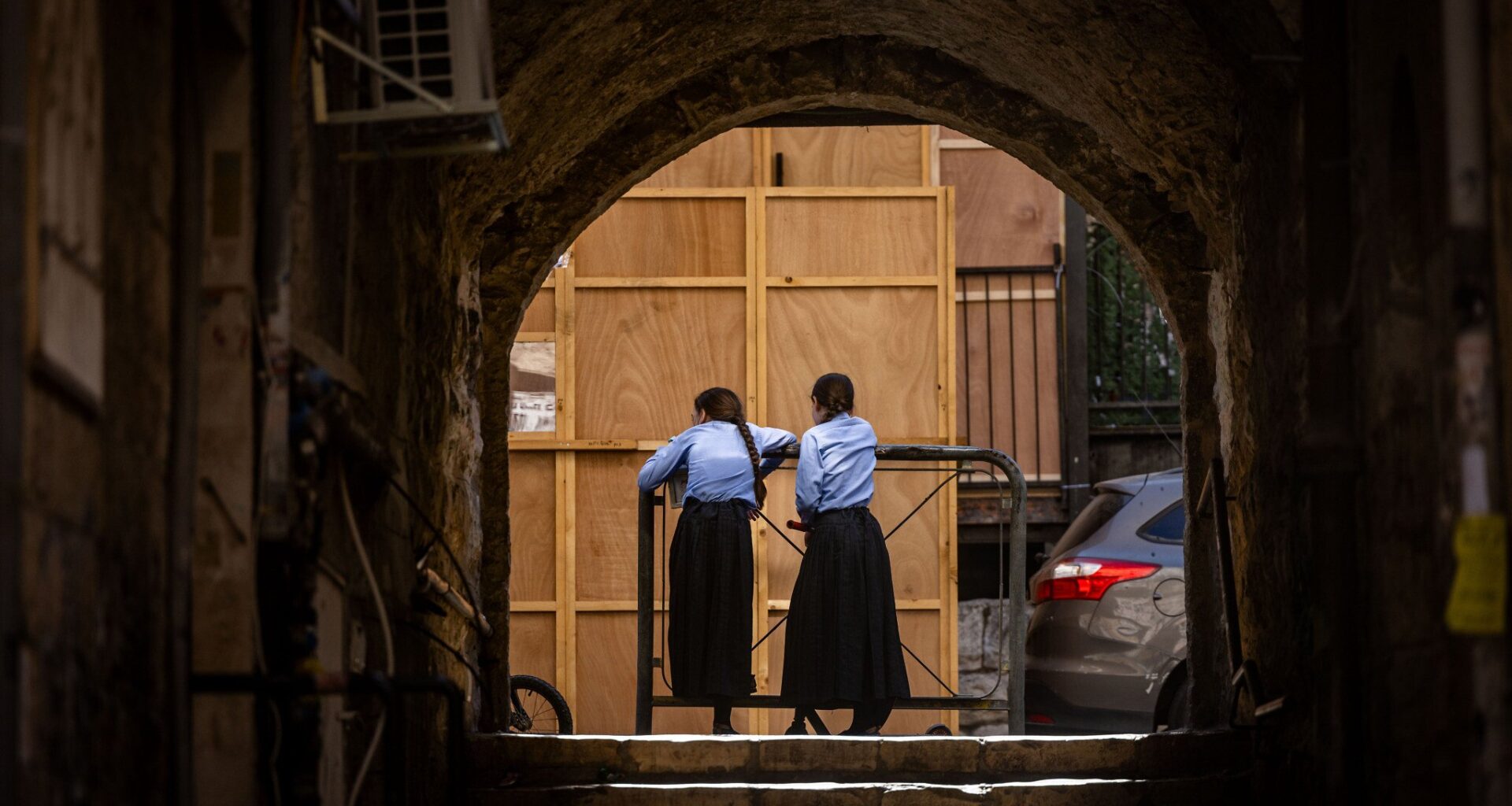
Ten days into the school year, 55 Haredi students — 15 in Jerusalem and 40 in Beit Shemesh — remain without a school placement, as the Education Ministry moves to sanction institutions that continue to block their admission, a source familiar with the matter told The Times of Israel.
The impasse marks the latest clash between national and local authorities and the ultra-Orthodox education system over anti-Sephardi discriminatory practices.
In Beit Shemesh, several 9th-grade classes have yet to begin their studies because of the standoff, a municipal spokesperson told The Times of Israel.
Seminaries run high-school and post-high-school programs for ultra-Orthodox female students, and enrollment can be very competitive. Since they usually teach both religious studies and the state-required curriculum (or at least part of it), they receive public funding.
Discrimination against Sephardi students has plagued the Haredi community for years, and critics charge that many Ashkenazi schools maintain unofficial quotas of Sephardi students stemming from racism against families of Middle Eastern origin.
Get The Times of Israel’s Daily Edition
by email and never miss our top stories
By signing up, you agree to the terms
In 2009, the Supreme Court ruled against an ultra-Orthodox school in the Immanuel settlement in the West Bank, instructing it to end all discriminatory practices against Sephardi girls.
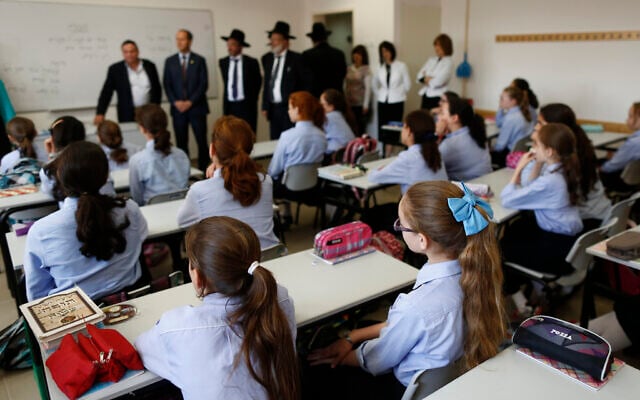
Ultra Orthodox girls at their seminary in Jerusalem, on September 2, 2014. (Yonatan Sindel/Flash90)
Yet, over the years, incidents of discrimination and refusals to admit Sephardi students have regularly resurfaced.
This summer, Channel 13 news reported that some 440 Haredi girls in Jerusalem, 73 percent of them Sephardi, had not been accepted into any seminary. As a result, the municipality decided to assign students to seminaries independently and required the schools to accept them.
A similar situation occurred in Beit Shemesh.
In the past few weeks, at the instruction of Haredi leaders in both cities, multiple seminaries have declined to allow 9th graders to begin their studies in protest of the orders issued by the two cities’ municipalities.
Last week, Ashkenazi Haredi leaders — including prominent cleric Rabbi Dov Lando — and the Jerusalem Municipality reached an agreement to solve the issue, which included opening two new classes in the “Old Seminary” — a prestigious Beit Yaakov teacher training program.
However, at least one school in the capital has refused to change its stance.
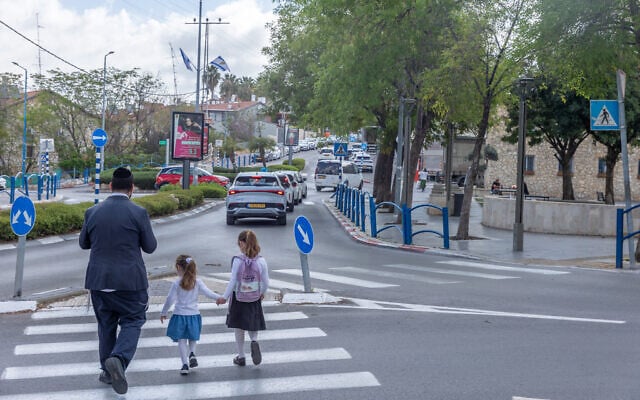
The Israeli town of Beit Shemesh on March 30, 2025. (Yossi Aloni/Flash90)
The source told The Times of Israel that the Education Ministry has already approved cutting its budget, adding that other seminaries were sent warning letters threatening to revoke their permits to operate and reduce their budget. The letters were sent on Wednesday and required a response within 24 hours.
On Sunday, Education Minister Yoav Kisch visited Beit Shemesh and announced the ministry would summon the representatives of the noncompliant seminaries to a hearing.
“I want to address the issue of the acceptance of Sephardic girls in schools here in Beit Shemesh,” Kisch said while visiting the Beit Ya’akov Netzach Yisrael school, a so-called mamlachti-Haredi school — one that teaches the full state-required curriculum of secular subjects alongside religious studies.
“We still have five schools that are summoned for a hearing and are not behaving as they should,” he noted. “We will not give up. The municipality’s placement is what matters, and we will approve any solution that is agreed upon by the parents.”

Education Minister Yoav Kisch at the Ministry of Education in Jerusalem, in preparation for the opening of the school year, August 31, 2025. (Chaim Goldberg/Flash90)
The Beit Shemesh municipality spokesperson said that as of Wednesday there were still ongoing negotiations to find a solution.
The seminaries include the Beit Shemesh branch of Darchei Rachel, and the “New Seminary,” one of the branches of the Beit Yaakov teacher training program.
Sam Sokol contributed to this report.
Is The Times of Israel important to you?
If so, we have a request.
Every day, even during war, our journalists keep you abreast of the most important developments that merit your attention. Millions of people rely on ToI for fast, fair and free coverage of Israel and the Jewish world.
We care about Israel – and we know you do too. So today, we have an ask: show your appreciation for our work by joining The Times of Israel Community, an exclusive group for readers like you who appreciate and financially support our work.
Already a member? Sign in to stop seeing this
You appreciate our journalism

You clearly find our careful reporting valuable, in a time when facts are often distorted and news coverage often lacks context.
Your support is essential to continue our work. We want to continue delivering the professional journalism you value, even as the demands on our newsroom have grown dramatically since October 7.
So today, please consider joining our reader support group, The Times of Israel Community. For as little as $6 a month you’ll become our partners while enjoying The Times of Israel AD-FREE, as well as accessing exclusive content available only to Times of Israel Community members.
Thank you,
David Horovitz, Founding Editor of The Times of Israel