
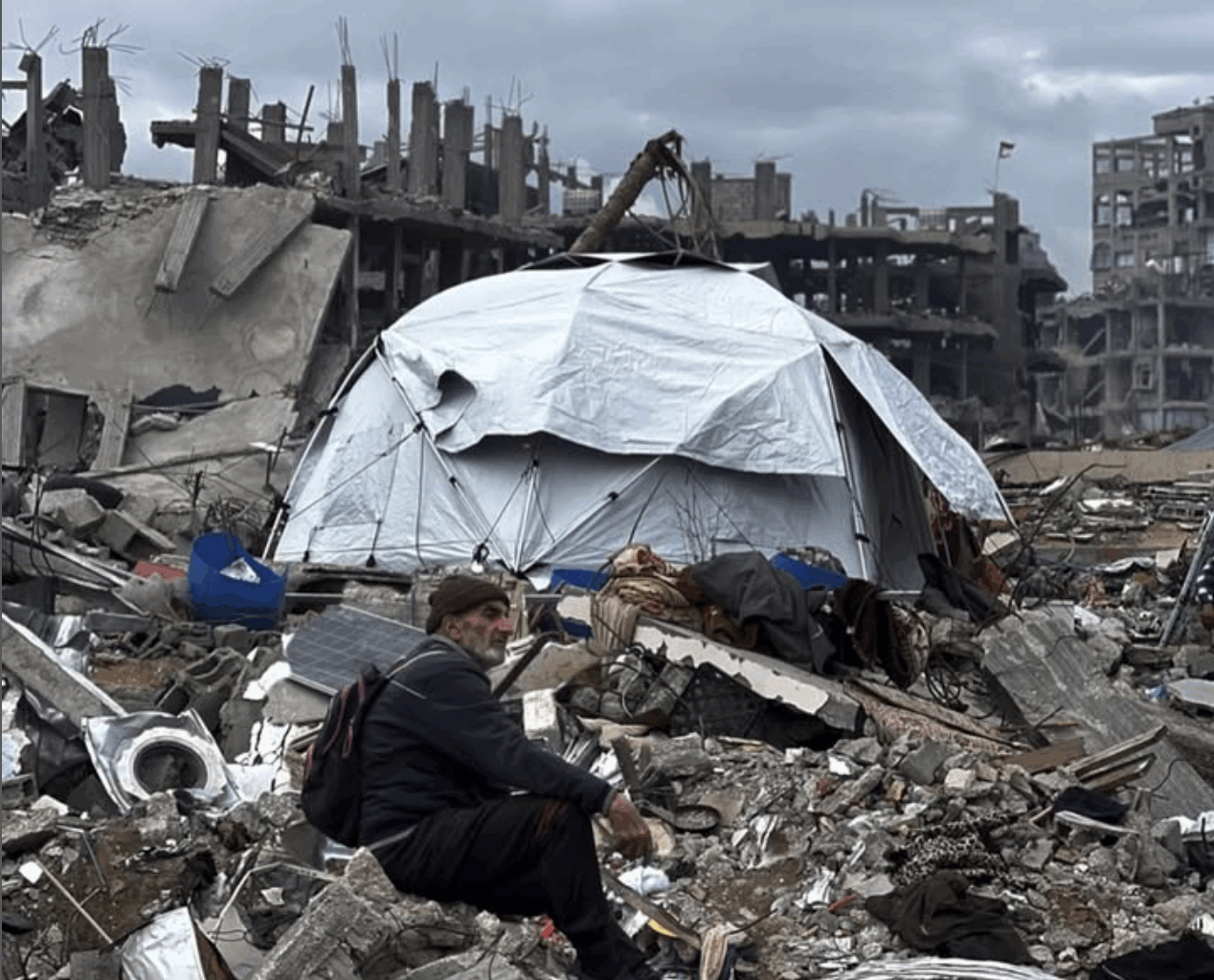
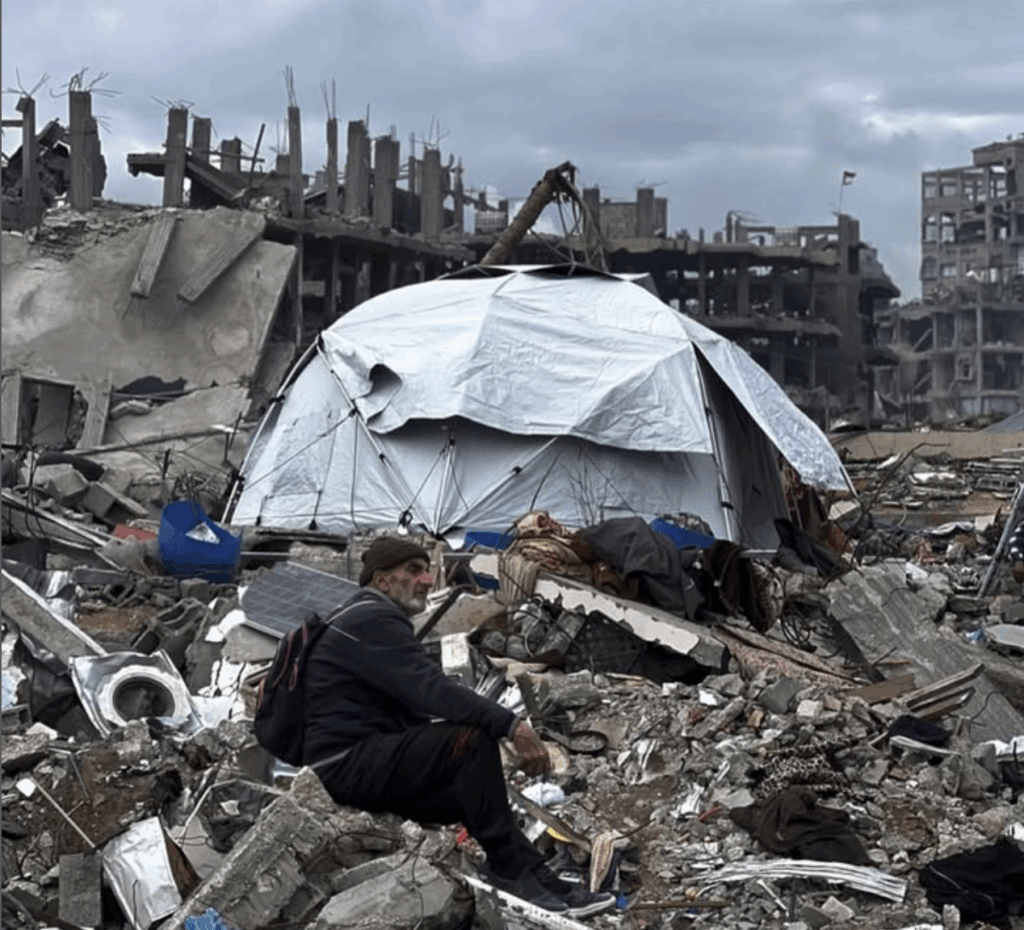
Mounir Odeh arrived in the coastal Mawasi region of Khan Younis like many other displaced Palestinians in Gaza, looking for a place to shelter his family amid the ongoing violence throughout the strip.
After hours of searching in the already crowded area, which is increasingly becoming more crowded as people flee Israel’s military campaign in Gaza City, he was told there was empty, public land east of Mawasi.
Odeh arrived in the area and thought his search was over: here was open land. He was one of the lucky ones, he thought, as he began to pitch his tent.
But this moment of relief was quickly dashed. Armed men appeared and began to attack him. They uprooted his tent pegs and threatened to shoot him if he didn’t pay them a rent of nearly US$400.
Odeh insisted that he was told the land didn’t belong to anyone, but the men continued their threats.
“I had to leave and not risk a clash with them, as I was alone with my family. We headed to Nasser Hospital, where we are still waiting for the next step,” Odeh told Mada Masr.
What happened to Odeh is a microcosm of life in the south of Gaza for many Palestinians trying to find safety. The absence of government oversight and limited land and housing due to the destruction of large swaths of the built environment over two years of Israel’s assault on the strip have created an environment marked by rampant competition, skyrocketing prices and sometimes, like in the case of Odeh, violence.
For people who decide to try and move south out of Gaza City, there are not many neighborhoods to choose from to begin with.
Israel invaded the entirety of the Rafah Governorate and significant portions of Khan Younis earlier this year. Only around 13 percent of the strip is categorized as liveable, the rest either designated as an active Israeli military zone or ordered by the military to evacuate, according to the Global Camp Coordination and Camp Management Cluster.
That means the only options are to pitch a tent on land in the “humanitarian zone” indicated by Israel, Mawasi, or find apartments in the pockets of relatively safe housing still standing in the central zones or Khan Younis.
Mada Masr inquired into rental prices across central Gaza and Khan Younis. Calls to around 20 apartment owners showed that landlords are setting rents from around $1,000 for a small apartment with a single room, small kitchen and bathroom with no water or electricity to $3,000 for a larger apartment.
These figures, providing profit for landlords who will lease to those displaced from their Gaza City homes, stand in stark contrast to pre-war prices, which could start at around $100.
Ahmed Nasman had made hundreds of phone calls to find an apartment. The cheapest he could find, with no basic utilities, was no less than $1,000 per month. Other apartments, he said, were priced far higher.
“How am I supposed to pay that amount every month? I’ve lost my home and my source of income because of this war. I can’t pay that money,” Nasman told Mada Masr.
In one call, a central Gaza landlord told Mada Masr that the $1,500 monthly rental price they set for a small apartment is final and non-negotiable. Many displaced families from Gaza City are willing to pay that sum, they said.
The landlord said it is for apartment owners to determine prices based on their assessment of the general situation and demand, as well as the size of the property and available utilities.
They said they receive dozens of enquiry calls each day from Gaza City residents, adding that they managed to rent one “at a good price” in recent days.
Much of the scarcity is driven by the fact that Israel has systematically destroyed thousands of buildings in areas including Rafah and Khan Younis by controlled explosions and demolition contractors since withdrawing from the ceasefire earlier this year.
Occupation military destroying buildings in Rafah in April.
For those who can’t afford a rental property, there are tents and whatever open ground they can find.
But as Israel has blocked the import of tents into the strip for months, these have also become prohibitively expensive. Since the start of the Israeli military’s operation to “capture” Gaza City in August, demand has driven prices to exorbitant levels. A single tent now costs between $1,000 and $1,500, depending on its size and material.
After days of heavy bombardment on Sheikh Radwan in northern Gaza City, Moamen al-Aklouk could see no option but to move to Khan Younis’s Mawasi. He paid around $600 to rent a small truck to transfer his family and some belongings south.
“We went through hell trying to find a spot to pitch our tent in Mawasi,” he told Mada Masr. After hours of searching, the family found a small 20-square-meter patch of land, barely enough to pitch one tent. The rent was $300. Aklouk had to accept, as there was no better option available.
Anwar Hammouda has also left his neighborhood facing invasion in northern Gaza City after days of heavy bombardment. He went first to stay with his relatives in the city’s west, but as the situation worsens, with bombardment increasingly extending to the crowded western neighborhoods of Shati and Raml, he began searching for places in central Gaza or Khan Younis to the south.
He was met with “insane rental prices” for both apartments and plots of land, he told Mada Masr. When he started asking about tents, the cheapest he found was $1,000. The prospect of displacement for Hammouda’s family feels extremely challenging and he is yet to locate a plot of land.
The conditions mean that hundreds of thousands of people have stayed in the city, accepting that this could mean they will die there.
Of the estimated population of around 1 million before Israel launched its operation, around 73,000 people are estimated by the camp coordination and management agency to have been displaced from the strip’s north to its south since mid-August.
Others have moved to western Gaza City from the city’s east, where street-level artillery fire and extensive Israeli remote demolitions are tearing through whole neighborhoods.
These rapid demolitions have all but leveled the eastern Zeitoun neighborhood since the beginning of August, Gaza Civil Defense spokesperson Mahmoud Basal told Mada Masr.
Others refuse to abandon their homes, with hundreds of people heading down to demonstrate in the streets against the evacuation order earlier this week.
Many insist they won’t abandon their homes and neighborhoods in an attempt to protect the city and thwart the Israeli military’s scheme to occupy and destroy it.
And for some, displacement is impossible, with families sharing accounts of attempting to move south only to face such hardship that they returned to the city facing invasion.