
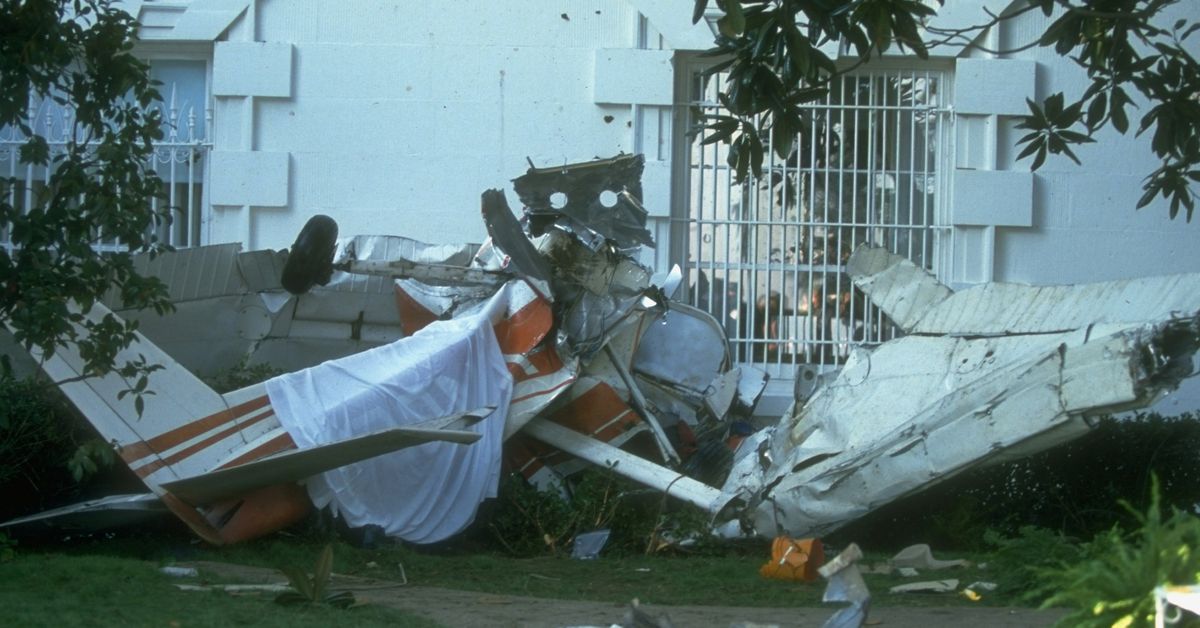
A very drunk truck driver piloting a stolen plane crashed onto the White House lawn on September 12, 1994.
It is believed Frank Eugene Corder was attempting to crash into the building itself, but he undershot the landing and hit the grounds outside.
Corder was killed instantly in the crash, and nobody else was hurt.
Instead, they were sleeping across the road at presidential guest house Blair House, while their usual residence was undergoing renovations.
Corder had stolen the plane from a Maryland airport earlier that night and crashed it just before 2am.
 Frank Eugene Corder died when he crashed a plane into the White House lawn. (Supplied)
The plane landed just below the Clintons’ bedroom, through the branches of a magnolia tree planted by President Andrew Jackson in 1829.
“It has been quite an unusual day here at the White House,” Hillary Clinton remarked later that day.
The National Transportation Safety Board concluded the crash was intentional because of the speed of the impact.
Corder was not political, and his family believed he crashed the plane at the White House to make a name for himself.
He had taken an interest in the exploits of German pilot Mathias Rust.
 German teenager Mathias Rust was jailed for a brazen stunt that deeply embarrassed the Soviet Union. (Wikimedia Commons)
Seven years earlier, Rust had flown from Finland to Moscow, flummoxing Soviet air defences by landing a little plane at Red Square next to the Kremlin.
Corder’s brother later remarked that he didn’t think he was even registered to vote.
But Corder was reportedly despondent over the recent collapse of his trucking business and his third marriage.
His wife had sought a divorce from him three weeks earlier.
The crash rattled the administration, with security officials questioning how a man with practically no flying training could get so close to hitting the White House.
The plane was only noticed by radar technicians minutes before the crash, and the Secret Service did not see it until seconds before impact.
But security officials noted the Secret Service would have been more alert to the risk had the president been at home.
“Our job is not to protect the building but the President,” one told the New York Times.