
The EIIP has evolved over 50 years, linking together a series of labour-intensive infrastructure programmes, to establish a comprehensive package of integrated interventions. The programme recognises that construction activities can boost local economic and social development and contribute to reducing urban and rural poverty. An emphasis on labour-based construction leads to the creation of decent jobs, improved assets and cash income. The EIIP recognises that the construction industry has huge potential to absorb employment with the sector employing about 7.7% of the global workforce.
The ILO places special emphasis on South-South Triangular Cooperation (SSTC) as a means achieving its mandate and mission, implementing the Decent Work Agenda and achieving its objectives, and has aligned the SSTC and Decent Work Agenda frameworks by using SSTC as a strategy to promote fair, inclusive and sustainable labour practices worldwide. Within the SSTC framework the ILO can facilitate the dissemination and exchange of good practices and can coordinate and build partnerships with government and institutions. The SSTC principles and EIIP approaches dovetail neatly in that EIIP strategies include using local skills and expertise through participative projects that connect communities, employers and government to build sustainable infrastructure, which bolsters local economies and long-term employment.
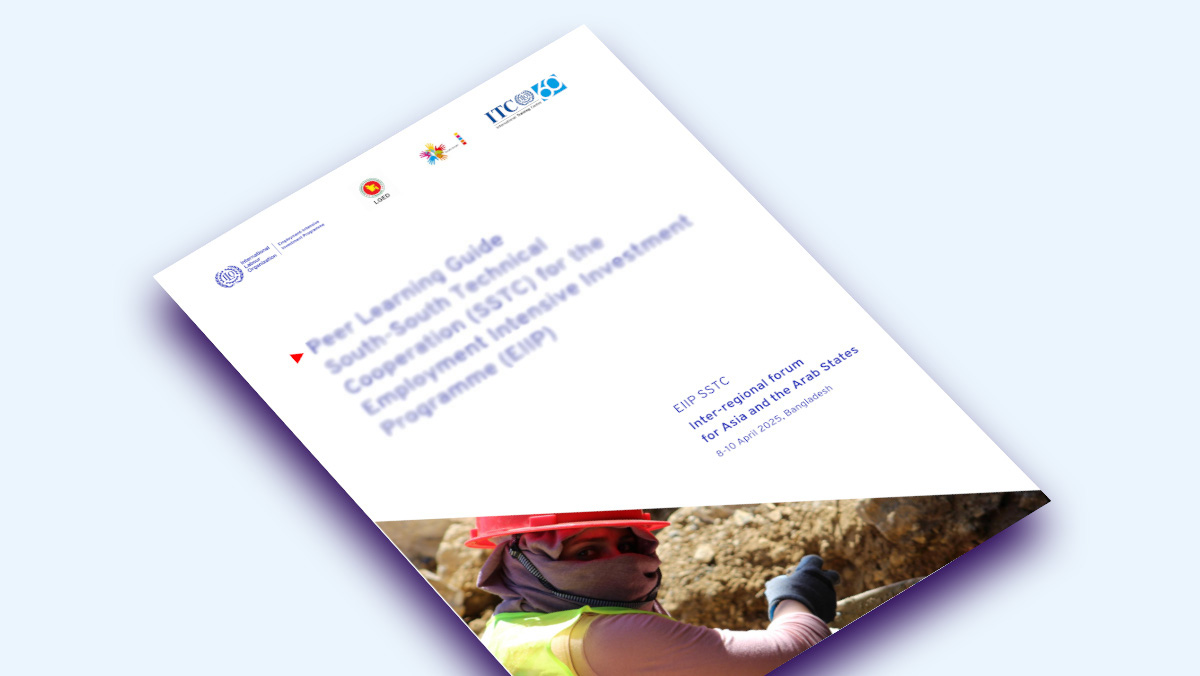
An SSTC approach applied in tandem with EIIP activities can be instrumental in supporting employment generation and the local economic development of countries in the global south. This learning guide aims to introduce SSTC as a tool for socio-economic development and to achieve the Agenda 2030. It explains the main concepts of SSTC, its fundamental principles, processes to be followed to implement projects under the framework of such cooperation and the actors involved. A “do’s and don’ts” section clarifies the basic characteristics of SSTC and how the principles are applied in practice.
The guide also explains the fundamentals of the EIIP approach and how this converges with SSTC, providing case studies of selected Employment Infrastructure Investment SSTC projects and activities in the Arab States and Asian regions. The guide is aimed at a wide audience, including those who are not yet familiar with SSTC and those who want to learn more about the connection between SSTC and the EIIP. The ideas in this Learning Guide is to focus on how EIIP SSTC projects have been carried out in the past and how they illustrate the process of engaging ILO’s constituents and partners in the realization of the ILOs four strategic objectives.
This document has been prepared as guidance for participants in an EIIP South-South Technical Cooperation Forum, scheduled to take place in April 2025 in Bangladesh. The forum aims to foster peer-to-peer learning among stakeholders from countries in the global South who are employing employment-intensive approaches to address pressing issues such as climate change, natural disasters, conflicts, and economic downturns. The forum will target government officials, ILO staff, development practitioners, research and education institutions, and donor organizations that support employment-intensive work.