
This article is an on-site version of our Swamp Notes newsletter. Premium subscribers can sign up here to get the newsletter delivered every Monday and Friday. Standard subscribers can upgrade to Premium here, or explore all FT newsletters
The Qataris must be confused. They present Donald Trump with a luxury Boeing jet, host the largest US air base in the Middle East, pledge $500bn investments in America and have played all-purpose mediators on Washington’s behalf — including over the Hamas hostage crisis. Yet Trump could apparently do nothing this week to stop Israel from launching a missile attack on its capital. With friends like Trump, who needs enemies?
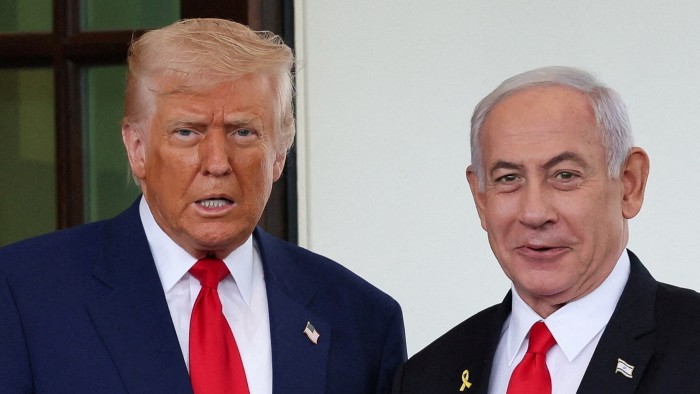
Whether Trump knew in advance of Israel’s Doha strikes — the evidence suggests that he probably did — the result is the same; nobody believes he exerts any control over Benjamin Netanyahu. In that respect, Trump is little different to Joe Biden. Successive US presidents have turned out to be putty in the Israeli prime minister’s hands. Is there anything Netanyahu cannot do? That was a rhetorical question.
Netanyahu’s next step is the emptying of the Gaza Strip that will probably be followed by the near full annexation of the West Bank. Those who think I’m being too alarmist should pay attention to what Netanyahu does, not what he says. The latter has proved to be worthless. Netanyahu is midway through the pre-endgame, which is to herd all of Gaza’s 2mn or so people into a “humanitarian city” on the Gaza-Egypt border. His strike on Qatar was essentially a hit on what remains of Gaza ceasefire talks, which gives further evidence (as if it were needed) that he is indifferent to the fate of the remaining Israeli hostages. The only thing Netanyahu cares about is his political survival. That means keeping his far-right ethnonationalist coalition partners, chiefly Itamar Ben-Gvir and Bezalel Smotrich, on side. Their “river-to-the-sea” greater Israel goals are thus his.
That such vast ethnic cleansing is not what most Israelis want is beside the point. For a wonderfully humane and sane description of what is at stake do read this recent FT Weekend essay by Fania Oz-Salzberger. It is among the best I have read. Defenders of Netanyahu’s Gaza rubble strategy say that this is what the allied powers did to Hamburg, Tokyo and other Axis cities during the second world war. They are right. American and British bombing was indiscriminate and killed tens of thousands of German and Japanese civilians. The effectiveness of allied carpet bombing was highly questionable. Some scholars say the firebombing of German cities only reinforced civilian determination to follow Hitler. By contrast, there is little dispute that dropping atomic bombs on Hiroshima and Nagasaki did hasten Japan’s surrender.
But this is where the second world war analogy collapses. As Nick Cohen points out in this excellent essay in the Jewish Chronicle, the allies had a “day after” plan to follow their victory. This was to invest in the creation of sovereign German and Japanese democracies. To put it mildly, that is not what Netanyahu is planning for Gaza or the West Bank. Whether he plans to expel Gaza’s population to Egypt or elsewhere, or simply to corral them in permanent camps, his goal is not to win the peace or even to deliver peace. We should base all our expectations on this home truth.
For Trump, this poses an escalating dilemma. Last year, the US gave Israel $12.6bn in military aid — considerably up from the annual $3.8bn that Israel ordinarily receives. The bill for clearing Gaza and funding their encampment will be considerably higher. Trump has trolled the world with tasteless AI-created videos about turning Gaza into the Middle East’s riviera. But even he must know that the cost of such a fantasy would be exorbitant. Trump often boasts of the Abraham Accords as one of his greatest achievements. Netanyahu’s ethnic cleansing would jeopardise recognition of Israel by the United Arab Emirates (among others) and kill any remaining hopes of Saudi normalisation.
As Netanyahu’s pre-endgame unfolds, Britain, Canada and others are likely to follow France in recognising a Palestinian state — possibly at the UN general assembly annual gathering in the coming days. The rest of the west is also likely to broaden sanctions beyond those they have targeted at fringe extremists in Israel’s coalition. As Israel’s isolation grows, Trump’s instinct will be to rally behind Netanyahu. But that will clash with another Trumpian instinct to avoid funding open-ended overseas wars. As the second anniversary of the October 7 Hamas attack looms, the situation is only going to intensify.
I’m turning to my trusty colleague Andrew England, the FT’s Middle East editor, for my question this week. Andrew, if prudence and compassion fall on deaf ears, might money persuade Trump? And what role can the Saudis play in convincing Trump to restrain Netanyahu?
Recommended reading
My column this week assessed the woeful condition of America’s Democratic party — “America’s left cannot exploit Trump’s failures”. “Trump’s genius is to keep pushing Democrats into reactive conservatism,” I write. “That, plus the average age of the party’s leadership, makes Democrats look like permanently outraged grandparents.”
On that topic, I was intrigued by Mike Solana’s controversial essay in the Atlantic on the proposed Democratic “abundance” agenda, which is pioneered by Ezra Klein and Derek Thompson. I don’t agree with most of what Solana says but the outrage his essay provoked was telling.
Swampians will have noticed that I took an unusually long break this summer — and I made the most of what was a blissful digital detox. My break ended in London at the buzzing FT Weekend festival at Kenwood House. Panels on the future of the US constitution and Trump’s foreign policy, moderated by my colleagues Brooke Masters and Gideon Rachman, were great.
Finally, I hope Swampians will forgive another reference to my Brzezinski biography. While I was away Foreign Affairs published an essay-length review of Zbig by Tom Donilon, Barack Obama’s national security adviser, who began his DC career as a junior staffer in Jimmy Carter’s White House. Donilon calls Zbig “a gem of a book”.
Andrew England replies
Thanks Ed, As you suggest, the Israeli strikes against Hamas in Qatar were extraordinary, even by the standards of the past two years of grinding Middle East conflict, a shocking indictment of just how unrestrained Netanyahu’s far-right government is. Not surprisingly, the attack infuriated and alarmed the US’s Gulf allies, including Saudi Arabia, the region’s Sunni Muslim powerhouse.
This brings me to your question about the role the kingdom can, or cannot, play in convincing Trump to rein in Netanyahu. To be fair, Crown Prince Mohammed bin Salman, Saudi Arabia’s de facto leader, who has accused Israel of committing genocide in Gaza, has tried through quiet diplomacy. But the evidence tells us his efforts, and those of other Arab leaders, have borne little fruit.
After Trump’s re-election, I was slightly surprised that Arab officials were cautiously hopeful that the self-proclaimed dealmaker might shift the dial on Israel’s war against Hamas in Gaza. In part that reflected deep frustration at Joe Biden’s failure to deploy Washington’s leverage sufficiently to pressure Israel to reach a deal with Hamas to end the war and release the hostages. Could Trump really be any worse, the thinking went.
In November, I wrote a piece analysing how Arab states were looking to MBS to use his personal relationship with Trump and Saudi Arabia’s heft to influence the incoming administration’s Middle East policies and act as a counterweight to Netanyahu.
Trump had, after all, entered the White House promising to bring peace to the Middle East and his team had helped broker a Gaza truce and hostage deal in the lead up to his inauguration in January. There was also hope — perhaps out of desperation — that the mercurial president might be the one to stand up to Netanayahu, despite his obvious pro-Israeli bias. But it’s been downhill since, with Trump pretty much giving Israel carte blanche to act as it wants in Gaza.
In February, Trump unveiled his plan to “empty” Gaza of Palestinians — anathema to Saudi Arabia and other Arab states — and turn it into the “Riviera of the Middle East”. The next month, he was silent as Netanyahu broke the ceasefire, imposed a full siege on Gaza and expanded Israel’s offensive in the strip.
MBS could claim a success in May when he encouraged Trump to meet with Ahmed al-Sharaa, Syria’s new president, in Riyadh, and, with Turkey, convinced him to lift US sanctions on his war-shattered state.
That came during the US leader’s three-country tour of the Gulf, during which MBS and the leaders of Qatar and the United Arab Emirates lavishly feted Trump and pledged more than a trillion dollars of investment in the US. Away from the glitz, they also pressed Trump on Gaza and urged him to prevent Netanyahu from attacking Iran.
What happened? Within weeks, Israel was bombing the Islamic republic with the US briefly joining the assault. And Israel, to the chagrin of Arab states, continues to launch strikes into Syria, while they back the weak government in the hope of stabilising their neighbour after almost 14 years of civil war.
That all suggests that not even the promise of vast petrodollar sums to bolster Trump’s “invest in America” policy can sway the president when it comes to Israel. And, like their peers across the globe, Arab leaders are wary about pushing too hard, fearful of antagonising the unpredictable president. There is now a question about whether the Israeli strikes on Doha will harden Arab attitudes and lead to a more collective response to Israel’s actions. But it’s too early to tell.
The irony in all this is that Trump’s unwillingness or inability to rein in Netanyahu and end the war in Gaza has scuppered the slim chances of the one deal he wants more than any other — Saudi Arabia agreeing to normalise relations with Israel.
Your feedback
We’d love to hear from you. You can email the team on swampnotes@ft.com, contact Ed on edward.luce@ft.com and Andrew on andrew.england@ft.com, and follow them on X at @cornishft and @EdwardGLuce. We may feature an excerpt of your response in the next newsletter
Recommended newsletters for you
US Top Stories — The latest US top stories, from markets to geopolitics. Sign up here
Unhedged — Robert Armstrong dissects the most important market trends and discusses how Wall Street’s best minds respond to them. Sign up here