
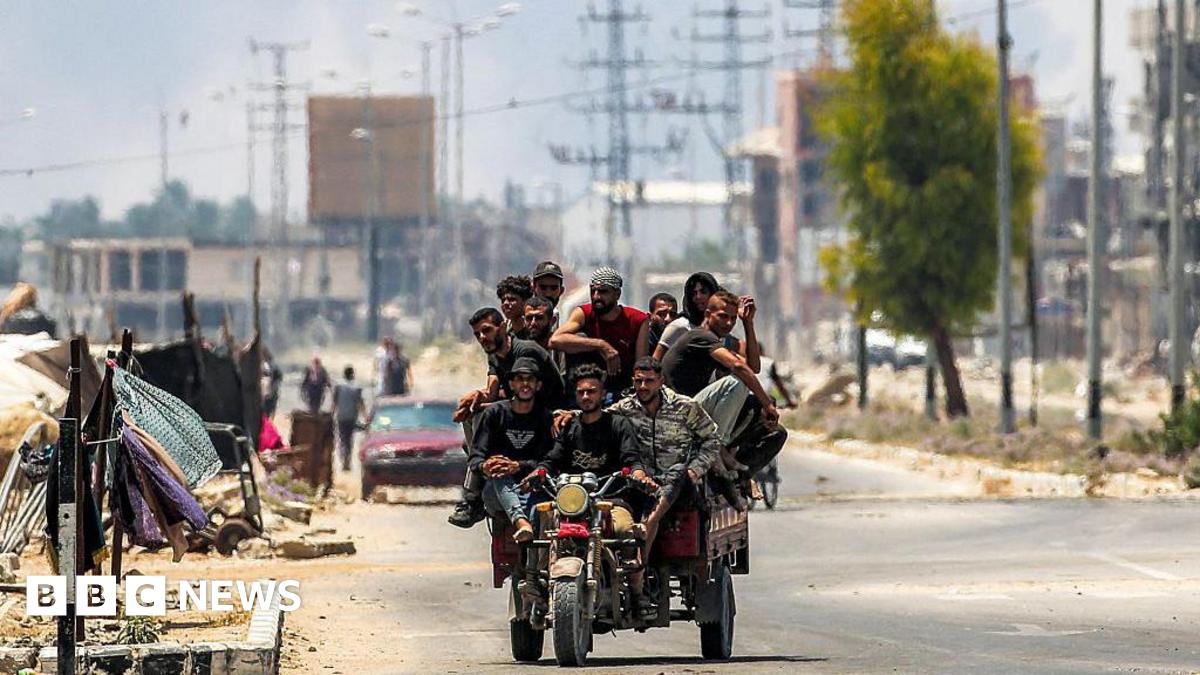
A spokeswoman for the British charity Medical Aid for Palestinians (MAP), which operates a clinic in Deir al-Balah, described the situation as “extremely critical”.
“Shelling is taking place all around our office, and military vehicles are just 400m away from our colleagues and their families, who endured a harrowing night after relocating there,” Mai Elawawda said in a statement.
On Sunday, the Israeli military ordered the immediate evacuation of six city blocks in southern Deir al-Balah, warning that it would be operating “with great force to destroy the enemy’s capabilities and terrorist infrastructure”.
Leila Ezzat al-Shana and her family – including two young children and her sister-in-law, whose leg has been amputated – told the BBC that she had fled from the Bureij refugee camp, about 5km (2.5 miles) north-east of Deir al-Balah, to the nearby Nuseirat camp on Monday.
“[Bureij] was a really dangerous place,” she said. “We saw the tanks in front of us. There were so many snipers shooting everywhere. The shots entered the home in front of me… It’s a miracle to stay alive.
“People are losing their minds and they are falling to the ground due to the lack of food.”
The UN Office for the Co-ordination of Humanitarian Affairs (OCHA) said on Sunday that hundreds of families had already fled.
It said the evacuation order covered about 5.6 sq km (2.2 sq miles) of Deir al-Balah, home to between 50,000 and 80,000 people, including 30,000 in 57 camps for the displaced.
OCHA said UN staff were remaining in Deir al-Balah, spread across dozens of premises whose co-ordinates had been shared with Israel, and stressed that they must be protected.
The affected areas house several aid warehouses, four primary health clinics, four medical points, a water desalination plant, three water wells, a water reservoir, a solid waste dumping site, and a wastewater pumping station, it added.
“Any damage to this infrastructure will have life-threatening consequences,” it said.