
Photo by Julien Rosa/AFP
When demonstrators mobilised across France on Wednesday evening (10 September), the authorities made no secret of their satisfaction. The relief felt by the government, and particularly by the Home Secretary, was not only due to the fact that the “Bloquons tout” (“Let’s block everything”) movement had failed to paralyse the country, but above all to the fact that this slogan had left the vast majority of French people indifferent.
In his office on Place Beauvau, Bruno Retailleau compared the “map” of the demonstrations with those of the Yellow Vests movement in November 2018. The likeness between the two maps is clear: one is the negative version of the other. While peripheral France – small towns, mid-sized towns and rural areas – supported the Yellow Vests movement, the demonstrations on 10 September took place only in the major cities.
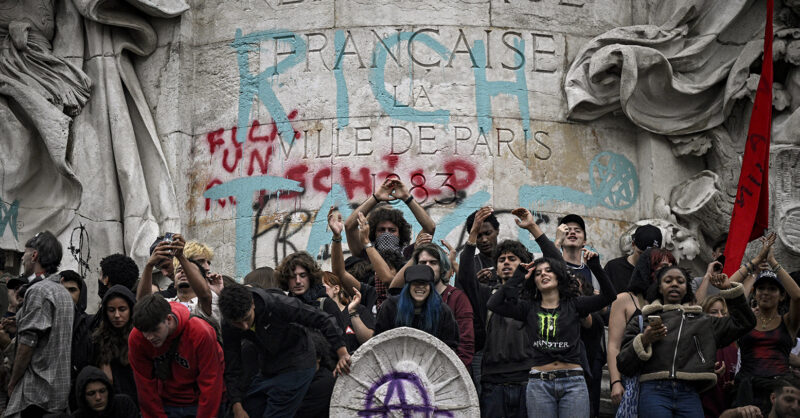
The government’s fears were quickly allayed, as it was the major cities – Paris, Rennes, Toulouse and Lyon – that saw the first protests in the morning. This observation immediately reassured the authorities: this was a “traditional” protest movement, led by the metropolitan left and far left.
The sociology of the participants confirmed the harmless nature of this revolt: high school pupils, university students, and an over-representation of the upper classes and intellectuals. For the police, it was “predictable”, familiar, easily manageable.
In 2018, the geography was inverted. Spread across the country and holding up roundabouts, the Yellow Vests took the authorities by surprise. Sociological analysis indicated that they represented the majority of the working and middle classes: labourers, workers, small business owners, farmers, young professionals and retirees from these backgrounds. But the most problematic aspect for the government was the total absence of political or trade union leadership.
Conversely, the movement of September 10 was very quickly taken over by La France Insoumise (“France in Revolt”), a left-wing political party, which ultimately reassured the authorities; the police are accustomed to dealing with this type of demonstration.
Here’s the truth. Today – as in all Western countries – the protest movements spurred on by the metropolitan left no longer frighten the authorities. By contrast, it is the spontaneous movements emanating from the periphery of France that are cause for concern, as they are unpredictable and driven by groups who feel dispossessed of what they have and who they are.

Subscribe to The New Statesman today from only £8.99 per month
The conclusion is now clear: in recent decades, all serious and sustained protests have emerged in what I call “Périphéria”, i.e. in areas where the majority of the working and middle classes now live. This was the case with the 1992 Maastricht referendum, the 2005 referendum on the European Constitution, the Yellow Vests movement, but also with populist revolt, from Trumpism to the National Front vote, to Brexit.
All these movements have the same geography and the same sociology. These protests draw their strength from their cultural autonomy and their potential for majority support.
In Le capitalisme de la séduction (1981), Michel Clouscard contrasts the “frivolous” and the “serious” to analyse the transformation of capitalism. For the Marxist sociologist, the “frivolous” – which represents permissiveness, hedonistic consumption and the apparent liberation of morals – is encouraged by capitalism in order to create new markets. Meanwhile, the “serious” embodies work and industrial production.
Metropolia, as I call it, is the embodiment of the new capitalism: dependent on services, financialised, a place where the “spectacle” – the superficial imagery of mass media – is permanent. “The frivolous metropolia” can thus never produce serious social movements – and moreover, it smothers them. The Yellow Vests movement began to lose momentum and public support when demonstrations became concentrated in large cities. The logic is thus remorseless: first, the extreme left in the cities took over the movement, turning it violent. Then, opinion formers – academics and pollsters – imposed a narrative that sought to render invisible a movement actually supported by the majority. This led to a focus on minority segments and the presentation of a fragmented France – to the great benefit of those in power.
On 10 September, the metropolitan stifling effect worked even faster: the Mélenchoniste revival – the movement behind La France Insoumise – and the commentariat left no room for spontaneity.
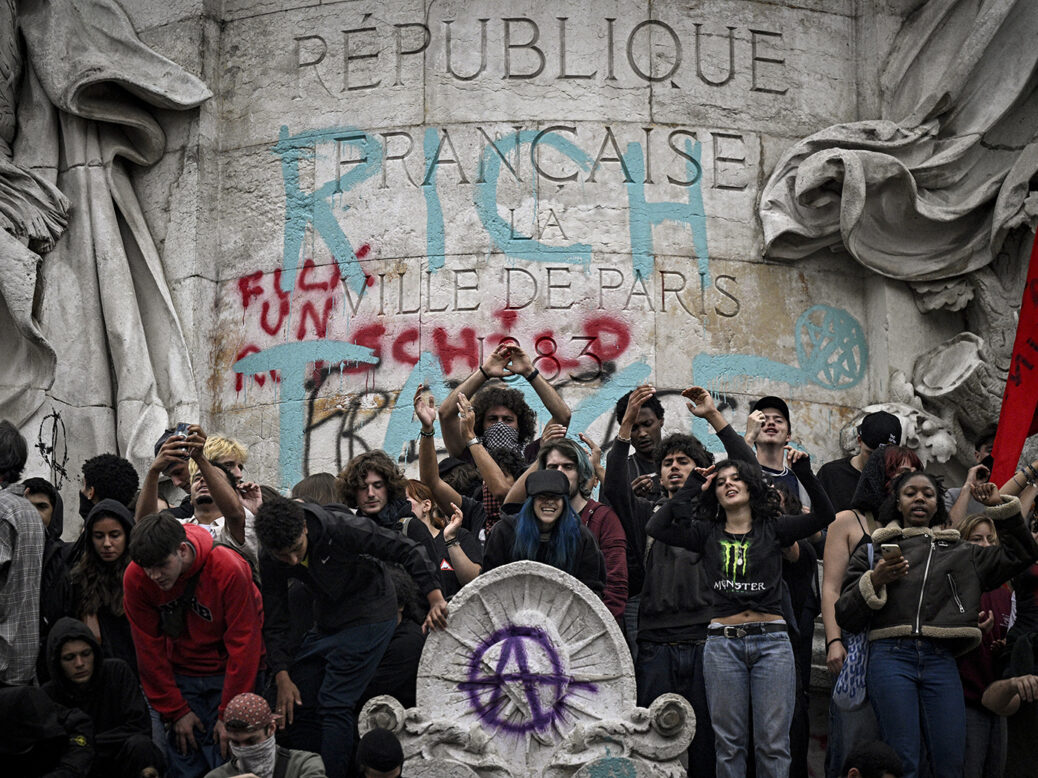
From the point of view of the metropolia, the ordinary majority does not exist. French society is reduced to advertising panels, categories perfectly suited to the neoliberal market, and ultimately to slogans in English: “Eat the rich”, “Free Palestine”, “ACAB” “Let’s block”…
The metropolitan bubble isolates its inhabitants culturally and politically. Ultimately, it stifles politics and thought: social movements have become mere spectacles. This stifling of thought and political discourse is also evident in the world of culture, which no longer caters to the ordinary majority. Ultimately, we are left with the mediocrity of French cinema (in reality, Parisian cinema), which now plays to empty theatres. Literature is following the same path.
The intelligentsia, the politicians, the left, and the creatives are dying out in the metropolitan citadel because they are no longer connected to the soul of the ordinary majority. It is understandable that in Périphéria, the appointment of a new prime minister leaves people completely indifferent. The quintessence of metropolitan frivolity, Macronism, is incapable of seeing the world’s transition from frivolity to seriousness.
On the other hand, if social and political protest is serious, it is primarily because its motivations are existential. It does not obey any party, but rather a widespread feeling among the working classes that they have been dispossessed: dispossessed of their work, their way of life, their very identity.
It is why – in France, as in the rest of western Europe – the demands of the ordinary majority no longer follow traditional political lines. Unlike the political and media elites, ordinary people have become empowered. They no longer refer to a left-right divide, which has become paralysed, but to the question of existence.
Thus, throughout the West, the demands of the majority of ordinary people are structured around four key issues: work, the maintenance of public services, security and the regulation of migration. These issues are relevant to the left and the right, which is why the traditional parties cannot respond to them effectively.
Périphéria is not only the soul of people, it also represents the future, at a time when the Metropolia model, based on finance and globalisation, is becoming fragile. In the new multipolar world, the countries that matter are those that have been able to preserve and develop an industrial base in Périphéria. Périphéria is the world of producers, the world of power.
A few weeks ago, the world witnessed a show of strength: it did not come from a tower in Silicon Valley or London, but from a small town in Missouri – Saint Charles – in the heart of the Midwest. It is a town of 70,000 inhabitants, where industrial know-how has not completely disappeared, where engineers and workers produce the most powerful military weapon ever made: the GBU-57. This is how, armed with the potential for destruction, the US President struck Iran and silenced the belligerents of the Third World War… which never happened.
At the same time in France, another small town in Périphéria was making headlines. Also located in the centre of the country, and again like Saint Charles, this French town has around 70,000 residents – but symbolises the coming world. This small town in the thrust of reindustrialisation is Bourges, where they now make the famous Caesar (Camion Équipé d’un Système d’Artillerie, or “Truck equipped with an artillery system”) self-propelled howitzers, which are supplied to numerous Nato countries, including Ukraine. Like those in the Midwest, the producers, engineers and workers from this area of central France have never forgotten their industrial roots. They also know that in the end, power depends on industrial production.
A month ago, Apple also announced its return to Périphéria with an investment of $600m over four years, including the opening of a factory producing screen protectors in Harrodsburg, a village of 9,000 residents.
Metropolia has skyscrapers, air-conditioned offices and banking headquarters. But Metropolia no longer has power. Across the multipolar world, the countries that matter draw their strength from Périphéria. A low rumble has been emitted: the centre of gravity is shifting from Metropolia to Périphéria.
The return to Périphéria isn’t a choice, but a necessity. An opportunity to close the Thatcherist chapter of “there is no such thing as society” and to leave behind the neoliberal barbarism embodied in Metropolia – striving towards popular demand, towards civilisation.
Périphéria’s social and cultural opposition is indestructible, no power can stop a long-term existential movement; a movement which is not borne from sadness, but from reason, and the dignity of ordinary life.
Christophe Guilluy’s new book, The Dispossessed: The Working Classes and Their Instinct For Survival, is out now from Polity Press.
[See also: A glimpse into fractured France]
Content from our partners