

Is it a stall? Or a full-blown slump? And is it a short run thing? Or something that threatens the hoped for economic recovery?
Some, but possibly not all of the above questions will be answered when Statistics NZ releases the GDP figures for the June quarter this coming Thursday, September 18.
And, yes, these (GDP) figures are, as is always the case, coming out a long time after the quarter in question has finished.
Indeed the June quarter GDP figures are already seeming to be a bit like one of those meals that you’ve over-prepared and by the time you get to eating it, feel like you’ve already had it. I think we need to keep stressing the fact that, particularly our GDP information, is not timely enough – in the hope that at some stage we will get a more timely data information series on our economy.
But timely or not, the latest GDP figures will be important nevertheless and will be a key influence on what the Reserve Bank (RBNZ) decides to do with interest rates between now and the end of the year – given that it’s still got two Official Cash Rate (OCR) reviews to go, on October 8 and November 26.
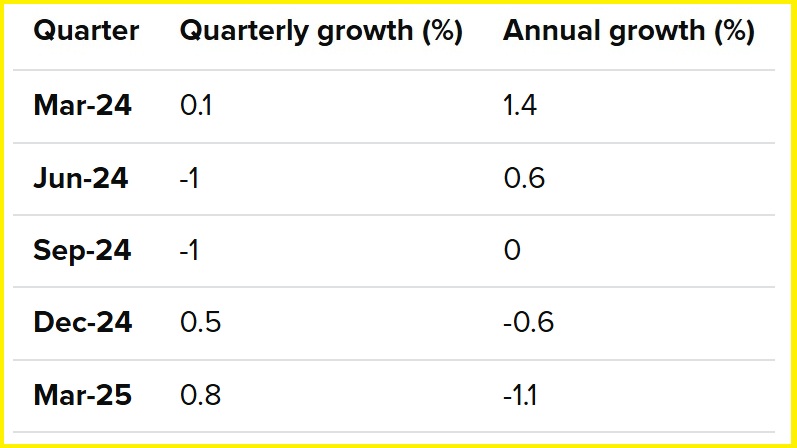
If we recall, the March quarter GDP figures (released in June) showed a rise of 0.8%, following a 0.5% gain in the December quarter. But these rises had followed 1.0% drops in both the June and September 2024 quarters.
Following the decision of the RBNZ to start progressively dropping the OCR from August 2024 onwards down from its 5.5% cycle high, there was obviously keen interest in how quickly the economy could start to bounce back from a recession the RBNZ earlier conceded it had set out to cause – all in order to bring inflation back into the targeted 1% to 3% range.
And those December and March quarter GDP outcomes, while not brilliant, offered some encouragement. However, as early as June even before the March quarter GDP figures had been released, there came indications from some of the lower level high frequency data that the economy had run up against a brick wall. Uncertainty around tariffs would appear to have been a big part of this.
The RBNZ took all the signs that the economy was stalling again on board – eventually – and at its last OCR Review/Monetary Policy Statement release on August 20, it cut the OCR to 3.00% from 3.25%. But, more significantly, it suggested it may take the OCR down to 2.5% before the end of the year. Undoubtedly a key driver for this ‘dovish pivot’ was the RBNZ’s forecast that GDP will have fallen 0.3% in the June quarter. And the central bank’s therefore now decided more encouragement is needed for the economy to get going again.
As mentioned above, a glance back at our quarterly GDP performances over the past year or so reveals a pretty ‘spotty’ performance:
What comes next then? Well, as we said above, the RBNZ’s most recent (August) forecast was for a 0.3% drop in GDP for the June quarter, which was a big change from the previous forecast in May of a +0.3% figure. Without having seen all of the major bank economists’ picks at time of writing, it appears predictions are coming out in a -0.2% to -0.5% range.
What clues have we had so far as to where the figure may land? Well, we’ve had the release of some so-called ‘partial indicators’, IE component parts of GDP.
And this has backed up the idea that the economy did indeed go back into stall mode in the June quarter.
The volume of total manufacturing sales fell 2.9% in the June quarter, following a 2.4% rise in the March 2025 quarter. Wholesale trade sales fell a seasonally adjusted 0.1% after a 3.4% rise in the March quarter.
The seasonally adjusted volume of building work done in the June quarter fell 1.8%, which was a bit weaker than expected after an upwardly revised 1.3% rise in the March quarter. Separate construction sales data released at the same as the manufacturing sales figures showed a 3.1% drop in sales after a 0.7% rise in the March quarter.
Retailers have been struggling as we know, but retail trade volumes rose 0.5% in the June quarter – wrong footing most economists who had picked a fall. The June quarter rise in retail sales activity, followed on from a 0.8% rise in the March quarter. These figures are arguably a bright spot among the various GDP components – but it has to be stressed that retail trading is coming off a VERY low base.
All in all then, it’s looking like we may see a drop in GDP of 0.2% to 0.5% for the quarter. Does this have any immediate ramifications?

Source: 123rf.com
Well, not really. A result of that magnitude is going to be very much in line with what the RBNZ was seeing when it made its OCR decision and forecasts last month. So, the RBNZ is not likely to be ‘blown off course’.
A 0.2%-0.5% GDP drop therefore could be expected to lead us to another OCR cut (to 2.75%) next month.
We won’t see the September quarter GDP results till mid December – after the RBNZ has made its final OCR decision for 2025. What we will see between the October OCR decision and the November OCR decision is the September quarter inflation figures (October 20) and the September quarter labour market figures (November 5).
The RBNZ’s already mentally prepared itself for the next annual inflation rate figure to be up around the top of the targeted 1% to 3% zone, if indeed not actually above it, so, it’s unlikely to be spooked by what it sees.
Perhaps the only thing between now and the end of the year that could prompt the RBNZ to rethink the basic supposition that it will drop the OCR to 2.5% before Christmas would be significant signs of a recovery in the labour market. But while the unemployment rate looks somewhere close to the top of the cycle at the current 5.2%, there seems little sign of an imminent sudden improvement.
So, to go back to the questions posed at the top of this article, and addressing particularly the key one; is the expected drop in GDP during the June quarter going to be a short-run stall?
Well, probably. The most recent high frequency data, including that about manufacturing, services and retail, has suggested signs of life. The RBNZ people were adamant at the press conference after the August OCR announcement that the June quarter would prove to be the nadir.

Whatever ailed us during the second quarter, whether it be tariff concerns and the like, appears to be passing. The interest rate drops we’ve seen so far are working through. The thought then is that the third quarter will be better – not roaring away, by any means, but better. And indeed, the RBNZ’s most recent forecast is for a 0.3% rise in the September quarter and then a stronger, 0.8% lift in the December quarter.
Any signs that future growth is looking weaker than that will start conjecture that the OCR might need to be lower than 2.5% next year – but equally, any sign that inflation may head north of 3% and not look like coming down soon could push against that.
For now though, what we can say is it seems a given that the economy did sag again in the second quarter of this year – but that the pick up is now under way again – and the RBNZ is going to continue helping that with further OCR reductions before the end of 2025. Onwards and upwards. Eventually.
*This article was first published in our email for paying subscribers early on Friday morning. See here for more details and how to subscribe.