
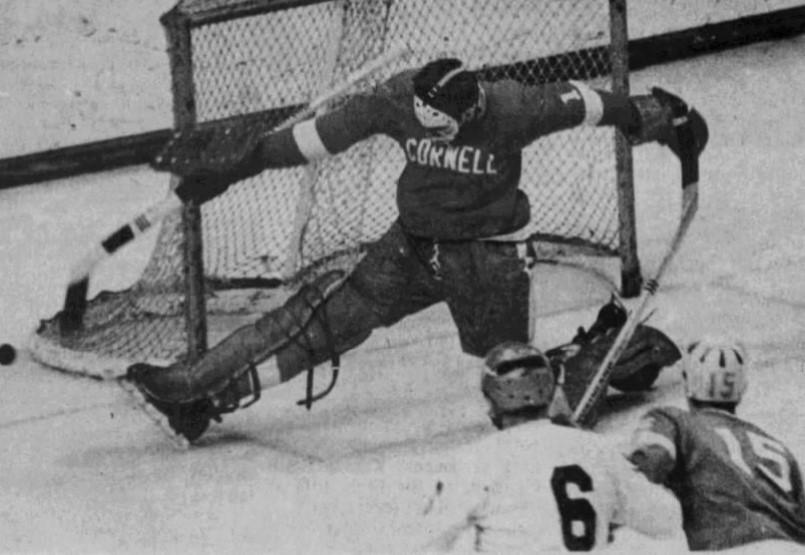
What Sam Pollock wants, Sam Pollock gets.
That was the old saying, as the general manager of the Montreal Canadiens made a name for himself league-wide as a savvy talent scout, with shrewd moves that would keep the Canadiens at the top of the standings for decades. But there was one player who proved to be quite elusive: goaltender Ken Dryden.
The story begins at the 1964 amateur draft. In those days the amateur draft was no more than a bunch of paper shuffling while the majority of NHL prospects had their rights grandfathered in under the old sponsorship system which ended in 1963. Ken Dryden, unattached to any NHL team, was one of the few players available in the draft, and was picked 14th overall by the Boston Bruins. The Bruins then foolishly traded Dryden to Montreal in what is called the worst trade in Bruins history.
It wasn’t some Pollock masterstroke, but sheer luck that landed Dryden in Montreal’s hands. The Bruins’ Herb Ralby recalled to the Boston Globe in 1979 that, “we took him in the amateur draft, but we never had him really. It was a phony deal. We took him as a favour to Pollock and dealt away his rights to Montreal later.”
Two weeks later in fact. It was something of a pre-arranged deal, as the Bruins had asked Montreal to draft an unclaimed amateur by the name of Guy Allen, who was the player they wanted, and they weren’t too keen on Dryden despite taking him because he wanted to pursue academics over professional hockey. Meanwhile, Pollock was convinced by others that the Canadiens made a mistake skipping on Dryden, so the deal was completed a couple of weeks later with no media coverage or any attention given to the trade at all. Even the involved parties had no idea. Dryden himself admitted years later that he wasn’t even aware he was drafted by the Bruins until he made it to the NHL in 1971. A player by the name of Paul Reid, who went with Allen to Boston in return for Dryden, found out 38 years later that he was drafted by Montreal!
Following the trade, the Canadiens approached the goaltender who was playing for Etobicoke Collegiate as a junior in grade 12. The Canadiens offered 15-year-old Dryden a chance to play for their Junior A team in Peterborough, buying his negotiating rights from Etobicoke for $2,000, but he turned down the opportunity in order to finish high school at home and continue to play Junior B in Etobicoke. “That means,” said Canadiens chief recruiter Ron Caron in an interview for the Montreal Star, “that up until the time he decides what he wants to do, his negotiations will be with us.”
Cornell University
When Dryden completed high school, as a double all-star in hockey and basketball, he received offers from plenty of Ontario Junior A teams, the traditional path for players to take on the way to the NHL. Instead, he chose the collegiate route in the United States because of his desire to prioritize education over a professional hockey career. His belief, one that he would apply numerous times in his life, is that a career in hockey lasts only a few seasons, and that’s why it is important to have a solid educational foundation to fall back on when the time comes to hang up the skates.
Dryden received offers from the University of Minnesota and also Princeton University, but he was convinced by Cornell University head coach Ned Harkness who took a rather unorthodox approach in recruiting the goaltender. Harkness understood that, to Dryden, academics were the core of any decision, so Harkness smartly told him to go out to lunch with the head of the political science department at Cornell, Clinton Rossiter. Dryden loved his conversation so much with one of the top advisors to American president Lyndon Johnson that he soon found himself a part of the Big Red at Cornell without having ever seen a single game or even the hockey facilities before making his decision.
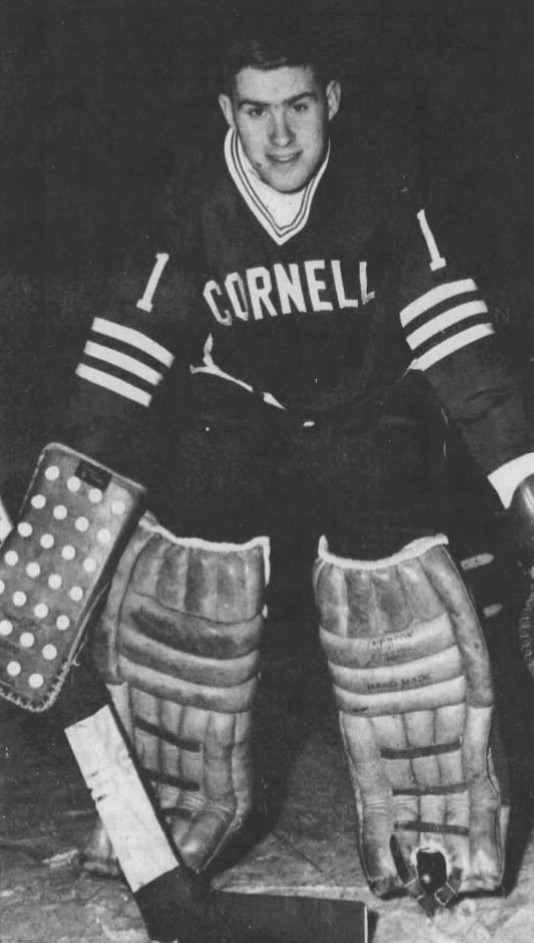
He immediately impressed to start the 1965-66 season, making 20 saves on 22 shots in the annual Frosh vs. Varsity game at Cornell in two periods of work for the rookie team. The Frosh team went unbeaten in the 1965-66 season, and Dryden’s reputation began to swell.
When the hockey season finished, Dryden, diversified as always, turned his attention to baseball where he played shortstop.
The 1966-67 season started fortuitously for Dryden, who was called to start the first exhibition game of the season for the Cornell varsity team against his hometown McMaster University from Hamilton, when sophomore goaltender Dave Quarrie suffered an ankle injury. Cornell drubbed McMaster 14-2. Both teams managed 24 shots on goal, with Dryden getting the better over his unfortunate counterpart. Dryden never looked back, taking the starting goaltender job from Quarrie who only played two games all season. Dryden went undefeated in 27 starts.
By the end of the season, praises were being sung about Dryden who helped the dominant Cornell team to an NCAA championship, 4-1 over Boston University. He was named the best goaltender of the NCAA tournament, and set a tournament record by yielding just one goal in two games, with 71 saves. He also recorded the first shutout in NCAA tournament history in a game against North Dakota. To top it off, he was given the MVP award.
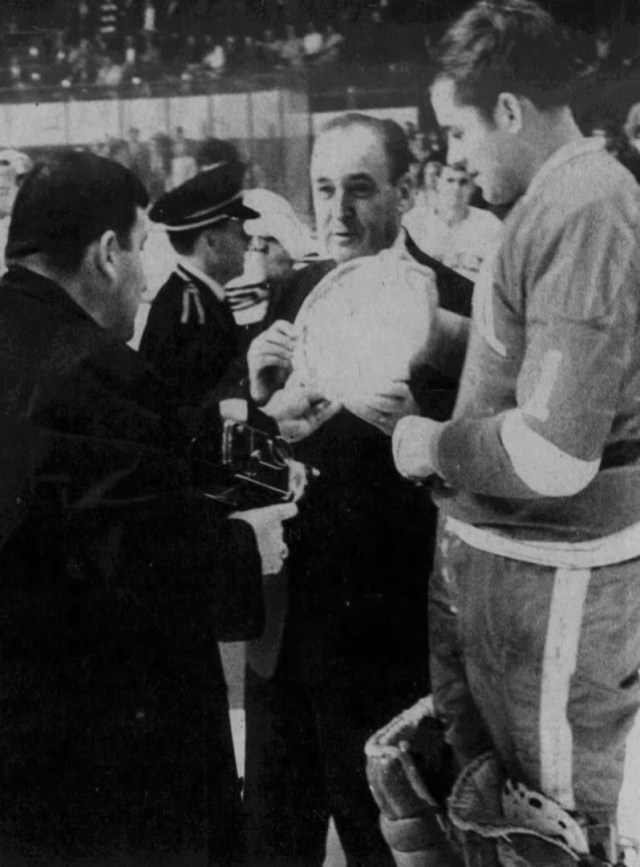 Dryden receiving the MVP award for his tremendous play for Cornell during the NCAA tournament
“The finest goalie I’ve ever seen in college hockey,” said Boston University head coach Jack Kelley.
“He’s all over the net, he’s all arms, you can’t see any open space to aim for, and he doesn’t give up rebounds, which hurts our power play,” said Jim Quinn, a BU forward.
“That Dryden is just a sophomore?” a BU fan moaned after the championship game, realizing his team is likely to face the netminder for two more seasons.
Harkness recalled in an interview in the Boston Globe that Montreal’s interest in Dryden had subsided by his senior year. Harkness said that he called up Pollock one day out of confusion and said, “You’ve got a great goaltender here. You better come down and look at him.”
So Pollock sent Toe Blake to Boston to look at Dryden, where he witnessed him put on a show against Boston College in a 4-3 win. “We’re definitely interested in him,” said Blake, “but we don’t know whether or not he’s interested in playing pro hockey or not. Watch him, he plays up to the league he’s in. He relaxes out there. But when the puck comes into his zone, he’s like a cat.”
Clearly impressed from hearing Blake’s report, Pollock immediately decided to go see for himself. Pollock made it down to Ithaca for Cornell’s game against the University of Toronto, where he witnessed a beating. Cornell made short work of the best collegiate team in Canada, beating them 7-2. “I saw Toronto win our Montreal Forum tournament last month, and I am surprised Cornell was able to so thoroughly dominate them tonight,” said Pollock. Dryden only had to make 20 saves in what coach Harkness called “our best skating of the season.” Pollock clearly left impressed and the wheels were in motion to make Dryden a member of the Canadiens.
Dryden completed his college career on March 17, 1969, in a 4-3 loss to Denver in the NCAA championship final. He was once again selected MVP for the tournament. Although the exact numbers of games varies depending on the source (78-4-1 and a 1.59 goals-against average according to Elite Prospects), the conclusion is always the same: Dryden was beyond dominant. Opposition coaches called him “the best college goalie in history,” and it certainly can be argued that he so remains to this present day. All-star honours three years in a row. Three-time All-American. Three-time All-East. Three-time All-ECAC. NCAA player of the year for 1969. The accolades were just an indication of his potential should he decide to turn pro.
The National Team
Days after his final college game, Dryden flew to Stockholm to join the Canadian national team for the World Championship. Team Canada wanted Dryden sooner for the tournament but he didn’t want to leave school early. After he played his final game, Team Canada called Dryden and asked if he was interested in the backup position left open when Steve Rexe was hurt in practice and forced to drop out of the tournament. Dryden seized the opportunity and soon another door opened for Dryden, getting the start in his first game with the team because starter Wayne Stephenson was dealing with a charley horse. Dryden shut out the American team 1-0 in his debut. He stopped 25 shots, instantly building up the impressive legacy that he had already begun weaving. That would be Dryden’s only start as the Canadian national team returned to Stephenson in their next game, promptly losing 5-1 to Sweden and getting bounced from the tournament.
The team was in the midst of some change, being organized under the auspice of the newly create Hockey Canada umbrella, and they were looking at stocking the team with promising players who had not yet signed with the professionals. They were setting their sights on Dryden to build the team around ahead of the 1970 World Championship, and more importantly the 1972 Winter Olympics.
Dryden gave an interview to the Ithaca Journal in July, 1969 prior to his graduation where he outlined that his first choice following graduation was law school, his second choice was playing with the national team, and that his third choice was joining the NHL Stanley Cup-champion Montreal Canadiens. True to these goals, Dryden rejected an offer from the Canadiens and signed a three-year deal with the Canadian National Team for a total of $37,000. The Canadiens reportedly offered $50,000 with an increase to $60,000 if he made the NHL team.
Pollock wasn’t too happy that he had to negotiate with Dryden through an agency, Pro Sports Inc. out of New York, while also contending with Dryden’s pursuit of an education. “Yes we are interested in signing him and talks started last week,” said Pollock to the Ottawa Citizen. “We gave him a detailed offer both verbally and in writing. He said he’d like to talk to his family and advisers before reaching any decision. We feel in the end we’d like to deal on a personal and friendly basis because we haven’t had a holdout or arbitration in the five years I’ve been here.”
Dryden was quite logical with what seemed like an illogical choice. “Continuing my education was the prime factor. Getting my degree and maybe also my Masters in Business Administration is an important motivation, and I also want to play in the Olympics. The Canadiens thought I could go to McGill Law School while playing professionally in Montreal (either in Montreal or with their new farm team Montreal Voyageurs). At first I was interested, but when I realized that I couldn’t combine the two, I decided against it. International hockey is exciting and then there is the extra kick of travelling to Europe for games. Some day I still hope to be in the National Hockey League.
“I’ve been thinking about it since March, then everything happened at once. I was accepted at Harvard and the reputation of that school made it very tempting. Getting into Harvard law school is the big thing. Only about one per cent ever fail and starting salary for a Harvard grad averages around $15,000. Had I gone to Harvard, hockey would have been out. The main factor in my choosing to join Hockey Canada is that it provides the money for me to go to school comfortably and I can continue in hockey. The Montreal offer was more money, but no school. The Harvard thing was school, but no hockey. This way I can have them both.”
The national team started badly, however. Training camp was to open on August 14 and the team was due to leave for Moscow for a series of exhibition games on August 28, but there was no coach or players. Making matters worse, general manager Hap Emms resigned on August 7. Under tremendous pressure, Emms only accepted the role in April when he received assurances that the Maple Leafs and the Canadiens would provide a total of six players for the team. But once he accepted, NHL President Clarence Campbell stated that any such loans would go against the NHL constitution, so it would have to be players from the farm systems and not NHL players. Emms was unable to sign any promising young players besides Dryden, as they all preferred the riches of professional hockey.
When it came time for the team to travel to the Soviet Union, the Maple Leafs and the Canadiens did provide some players. From the Canadiens came Phil Roberto, Al MacNeil, and Guy Lapointe. Allan Houle was named the new GM. Upon their return from Europe, head coach Jack McLeod said that the tour of Europe “wasn’t worth it” stating that the quality of the opposition was not up to par, as Canada won eight of nine games they played.
Dryden and the national team would go on tour, playing all around Canada and the United States to sharpen their skills. A series of game against the Omaha Knights of the Central Hockey League proved to be too strong an opponent as they beat the Canadians in three of four games, but games against Canadian universities and senior teams proved to be too easy for Canada. In November, the Canadian national team played two games against the Montreal Voyageurs in Montreal, with Dryden receiving one start, a 3-3 tie. Pollock watched that game with a certain amount of resentment that Dryden was playing against his team, not with it. A second Russian tour would pit him for the first time against his life-long frenemy, Vladislav Tretiak.
The Hockey Canada national team experiment of having full-time dedicated contracted players was not exactly running smoothly. There was jealousy of Dryden’s salary, which was much higher than the returning players were making. Players started walking out on the team in protest at the perceived slight.
The final straw for the team came in January, 1970, when the IIHF ruled against professionals being allowed to join the national team for the World Championship, despite promising it earlier. The International Olympic Committee stepped in and deemed that any amateur who played alongside a professional would be ineligible for the 1972 Olympics, spooking everyone. Canada protested the decision, ultimately deciding to pull out of hosting the 1970 World Championship and boycotting the tournament altogether, collapsing the team, and rendering Dryden available to Pollock once again.
Montreal Voyageurs and history
“I had an agreement with Hockey Canada and I could have had a comfortable life, collecting my money from them and playing at the University of Toronto, but I’ve had enough college hockey. I decided that if I was going to continue playing, it would have to be with the pros.”
Going into his second-year law school as a student at McGill University, it was time for Dryden to step up, as he signed his professional contract with the Canadiens in September, 1970. He immediately went to work at the Canadiens’ training camp, facing the incumbent Rogatien Vachon and Phil Myre for a spot on the Canadiens. Dryden made his first professional start in an exhibition game against Boston on October 5. He made 42 saves in a 5-4 win in Boston, the city that was already well-versed in the type of goaltender it was facing.
Dryden ended up assigned to the Montreal Voyageurs for the 1970-71 season, where he was permitted to take occasional leaves of absence to focus on his law degree. By the end of the season he was called up to the NHL, where he would lead to the Canadiens to an unexpected Stanley Cup conquest. It coincided with the end of the remarkable career of Jean Béliveau. Whereas one legendary career ended, Dryden’s only began.
With a Calder Trophy, Vezina Trophies, Stanley Cups, and All-Star Games, Dryden cemented his foundation as one of the all-time great Montreal Canadiens. Yet he would once more prioritize law over professional hockey, skipping the entire 1973-74 season in order to be a clerk in a Toronto-based law firm. This time, however, it was triggered by a salary dispute with Pollock. It took a whopping $200,000 contract to coax Dryden back for the 1974-75 season, winning his argument against Pollock like only a lawyer could.