
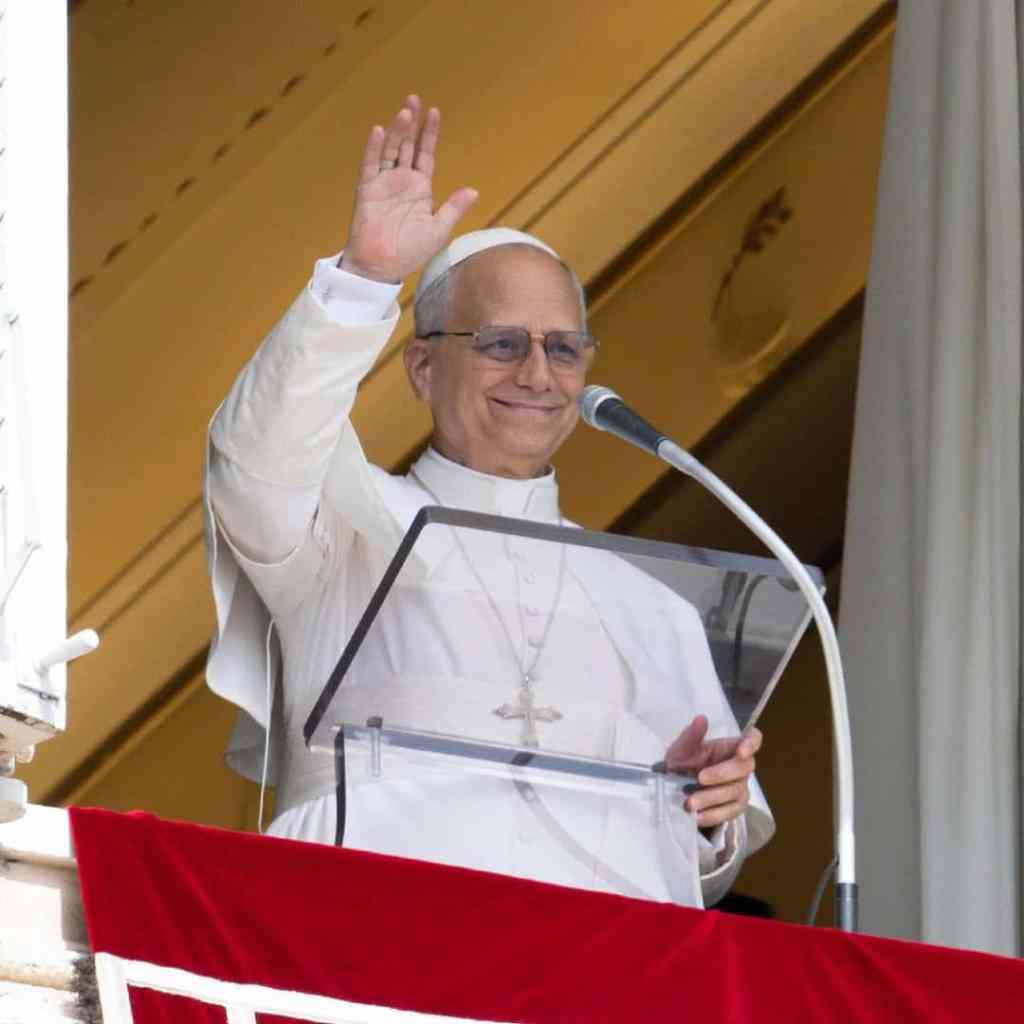
Before thousands of faithful gathered in St. Peter’s Square, Pope Leo XIV presided over the Angelus prayer on the feast of the Exaltation of the Holy Cross, emphasizing that this sign of death was transformed into an instrument of life and hope thanks to the love of God.
In his reflection, the Pontiff recalled Jesus’ dialogue with Nicodemus (Jn 3:13-17) and the biblical episode of the bronze serpent in the desert, recalling that “God so loved the world that he gave his only Son.” He emphasized that the cross, embraced by Christ, becomes the certainty that nothing can separate us from divine love.
At the end of the Marian prayer, Leo XIV recalled the 60th anniversary of the creation of the Synod of Bishops, instituted by Saint Paul VI, and invited us to renew our commitment to unity and synodality in the Church.
The Pope greeted pilgrims from Chile, Tanzania, the Czech Republic, Peru, and Italy, as well as various associations, communities, and youth groups.
Finally, he shared a personal note with those present: his 70th birthday, an occasion on which he thanked God, his parents and those who accompanied him with prayer.
POPE LEO XIV
ANGELUS
Saint Peter’s Square
Sunday, 14 September 2025
________________________________________
Today the Church celebrates the Feast of the Exultation of the Holy Cross, commemorating the discovery of the Cross by Saint Helen in Jerusalem in the fourth century, and the return of the precious relic to the Holy City by the Emperor Heraclius.
But what does celebrating this feast mean for us today? The Gospel reading that the liturgy places before us (cf. Jn 3:13-17) helps us to understand it. The scene unfolds at night: Nicodemus, one of the leaders of the Jews, a righteous and open-minded person (cf. Jn 7:50-51), comes to meet Jesus. He needs light and guidance: he seeks God and asks the Teacher of Nazareth for help because he recognizes him as a prophet, a man who performs extraordinary signs.
The Lord welcomes him, listens to him, and eventually reveals to him that the Son of Man must be lifted up, “so that whoever believes in him may have eternal life” (Jn 3:15), adding: “For God so loved the world that he gave his only Son, so that everyone who believes in him might not perish but might have eternal life” (v. 16). Nicodemus, who perhaps does not fully comprehend the meaning of these words in the moment, will certainly do so when he helps to bury the Savior’s body after the crucifixion (cf. Jn 19:39). It is then that he will understand that God, in order to redeem humanity, became man and died on the cross.
Jesus speaks of this to Nicodemus, recalling an episode in the Old Testament, when the Israelites were bitten by venomous snakes in the desert and were healed by looking upon the bronze serpent that Moses had fashioned and mounted on a pole in obedience to God’s command (cf. Num 21:4-9).
God saves us by showing himself to us, offering himself as our companion, teacher, doctor, friend, to the point of becoming bread broken for us in the Eucharist. In order to accomplish this task, he used one of the cruelest instruments that human beings have ever invented: the cross.
That is why today we celebrate the “exultation”: for the immense love with which God has transformed the means to death into an instrument of life, embracing it for our salvation, teaching us that nothing can separate us from him (cf. Rom 8:35-39) and that his love is greater than our own sin (cf. Francis, Catechesis, 30 March 2016).
Let us then ask, through the intercession of Mary, the Mother who was present at Calvary near her Son, that the saving love of her Son may take root in us and grow, and that we too may know how to give ourselves to each other, as he gave himself completely to all.
__________________
After the Angelus
Dear brothers and sisters!
Tomorrow marks the 60th anniversary of the establishment of the Synod of Bishops, a prophetic intuition desired by Saint Paul VI so that Bishops might increase and improve their exercise of communion with the Successor of Peter. It is my hope that this anniversary will inspire a renewed commitment to the unity and mission of the Church. *synodality
I affectionately greet all of you, faithful of Rome and pilgrims from Italy and various countries, especially those from Villa Alemana and Valparaíso in Chile, from the Archdiocese of Mwanza in Tanzania, from Humpolec in the Czech Republic, together with the Peruvians from the religious association Jesús Nazareno Cautivo. I also greet the faithful from Chiaiamari, Anitrella, Uboldo, Faeto, Lesmo, Trani, Faenza, Pistoia, San Martino in Sergnano, Guardia di Acireale, San Martino delle Scale in Palermo, and Alghero.
I also greet the bands of Borno and Sonico in Val Camonica, the “La Nuova Famiglia” Cooperative of Monza, the Regional Committee Pro Loco of Lazio, the Union of Catholic Apostolate, the young people of Don Bosco Youth-Net and the community of Communion and Liberation of Rome; as well as the Arti e Mestieri Association of Sant’Agata di Militello, the motorcyclists who came from Ravenna and the cyclists who came from Rovigo.
Dear friends, it seems that you know that today I turn seventy years old. I give thanks to the Lord and to my parents; and I thank all those who have remembered me in their prayers. Many thanks to everyone! Thank you! Have a good Sunday!