
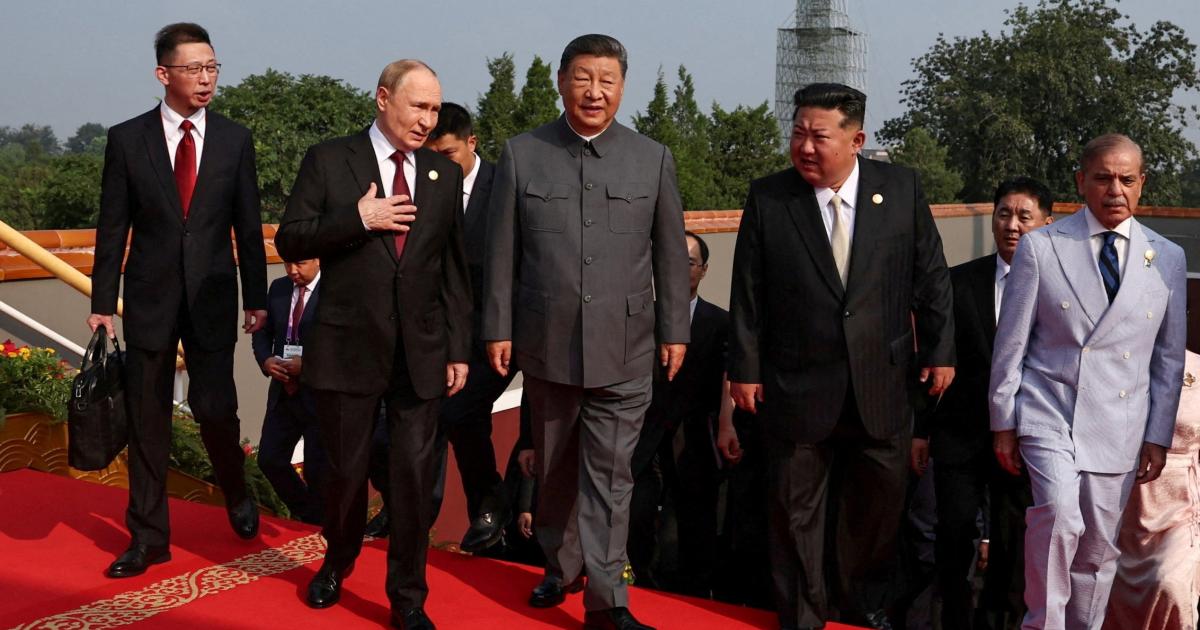
No moment captured the shifting global balance of power more vividly than when Chinese leader Xi Jinping, Russian President Vladimir Putin, and North Korean leader Kim Jong Un walked in lockstep on the red carpet at China’s military parade in early September. The three autocrats, despite a long history of mutual suspicion, projected a show of unity against Washington. The message behind the carefully managed scene was unmistakable: China is at the center of a rising anti-Western bloc, while the United States is adrift—divided at home, faltering abroad, and rebuffed by its rivals.
U.S. President Donald Trump has made no secret of what he wants from each of the three leaders: a peace deal with Putin to end the war in Ukraine, a trade pact with Xi to rebalance the U.S.-Chinese economic relationship, and a summit with Kim to revive stalled diplomacy on the Korean Peninsula. But all three have spurned his overtures. Instead of engaging on Washington’s terms, Kim, Putin, and Xi are now linking arms in Beijing, flaunting not only their growing willingness to challenge U.S. leadership but also their ability to do so in concert.
But beneath this show of solidarity, China, North Korea, and Russia remain uneasy partners. What the three countries have is a tactical alignment rooted not in trust or shared values but in overlapping grievances and necessity. History demonstrates that they are not natural allies. Each state remains wary of entrapment and is unwilling to subordinate its national interests to those of the others. And crucially, each still seeks something from the United States—leverage that Washington must wield wisely.
THREE’S A CROWD
The last time China, North Korea, and Russia aligned this closely was during the Korean War, which ended badly for all. Kim Il Sung, the grandfather of the current North Korean leader, invaded South Korea with Soviet and Chinese support. The gamble failed. North Korea became the isolated, impoverished pariah state it is today, while its southern rival, backed by the United States, flourished. For China, the intervention was costly, in both blood and treasure. Hundreds of thousands of Chinese soldiers were killed or wounded, and scarce resources were drained from its economy, which was already battered by years of civil war and World War II. Worse, the war entrenched a permanent U.S. military presence on its doorstep and upended Beijing’s plans for Taiwan. Fearing a broader communist advance, the Truman administration reversed its hands-off approach and signed a mutual defense treaty with Taipei, indefinitely forestalling China’s goal of annexing the island, which remains unfinished business for China’s leaders to this day. For Beijing, the Korean War offered a sobering lesson: aligning with volatile partners, such as Pyongyang, out of ideological solidarity can incur enormous costs and generate long-term liabilities.
The Korean War also sowed lasting distrust between China, North Korea, and Russia. Pyongyang believed that Beijing had prioritized its own interests during the Panmunjom armistice talks, sidelining North Korea’s concerns. In the years that followed, North Korea resented what it saw as persistent Chinese interference and overreach. Kim Il Sung purged pro-Chinese figures from his country’s leadership, just as Kim Jong Un would do decades later when he executed his uncle Jang Song Thaek, known for having close ties to Beijing. Meanwhile, Beijing bristled at Moscow’s tepid support during the conflict. This added to a growing list of grievances that would culminate in the Sino-Soviet split, which began to take shape by the mid-1950s.
These fractures deepened over time. North Korea, ever transactional, learned to play Moscow and Beijing against each other, extracting aid and concessions from both countries while refusing to subordinate itself to either. China and the Soviet Union, once comrades in arms, descended into an intense ideological and geopolitical rivalry. For China, fears of Soviet encroachment loomed large. In 1961, just days after Moscow signed a mutual defense treaty with Pyongyang, China inked its own pact with North Korea, despite its bitter lessons from the Korean War. That treaty remains China’s only formal alliance to date. Two decades later, similar fears drove China’s 1979 invasion of Vietnam, its last major war. By resorting to force, Beijing hoped to counter what it saw as Moscow-backed Vietnamese expansionism and Soviet encirclement in Southeast Asia. The throughline is clear: mutual suspicion, not solidarity, has historically defined relations among this trio.
FAIR-WEATHER FRIENDS
Today, more than 30 years after the end of the Cold War, the three countries have found common cause again in seeking to erode Washington’s power and influence. But the carefully choreographed display of unity masks old divisions and simmering distrust. Unlike Pyongyang and Moscow, Beijing seeks to reshape the global order without setting it ablaze. It aims to weaken U.S. influence without fully severing its profitable ties with the West. China has extended Moscow a critical economic lifeline and supplied dual-use goods that have helped sustain the Kremlin’s war in Ukraine. But it has done so because the costs have been manageable, limited to reputational damage among Western states. Crucially, the war between Russia and Ukraine has not yet posed a direct threat to China’s own security or economic stability. If that changed, Beijing’s calculus could shift quickly.
The cracks in the Chinese-Russian relationship are especially evident on the Korean Peninsula. China is deeply uneasy about Russia’s expanding ties with North Korea. Moscow has turned to Pyongyang for munitions and troops to sustain its war in Ukraine and the two countries have signed a mutual defense pact. Putin has now eclipsed Xi as Kim’s most important partner—frustrating Beijing’s effort to be the dominant player on the Korean Peninsula. Over the past two years, Russia has added to China’s concerns by transferring sensitive military technology, including air defense missile systems and drone capabilities, to North Korea. In private, Chinese analysts express concerns about the limited visibility over these transfers and their destabilizing potential.
Putin has now eclipsed Xi as Kim’s most important partner.
What Beijing fears is a lack of control. In flash points such as the Taiwan Strait or the South China Sea, China can calibrate the pace of escalation. But North Korean adventurism, backed by Russia, could create volatility on China’s doorstep that it cannot easily manage. As in the Korean War, China risks being dragged into a crisis by a reckless junior partner supported by Moscow. Russia, for its part, is less concerned about the consequences of instability in Asia. Putin’s focus is squarely on reasserting Russian influence in eastern Europe. Should tensions escalate on the Korean Peninsula or in the Taiwan Strait, it is far from certain that Moscow would be willing to shoulder serious costs to support either of its partners.
Indeed, a deeper rivalry between Moscow and Beijing lingers beneath the surface. In June, for example, The New York Times reported that Russia’s domestic intelligence agency refers to China as “the enemy” and worries about Chinese espionage. Within Russia, there are persistent fears that Beijing harbors long-term ambitions in Siberia and the Russian Far East. Moscow is anxious, in part, because Chinese investment and workers have flooded into these areas in recent years and because China published official maps in 2023 that used historical Chinese names for several Russian regions and cities.
Of the three leaders, Kim Jong Un has the most potential to exploit the trilateral relationship. Pyongyang has long perfected the art of leveraging great-power competition to extract concessions and preserve its autonomy. Today, Kim is simultaneously capitalizing on his ties with Moscow and reengaging Beijing to ensure he doesn’t become too reliant on either patron. Attending the military parade with Xi, the first time the two leaders have met face-to-face since 2019, is part of a calculated recalibration. Kim reaffirmed his ties with China while keeping Russia close, strengthening his position to demand greater concessions from Washington in any future round of diplomacy. In this triangle, each country is hedging as much as aligning—pursuing its own interests under the guise of unity, yet prepared to shift course if either relationship becomes a liability.
PLAYING THE RIGHT CARDS
The uneasy convergence of China, North Korea, and Russia may not give the United States a sweeping strategic opening, but it still leaves Washington room to maneuver if it engages each adversary with purpose and discipline. The United States still holds meaningful leverage with China because Beijing seeks economic stability. It wants to avoid any direct confrontation with the United States that would jeopardize its rise. Beijing also shares, at least in principle, several U.S. objectives: preserving regional stability, preventing a nuclear cascade in northeast Asia, and witnessing a peaceful resolution to the war in Ukraine. Chinese officials have repeatedly emphasized their support for cease-fire negotiations between Russia and Ukraine, portraying dialogue as the only way to resolve the conflict.
But overlapping interests alone are insufficient to spur cooperation. If Washington wants to translate these shared goals into tangible outcomes, it must proceed deliberately. The United States should make clear that progress on a trade deal and a possible Trump-Xi summit are contingent on China demonstrating its willingness to cooperate on areas of mutual concern—particularly curbing North Korea’s unchecked nuclear and missile expansion and ending the war in Ukraine.
The United States does not need to engineer a split between China and Russia, nor could it anytime soon. Beijing will resist overt pressure to publicly break ranks with Moscow or Pyongyang. But private pressure might work to sway China, especially when its larger priorities are on the line. Despite its defiant tone, Beijing still seeks a trade deal with Washington that lowers tariffs and preserves a degree of stability in the U.S.-Chinese relationship. Failure to secure a deal may not be catastrophic for China’s economy. But it would add unwanted volatility, compounding existing economic strains and increasing discontent among the Chinese public. By raising the stakes and conditioning Chinese cooperation on Ukraine and North Korea as integral to a broader bilateral agreement, Washington could force Beijing to make modest but meaningful adjustments, such as slowing purchases of Russian oil, curbing dual-use exports to Moscow, and signaling to Pyongyang that denuclearization must remain a long-term goal.
The red carpet moment in Beijing was meant to unsettle Washington.
With Russia, Putin has shown little interest in peace talks that would require him to abandon his maximalist demands in Ukraine. He remains committed to outlasting U.S. and European support for Ukraine. But over time, Russia will need an off-ramp as troop losses mount, economic strains deepen, and public fatigue grows. Neither China nor North Korea can give Putin the diplomatic exit he needs. Only Ukraine and its partners can. Washington should not rush into negotiations; rather, it should use this leverage to carefully shape the conditions for a just and sustainable resolution to the war. The United States should coordinate with European allies to enhance Ukraine’s capacity for self-defense, provide credible security guarantees, and apply mounting economic pressure on Moscow. A key part of that strategy must involve pressuring China and India to scale back their support for Russia’s wartime economy—not through public ultimatums, which often provoke defiance, but through forceful backchannel diplomacy—allowing Beijing and New Delhi to change course without appearing to capitulate to U.S. pressure.
And with North Korea, the United States has bargaining power. Kim wants sanctions relief, regime security, and recognition of North Korea as legitimate nuclear power. There is a limit to how much China and Russia can deliver on these without U.S. cooperation. Despite its anti-American rhetoric, Pyongyang has long pursued a peace deal and normalization with Washington—not just for direct gains, but also because such a breakthrough would unlock broader engagement and economic assistance from Tokyo, Seoul, and beyond. This leverage shouldn’t be squandered in pursuit of a quick Trump-Kim photo op. A workable deal could start with reaffirming the joint statement, signed by Trump and Kim, from the 2018 Singapore summit, which included a clear commitment to the denuclearization of the Korean Peninsula. It could be accompanied by interim steps to reduce nuclear risks and expand diplomatic, economic, and humanitarian exchange with North Korea.
The red carpet moment in Beijing was meant to unsettle Washington—and it should. It underscored how far the United States’ rivals have come in teaming up, even if their interests do not completely align. Yet China, Russia, and North Korea each still have reasons to deal with the United States. If Washington can resist the urge for improvised, optics-driven diplomacy; recognize its sources of leverage; and lean into its comparative strengths—its alliances, military power, economic influence, and diplomatic reach—it can shape the strategic environment instead of just reacting to it.
Loading…