
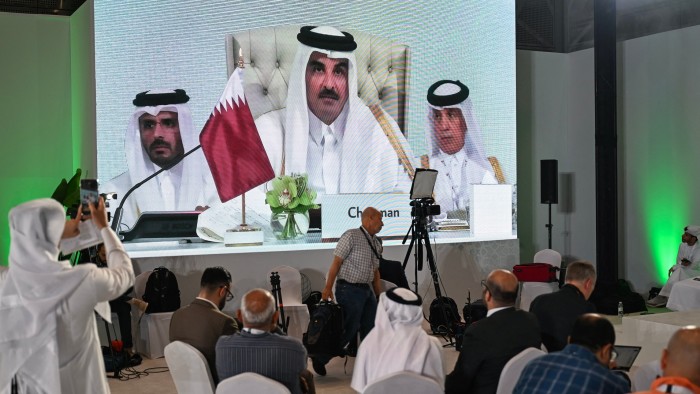
Qatar’s emir urged a summit of Arab and Muslim leaders to take “concrete steps” against Israel in response to last week’s Israeli missile strikes targeting Hamas political leaders in Doha.
In a fiery speech to the gathering of delegations from about 50 nations in the Qatari capital, Sheikh Tamim bin Hamad al-Thani described the attack as “blatant, treacherous and cowardly”, and accused Israel of waging a “genocidal war” against the Palestinians.
He urged leaders to take “concrete steps to address the state of madness of power, arrogance and bloodthirstiness obsession that has befallen the government of Israel”.
Leaders lined up to condemn Israel. But Monday’s emergency summit — held in response to Israel’s attack on Hamas’s office in Doha — fell short of agreeing on any collective measures, highlighting differences among the nations and the limited options they have to respond, as well as wariness of antagonising US President Donald Trump.
A resolution adopted at the emergency summit called on “all states to take all possible legal and effective measures to prevent Israel from continuing its actions against the Palestinian people”.
It urged states to review “diplomatic and economic relations” with Israel, while warning of “catastrophic consequences” of any move to annex “any part of occupied Palestinian territory”.
An Arab official said some states planned to take bilateral measures against Israel, adding that the “key message is that the Arab and Muslim worlds are united against the [Israeli] threat”. Qatar, which has been integral to efforts to mediate an end to Israel’s 23-month war against Hamas in Gaza, has already halted all contact with Israel, including intelligence co-operation, people briefed on the matter said.
Another option, diplomats and analysts said, would be for the United Arab Emirates to downgrade its relations with Israel under the so-called Abraham Accords, which led to the Gulf nation normalising relations with the Jewish state five years ago.
A senior official from the UAE told the Financial Times: “Everything is on the table, and everyone agrees that the stakes could not be higher”.
“We must avoid steps that would wipe out years of progress towards deeper regional integration and peace,” the official said. “The Abraham Accords are under enormous strain as the idea of a way forward that brings peace for the region.”
In 2020, the UAE became the most influential nation to sign the accords, a signature foreign policy success of Trump’s first term. The country was later joined by Bahrain, Morocco and Sudan.
 UAE vice-president and deputy PM Sheikh Mansour bin Zayed Al Nahyan, left, is welcomed to Doha by Qatar’s deputy PM and defence minister Sheikh Saoud bin Abdulrahman al-Thani © Qatar News Agency/Reuters
It has maintained its relationship with Israel even as anger across the Arab and Muslim worlds has soared over Israel’s conduct of its war in Gaza, arguing that it provided an important channel of communication.
But this month, the UAE issued a stern public rebuke after far-right ministers in Israeli Prime Minister Benjamin Netanyahu’s government outlined plans to annex the occupied West Bank, warning Israel that such a move would be a “red line”.
After the strikes on Qatar — which has hosted Hamas’s political office for more than a decade with the US’s blessing — the UAE blocked Israeli companies from attending an air show in Dubai and summoned the deputy Israeli head of mission to complain about the attack.
A person familiar with the UAE’s thinking said: “Expect more steps soon.”
Abdulkhaleq Abdulla, an Emirati academic, said there was, for the first time, a “serious conversation [in the UAE] that it is time to freeze the Abraham Accords”.
“The accord is becoming a political liability, not a strategic asset,” he said.
 Saudi Arabia’s Crown Prince Mohammed bin Salman at the summit © Saudi Press Agency/Reuters
Trump has made clear his desire to expand the Abraham Accords to include Saudi Arabia — which has long been Israel’s grand prize — and other Muslim states.
But Saudi Crown Prince Mohammed bin Salman has accused Israel of committing genocide in Gaza and stated that normalisation is off the table unless Israel ends its war in Gaza and agrees to the establishment of a Palestinian state.
Israel’s strike is also putting scrutiny on the oil-rich Gulf states’ relations with the US as they have become increasingly frustrated with Trump’s failure to restrain Netanyahu. Gulf states such as Qatar, a major US non-Nato ally, rely on Washington as their security guarantor.
But the region’s leaders are wary of upsetting their bilateral relations with the US.
Egypt and Jordan, vocal critics of Israel’s war in Gaza, have continued to maintain their decades-old peace agreements with Israel due to their own security interests and to avoid provoking the US, a key source of aid.
Recommended

Trump has suggested he only knew about the attack, which targeted Hamas leaders involved in negotiations for a ceasefire in Gaza, as it was being launched, despite Doha hosting the US military’s Central Command’s forward operating base. Israel, along with its regional neighbours, is a member of Centcom.
Trump has sought to reassure Doha that the strike would “never happen again”.
US secretary of state Marco Rubio sidestepped questions on Monday about whether he sought assurances from Netanyahu that Israel would not conduct a similar attack on Doha during a joint press conference in Jerusalem.
Rubio is due to travel to Qatar after spending two days in Israel, where he voiced unequivocal support for the Jewish state and Netanyahu’s policies in Gaza.
But the assault, which appears to have failed to kill Hamas’s top political leaders, has rattled the US’s Arab allies.
“Everyone in the Middle East is looking at this as a test of how far US [security] guarantees go, and ‘Will the US protect me against Israel?’” said an Arab official.
Additional reporting by Neri Zilber in Tel Aviv and Mehul Srivastava in London