
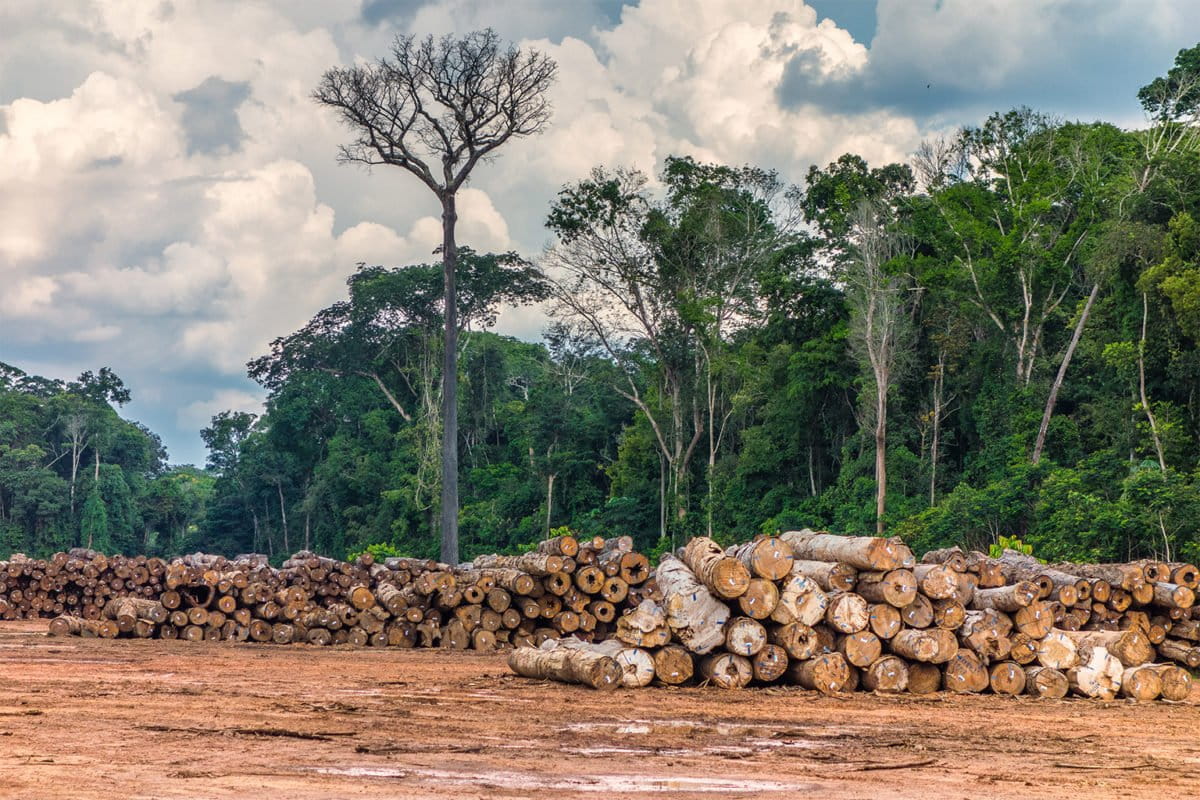
Between 2002 and 2015, forest loss in Brazil’s southern Amazon reduced the amount of rainfall during the dry season by more than 5%, a recent study found.Researchers studying how deforestation in the states of Rondônia and Mato Grosso affected the atmospheric water cycle between 2002 and 2015 found that a reduction in forest cover reduced evapotranspiration and disrupted regional atmospheric systems.Lower rainfall during the dry season can compromise crops, boost wildfires, and reduce water supplies and river levels, sometimes leaving communities isolated.
See All Key Ideas
In Brazil’s southern Amazonian region, where the notorious “arc of deforestation” has been expanding since the 1970s, forest loss is reshaping the region’s atmospheric water cycle. As the Amazon Rainforest releases moisture into the atmosphere, it fuels the rains that feed rivers, crops, wildlife and communities. But as deforestation disrupts the water exchange between forest and atmosphere, it significantly reduces the amount of rain in the dry season, researchers have recently found.
The team from Nanjing University, China, and the University of Leeds, U.K., analyzed how deforestation in the states of Rondônia and Mato Grosso — which together are responsible for about 30% of all deforestation in the Brazilian Amazon in recent decades — affected the atmospheric water cycle between 2002 and 2015. They found that a 3.2% mean loss of forest cover led to a 5.4% reduction in dry season rainfall, highlighting that precipitation in the Amazon is highly sensitive to changes in forest cover.
Deforestation deals a “double whammy” of blows to the climate, Dominick Spracklen, study co-author and professor of biosphere-atmosphere interactions at the University of Leeds, told Mongabay by phone. In addition to reducing how much water vapor is pumped into the atmosphere via evapotranspiration, deforestation also weakens the atmosphere’s ability to pull in water vapor from other regions.
By altering how Earth’s surface absorbs and reflects heat, deforestation led to warmer, drier air above the study area. This dry air impaired atmospheric convection, a process that moves warm air up and brings cool air down and plays a crucial role in transporting heat and moisture through the atmosphere. Weaker convection pulled even less moisture from other regions into the study area, further increasing atmospheric dryness. The reduction in atmospheric moisture from other regions was responsible for 76% of the observed drop in dry-season rain, the authors found.
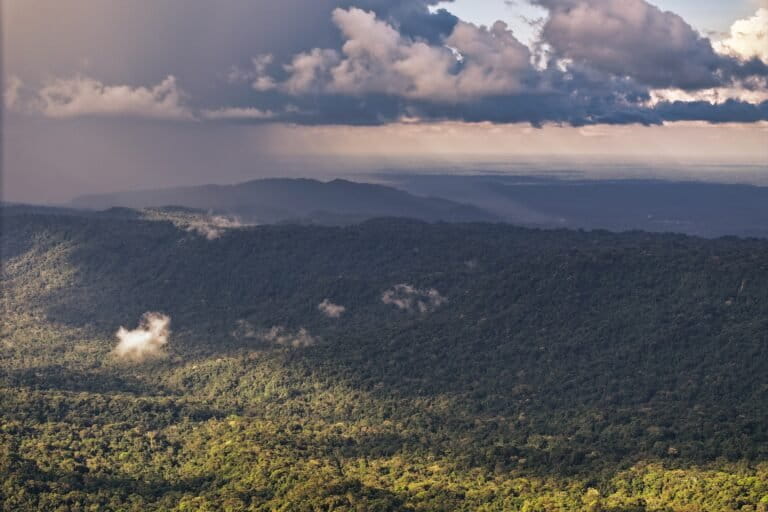 The Amazon Rainforest plays a critical role in the region’s water cycle. Image by Rhett A. Butler / Mongabay.
Warmer, drier air also slashes the amount of water vapor that can be recycled as rain, lowering precipitation efficiency — the ratio between the moisture in the air that could turn into rain and the amount of rain that actually falls. Alongside convection, reduced precipitation efficiency is one of the main drivers behind reduced rainfall in the dry season.
Such a decline can have wide-ranging impacts, including a rise in forest fires, poor agricultural yields, and water shortages. The latter can bring rivers to unnavigable levels, making life difficult for local communities. According to Spracklen, people in remote villages complain they can’t access the waterways they use every day. “There are communities where temperatures have gone way above what we’ve seen in living memory, and the cause is a combination of global climate change and deforestation.”
The researchers combined satellite data with climate models to observe how interactions between the land and atmosphere changed in response to forest loss. They relied on a single regional climate model, a limitation that Spracklen said could be improved in the future by using multiple climate models to test how robust their results are.
While the study found that the atmosphere responded to deforestation year-round, the researchers focused on the dry season between May and October, when changes in precipitation are most pronounced and have the biggest impacts on agriculture and local communities.
“Drying in both the wet season and dry season is going to have impacts on things like soybean production, fires, and … on the local community,” Spracklen said. “But we focused on the dry season, when these reductions are extra important.”
According to Ane Alencar, science director at the Amazon Environmental Research Institute (IPAM), those consequences aren’t some obscure, future problem — they’re already here. In 2023 and 2024, Brazil endured one of its worst droughts in decades, which affected 59% of the country. Water shortages and unprecedented wildfires took a toll on communities and ecosystems. In 2024 alone, fires affected 3.25 million hectares (8.03 million acres) of primary tropical forest in Brazil.
“Forest fires really used to be a rare thing in a tropical forest,” Alencar told Mongabay. “For the first time in 40 years, we saw the forest class burn more than all the other classes of native vegetation.”
According to Alencar, tropical forests aren’t fire-adapted ecosystems. Burned trees that are unable to survive may fall, allowing light and heat to penetrate the canopy and leave the forest warmer, drier and even more flammable during the next dry season. Millions of people living in cities endure smoke each year from these fires, with some already marginalized groups particularly vulnerable, Alencar said.
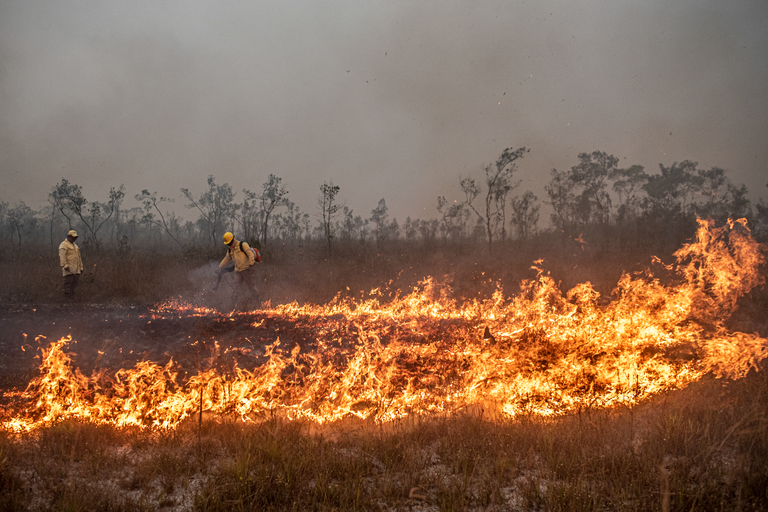 In 2024, Brazil faced its worst fire season in 14 years. Forest loss contributing to drier air plays a key role in boosting fire risk across the Amazon Basin. Image courtesy of Mayangdi Inzaulgarat/IBAMA.
“Indigenous communities, traditional communities, and those living in the periphery of Amazonian cities … these groups are suffering more with the effects of heat waves, droughts, floods and fires,” she said.
The high cost of agricultural expansion
In Rondônia and Mato Grosso, most fires are set by farmers clearing land for pasture.
“Agriculture is the major driver of deforestation in this region,” Spracklen said. “Nothing else comes close.”
Alencar said land grabbers also burn forests to signal ownership and claim territory, perpetuating an illicit cycle of clearing and land speculation.
Yet clearing forests undermines agricultural productivity. The study warns that reduced rainfall made worse by deforestation dries soils and stresses crops. Other research has predicted that continued deforestation and its impacts on rainfall could cost Brazil hundreds of billions of dollars in agricultural losses by 2050. Effectively, by destroying the Amazon, agribusiness is undermining its own viability.
Regina Rodriguez, a climate scientist at Brazil’s Federal University of Santa Catarina, said climate change is also altering the timing of the rainy season, disrupting life for local and Indigenous communities who rely on subsistence agriculture.
These changes mean the communities lose the markers they rely on to plant and harvest, Rodriguez told Mongabay by email. When rivers become too low to navigate, they can also be cut off from schools, health services and markets. “Any changes in the timing of the rainy season have disastrous impacts on their ability to survive,” Rodriguez said.
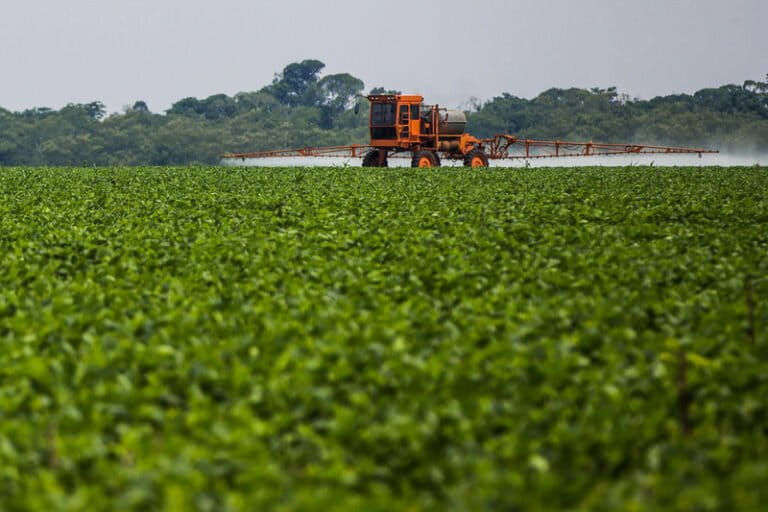 A sprayer deploys pesticides on a soybean plantation in Mato Grosso, a state in the Amazon Arc of Deforestation. Agriculture is one of the main drivers of forest loss that affects the water cycle in the region. Image © Bruno Kelly/Greenpeace.
Spracklen said conversations about curbing deforestation must give farmers a seat at the table.
“We need to be able to communicate to farmers that by just allowing these forests to exist, [forests] are providing the moisture that waters your crops and your livelihood,” he told Mongabay. “Farmers hate to see unplanted land be wasted … it’s about resetting the conversation, and showing them that these forests do an important job.”
The authors of the study are currently conducting a follow-up study on deforestation’s impact on rainfall since 2015. Between 2015 and 2024, Rondônia and Mato Grosso lost about 1.75 million hectares (4.32 million acres) and 4.03 million hectares (9.96 million acres) of primary forest, respectively. Research from the Federal University of Rio de Janeiro shows that in the southern Brazilian Amazon, annual maximum temperatures are sharply increasing, and the dry season is becoming longer and harsher.
Rodriguez said solutions must pair local and global actions. “The number one policy is to make the transition to greener energy by stopping the burning of fossil fuels. The number two is to stop deforestation.”
She called on policymakers to make contingency plans for drought, help improve extreme weather forecasts, and implement sustainable water management to help communities adapt.
Though reforestation can restore some ecological functions, Spracklen said protecting remaining primary forests takes precedence. Once the trees are burned or cleared, recovery can be slow and incomplete. “It’s a lot like triage. You’ve got to deal with the deforestation first, before you think about recovery,” he told Mongabay.
“We’ve got this very short period to get this right,” he added. “Once [the rainforest] is gone, we will look back with a lot of regret.”
Citations:
Liu, Y., Spracklen, D. V., Parker, D. J., Holden, J., Ge, J., & Guo, W. (2025). Recent forest loss in the Brazilian Amazon causes substantial reductions in dry season precipitation. AGU Advances, 6(2). doi:10.1029/2025av001670
Leite-Filho, A. T., Soares-Filho, B. S., Davis, J. L., Abrahão, G. M., & Börner, J. (2021). Deforestation reduces rainfall and agricultural revenues in the Brazilian Amazon. Nature Communications, 12(1). doi:10.1038/s41467-021-22840-7
Luiz-Silva, W., Bazzanela, A. C., Dereczynski, C. P., Oscar-Júnior, A. C., & Raupp, I. P. (2025). Temperature and precipitation extremes in the Brazilian Legal Amazon: A summary of climatological patterns and detected trends. Atmosphere, 16(2), 222. doi:10.3390/atmos16020222
Banner image: Logging activity in the Brazilian state of Rondônia. Image courtesy of Vicente Sampaio/Imaflora.
FEEDBACK: Use this form to send a message to the author of this post. If you want to post a public comment, you can do that at the bottom of the page.
