
$11.6 billion.
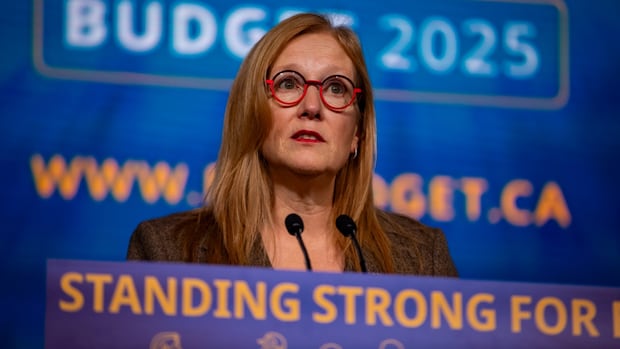
That’s how much the provincial government is in the red, a record high deficit forecast for the current fiscal year, laid out by Finance Minister Brenda Bailey in the first quarter financial results Monday.
By next year, the deficit is set to rise to $12.6 billion.
“While the province’s diverse economy is showing some signs of weathering the economic headwinds we’re facing, our financial bottom line isn’t immune to the impacts of uncertainty being felt in the global economy,” Bailey said in a statement.
It’s a worse financial picture than the $10.9-billion deficit forecast in the provincial budget.
February’s budget did not take into account the loss of the carbon tax, which blew a $1.8-billion hole in government revenues.
Bailey said the government is also grappling with decreases in other revenue sources, such as lower-than-expected prices in commodities like natural gas, copper and coal, and lower stumpage rates in forestry.
And the housing market has cooled — with home sales down by 5.6 per cent so far this year — which is good news for first-time home buyers but bad news for the government in terms of lower property transfer taxes.
The government is also facing higher-than-expected wildfire costs and is still awaiting a payment from the federal government’s disaster funding contributions.
Where the province reported a bump in revenue is from B.C.’s $2.7-billion share of the $32.5-billion lawsuit settlement against tobacco companies. The B.C. government has only actually received $936 million of its total, but is accounting for revenue that will come over the next 18 years.
Bailey denied that the government is trying to pad its books this year and said accounting for future revenue is a “standard accounting treatment.”
“This isn’t a magical number out of nowhere. This is a legal case. These assets are coming from the work to hold tobacco companies accountable for the harms they’ve caused,” she said.
B.C. Conservative finance critic Peter Milobar accused the government of misleading British Columbians by blaming the ballooning deficit on global tariffs. He said the real issue is “reckless mismanagement.”
“This is a government that’s desperate to try to paint a picture that’s better than it actually is,” Milobar said.
Ryan Mitton, the Canadian Federation of Independent Business’s director of legislative affairs for B.C., said the province’s financial picture “is setting off alarm bells” for small businesses, which are already struggling with the uncertainty caused by tariffs.
“There’s not a lot of light at the end of the tunnel.”
Bailey said the province is on track to cut $1.5 billion in government expenses over the next three years, with $300 million in cuts this year.
She said the savings come from a reduction in administrative costs, such as general office expenses, travel and discretionary advertising, and that a government hiring freeze has decreased the number of government employees by 850 people.
Bailey said most of those reductions came through attrition, but she did not rule out layoffs.
“The question of whether we’re going to see further reductions in public service workers … there is work afoot in each ministry to look at reductions,” Bailey said. “Some of that work may lead to some job loss. But we’re doing this as sensitively as we can.”
Earlier this year, Bailey announced a whole-of-government spending review, ordering ministers to find savings in their ministries. The health authorities have also been cutting administrative spending. Both Bailey and Premier David Eby have said the focus was on cutting bureaucratic spending while preserving front-line services.
“It’s important to us that we protect the critical programs that British Columbians rely on,” Bailey said Monday.
The provincial debt is now sitting at $155 billion.
Bailey’s update comes amid strike actions by members of the B.C. General Employees’ Union (BCGEU), which represents about 34,000 public service workers across B.C., and the Professional Employees Association.
Paul Finch, BCGEU president, said in a statement the financial update “confirms what we’ve been saying all along:
Investing in public service workers is critical for sustaining the services British Columbians rely on and to driving B.C.’s economy forward— in particular in our resource sectors.”