
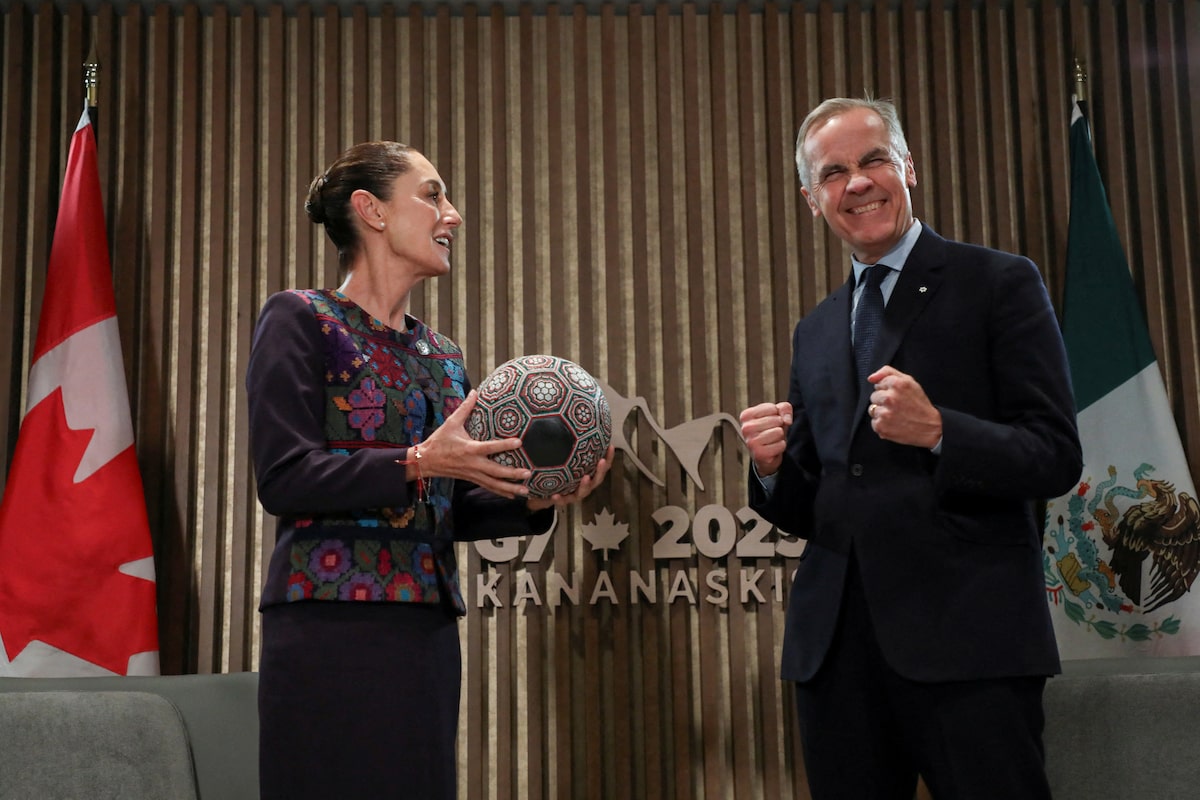
Prime Minister Mark Carney is set to meet with Mexican President Claudia Sheinbaum at the National Palace in Mexico City.Amber Bracken/Reuters
Mark Carney heads to Mexico this Thursday as part of his push to expand trade with countries beyond the United States, a visit that will also serve to patch up strained ties with one of Canada’s top five export markets.
The Prime Minister’s two-day trip is the latest effort, after three visits to Europe, to diversify trade away from the increasingly protectionist United States under Donald Trump.
When Mr. Carney meets with Mexican President Claudia Sheinbaum at the National Palace in Mexico City, both leaders will likely have in mind several incidents from 2024 that they would prefer to put behind them.
Last November, Mexicans were upset when Canadian politicians including Ontario Premier Doug Ford and Alberta Premier Danielle Smith publicly talked of cutting Mexico out of the continental free-trade deal, the United States-Mexico-Canada Agreement, and instead striking a bilateral deal with Washington. Then-deputy prime minister Chrystia Freeland also declined to rule out a separate bilateral deal with the United States when asked about the Ontario Premier’s comments.
Opinion: The USMCA agreement may be circling the drain. Time to fill the trade sink elsewhere
In tougher times, Parliament returns with Carney’s agenda at stake
Mr. Ford compounded Mexicans’ anger with comments he made when he rejected Mr. Trump’s plan to impose sweeping tariffs on both Canada and Mexico.
“To compare us to Mexico is the most insulting thing I’ve ever heard from our friends and closest allies, the United States of America,” the Premier said last November.
Laura Macdonald, a Carleton University professor of political science, said Mr. Ford’s comments in particular caused an uproar both in Mexican media but also in government circles.
She said Mexicans didn’t expect Canadian to engage in “this kind of rhetoric, almost racist rhetoric, against Mexicans in the way that they would expect from the Trump administration.”
Last summer, Canada’s then-ambassador to Mexico, Graeme Clark, sparked ire by saying investors were concerned about the country’s decision to change its judicial system to elect judges, including Supreme Court justices, by popular vote. These comments and similar ones from the U.S. envoy to Mexico prompted then-president Andrés Manuel López Obrador to announce he had temporally paused relations with Canadian and U.S. embassies in his country.
The difficult year for Canada-Mexico relations began in February, 2024, with Ottawa imposing a visa requirement on Mexican visitors to address a surge in asylum claims from Mexico.
Business Council of Canada chief executive Goldy Hyder said Mr. Carney’s decision to invite Ms. Sheinbaum to the Group of Seven meetings this June in Alberta was a good start to mending fences.
“We’ve had some repairing to do with this relationship,” he said.
“The trip to Mexico City will go a long way to deepening ties and allowing the past to be the past.”
Mr. Hyder said the Canada-Mexico relationship has at times been lukewarm as both countries focused on their ties with the United States. “But it’s become quite clear it’s in our mutual interest to diversify − we share a continent together and we don’t do nearly enough with this market of 130 million people.”
Opinion: Carney is looking for lost business potential in Mexico
He said natural gas exports are one way Canada and Mexico could deepen two-way trade through the second-phase expansion at the LNG Canada export terminal. “More than 70 per cent of Mexico’s natural gas comes from the United States and they don’t want to be that dependent – we can help with that.”
Ms. Macdonald said she expects Mr. Carney and Ms. Sheinbaum will also use their time together to strategize on how to approach the scheduled five-year review of the USMCA that takes place shortly.
“Both would prefer just to continue the existing agreement and hold firm against a complete review or rewriting of the agreement. So that’s a really strong element of continuity between the two governments’ positions.”
One senior Canadian government official said Ottawa’s approach now is not to regard Mexico as another spoke in the U.S. hub − meaning, a country that is important to Canada because it’s important to the United States − but rather as a significant trading partner with which it wants to maximize business ties. The Globe is not identifying the official because they were not authorized to discuss the matter publicly.
Canadian companies such as TC Energy Corp. and Bombardier Inc. have a significant presence in Mexico. TC Energy built the Southeast Gateway pipeline, a US$3.9-billion, 715-kilometre offshore pipeline that will deliver natural gas to power plants in Mexico’s southeast region. Bombardier has significant manufacturing operations in Mexico.
Like Canada, Mexico is in the midst of rolling out an industrial and trade strategy − Plan México − to diversify its economy in the face of Mr. Trump’s protectionism.
Mr. Carney and Ms. Sheinbaum are expected to issue a statement expressing their interest in mutual investment and policy priorities such as energy, mining, mitigating climate change and mobility between the two countries, although this has not been finalized, two sources say.
A Mexican official, speaking on background, said Mexico is eager to attract Canadian investment as it modernizes six of its ports and assembles a new shipping route with its Interoceanic corridor that runs a railway line between the Pacific port of Salina Cruz and the Atlantic port of Coatzacoalcos on the Gulf of Mexico.
A second Mexican official, also speaking on background, said Mexico would like to boost agricultural sales to Canada, increase two-way tourism and raise the amount of Canadian business investment in the country. The Globe is not identifying the officials because they were not authorized to discuss the matter publicly.