
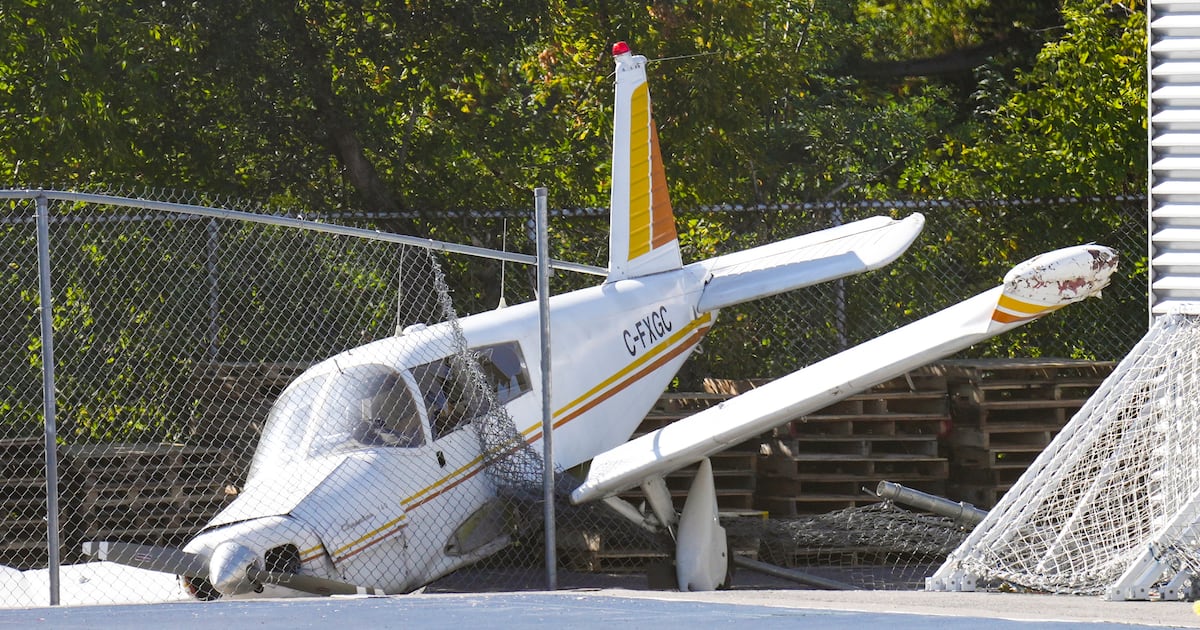
CP24’s Courtney Heels reports from the scene of a small plane crash in East York and what caused the malfunction.
A small plane that crash landed in Toronto’s east end on Monday night experienced engine failure, the Transportation Safety Board (TSB) of Canada says.
At around 8:15 p.m., a single-engine aircraft with three occupants crashed in a parking lot near a sports field at Monarch Park Collegiate Institute, which is located near Danforth and Coxwell avenues.
In a statement provided to CTV News Toronto on Tuesday, TSB said the Piper PA-28-140 aircraft departed from Orillia and was headed to Billy Bishop Toronto City Airport with a pilot and two passengers onboard when it experienced an engine failure that resulted in the crash-landing.
Spokesperson Nic Defalco said no injuries have been reported.
Investigators with the independent agency was at the scene on Monday night, he said, to assess the site and begin the process of interviewing witnesses and those involved in the incident.
‘I’m landing at a soccer field’
Air traffic control audio captured by LiveATC.net, a site that monitors aircraft communications, reveals the moments before the plane crashed.
“City centre, I think I might have an engine failure,” the pilot of the plane is heard over the radio telling the tower operator at Billy Bishop Airport.
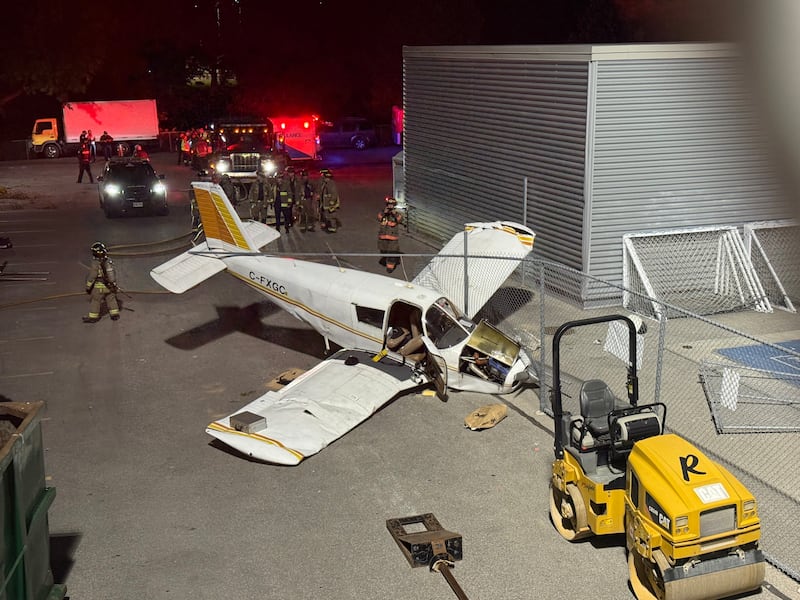 Plane crash Sept. 15 east Toronto No injuries have been reported after a plane crashed in Toronto’s east end on Sept. 15. (Sam Obeid/CTV News Toronto)
When the traffic controller asked if they could make it back to the airport, the pilot replied, “No.”
A short time later, after informing the controller that there were three people on board, the pilot said they could not see anywhere to land.
The controller then asked, “Can you make… it find a highway, or a street that doesn’t seem very busy, or a park or something?”
“I’m looking,” the pilot replied.
A few seconds later, the pilot informed traffic control, “I’m landing at a soccer field. There are people though.”
“Can you maybe find a gap with no people?” The traffic controller asked but the pilot did not respond after that.
Speaking with CP24 on Tuesday morning, CTV’s aviation expert Phyl Durdey said images of the plane from the scene show its propeller is not bent, which he explained is an indication the aircraft experienced engine failure.
“(The aircraft) was stopped at the time of impact,” he said, adding that one of the key aspects of private pilot training is practicing forced landings.
“So if the engine has failed what are we going to do? And we practice it over and over again. So we’re going to look for a place to land,” said Durdey.
“You know, that’s why sometimes you see aircraft landing on highways, because they’ve got to put it down somewhere, and they want to go away from a populated area. Maybe the pilot was looking at that football field, we’re not sure, but she will be interviewed.”
 Phyl Durdey Sept. 16 CTV’s avaition expert Phyl Durdey speaks with CP24 about a small plane crash in Toronto’s east end on Sept. 15.
Several people who saw and heard what happened have said the plane was quiet as it descended and that they only heard a thud when it crash landed.
“When the engine fails, basically you’re in a gliding mode. So the pilot is going to trim the aircraft to 70 miles an hour or 61 knots, which is the optimum glide speed, they’re going to be about 1000 feet above the highest obstacle,” Durdey explained.
“The pilot is going to be looking for a place to land. So it’s going to maintain that glide, and it’s going to be very quiet, because there’s no engine running. It’s going to be a quiet descent.”
He noted this type of aircraft won’t have a black box, a flight data recorder, so the pilot will need to be interviewed to determine exactly what caused it to go down.
He also pointed to the forensic investigation that will be conducted by the TSB.
“What they’re going to be doing is going to be checking the fuel. They’re going to be checking the engine itself. They’re going to be disassembling the engine to see what, in fact, caused the engine failure,” Durdey said.
“They’re going to start looking at every little piece, but it’s looking the main focus right now is going to be fuel and engine.”
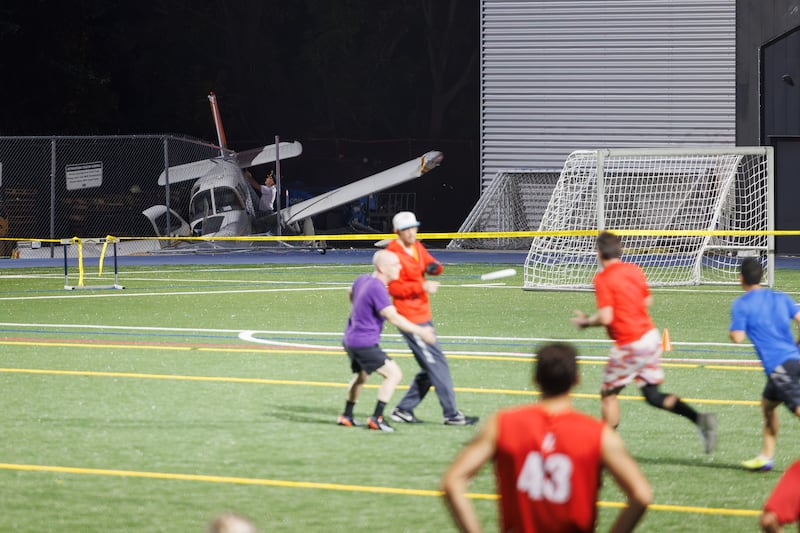 Plane crash Sept. 15 east Toronto Ultimate frisbee players continue their game after a plane crashed just metres away in Toronto’s east end on Sept. 15. (Jacob Estrin/CTV News Toronto) Fire chief said plane came through trees and skidded into a fence
Toronto Fire Chief Jim Jessop told reporters at the scene on Monday night that the aircraft appeared to have come through the tree canopy and skidded into a fence about 50 feet away from a field where people were playing soccer.
Jessop said at the time that he had yet to speak with the aircraft’s occupants, whom he described as being in their mid-30s to 40s.
“We have deemed the situation under control so there is no risk to the public,” said Jessop.
Paramedics were among the first emergency responders at the scene and reported smelling gas and fuel. Toronto fire’s hazmat team quickly responded to address this issue, locating a small amount of fuel that was leaking and promptly containing it.
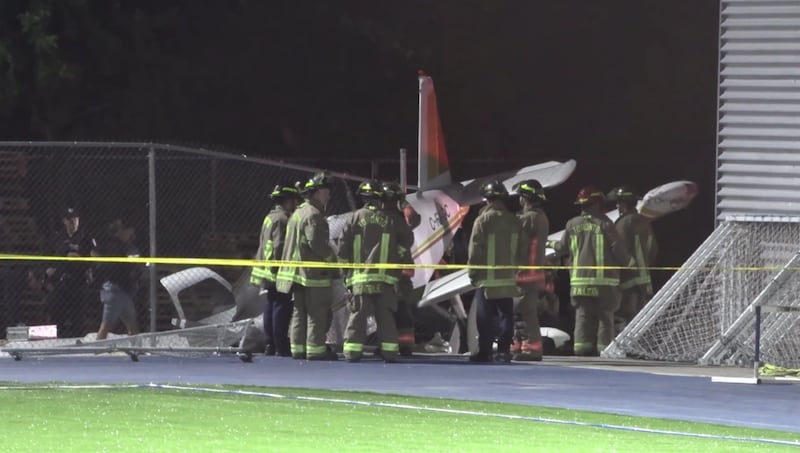 Plane Crash Monarch Park No injuries have been reported after a plane crashed in Toronto’s east end on Sept. 15. (Jacob Estrin/CTV News Toronto)
According to TSB, the aircraft was rented from Flightclub (FC), an aviation marketplace platform that connects plane owners and pilots looking to fly regularly.
In a statement, the company’s co-founder and CEO said they’re aware of an incident involving a Canadian-registered Piper Cherokee.
“The four-passenger certified aircraft conducted a forced approach and landed safely near Monarch Park Collegiate Institute, in the East Danforth area, with no injuries to the three souls onboard or any persons on the ground below,” Mathew Fernandez wrote.
“Upon initial review, the forced approach appears to have been executed with great proficiency and focus. When aviation incidents occur, pilot competency is consistently the largest factor in determining the survivability of the event and the protection of life and property.”
Fernandez went on to say that their mission at FC is to “help pilots fly regularly, as increased flight hours and recurrent experience leads to safer, and more competent pilots,” adding that “freedom of the skies is an incredibly uplifting pursuit, but it does come with its risks.”
“Aircraft and pilots that don’t fly regularly are statistically far more likely to be involved in accidents which result in fatalities. We are grateful that tonight, these risks didn’t amount to any loss of life,” he said, adding that FC is cooperating with authorities, is aiming to implement additional safety measures where possible, and will be closely studying the causes of this incident.
“We are grateful to all the citizens and first responders that assisted with this incident. We will refrain from further commentary, as the Transportation Safety Board of Canada carries out its accident investigation.”
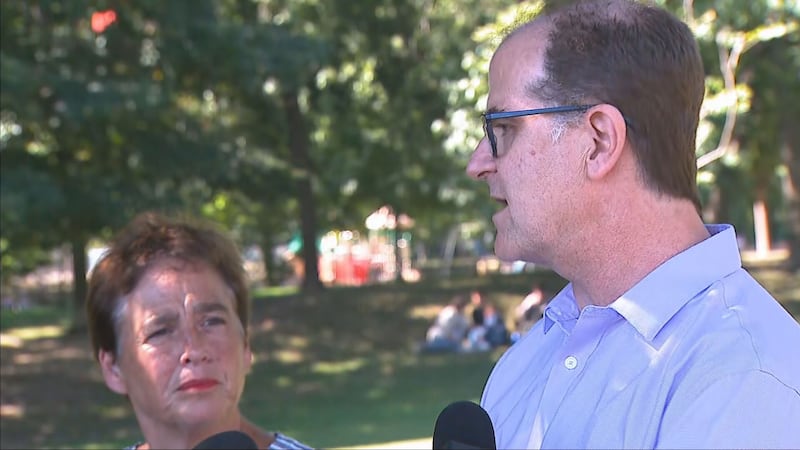 Kenn Harvey, Shari Schwartz-Maltz Kenn Harvey, the interim principal at Monarch Park Collegiate Instutute, stands next to TDSB spokesperson Shari Schwartz-Maltz during a media availability following a Sept. 15 plane crash on school property.
Classes, meanwhile, continued as usual on Tuesday at Monarch Park Collegiate Institute.
Kenn Harvey, the school’s interim principal, told reporters this afternoon that he lives in the area and came over about an hour after the incident occurred.
“When I got here everything was calm. Police were on scene. Fire was on scene. There were community members, but you know, we were glad to find out that there were no injuries, that the people were unharmed in the plane, and hugely thankful that nobody on the field, because there were people playing on the field at the time, was injured. That was our number one concern,” he said.
“And then we were able to pretty quickly determine that there was no damage to the facility so school would be able to operate this morning as per usual.”
Board spokesperson Shari Schwartz-Maltz said there was a “collective sign of relief” when they learned that no one had been hurt in the crash.
Schwartz-Maltz noted that Monday was the first day this school year that students had been permitted to use the sports field, adding that due to the TSB probe, it will likely be out of commission for some time.
The Transportation Safety Board of Canada said crews attended the scene of the crash today and chopped up the wreckage, removing it on a flatbed truck.
With files from Bryann Aguilar