
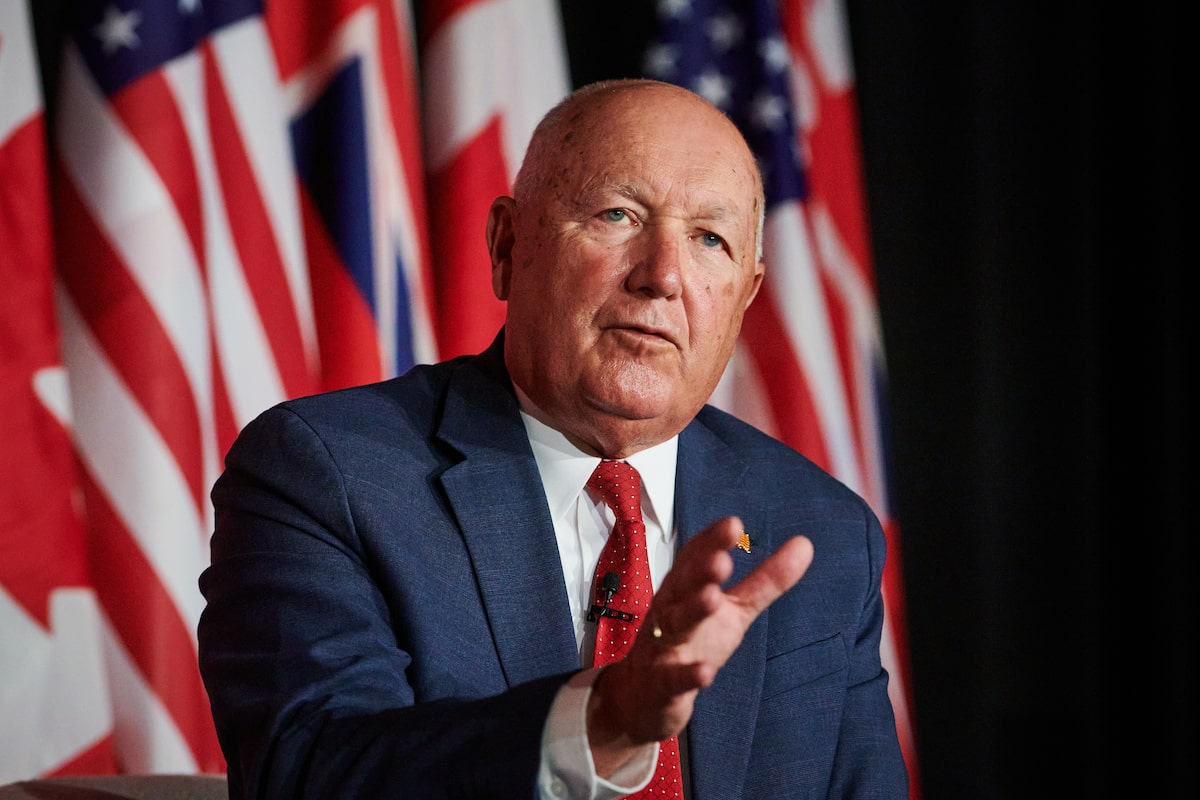
U.S. Ambassador to Canada Pete Hoekstra says the White House was aiming to make a deal that encompassed more than what the USMCA covers.Sammy Kogan/The Globe and Mail
The Trump administration had hoped to negotiate a grander bargain with Canada than simply a renewal of the United States-Mexico-Canada Agreement but it doesn’t seem possible at the moment, the U.S. ambassador to Canada said Tuesday.
Pete Hoekstra, speaking about the state of Canada-U.S. relations, said the White House had been looking for an agreement that encompassed numerous subjects, including defence.
“Americans were hopeful that we could negotiate a bigger deal,” Mr. Hoekstra told an Ottawa event hosted by the Canadian International Council on Tuesday.
“I mean, there is so much that we do together, where our economies are integrated, they graft off of each other and those types of things,” the envoy said.
“On trade, whether it’s energy, whether it’s automotive, whether it’s nuclear, defence and all of those types of things, we were hoping that we would not just renegotiate CUSMA, but that we could take it into being something much bigger,” he said, referencing the Canada-United States-Mexico Agreement, another name for the USMCA.
“It’s obvious, at least at this point in time, that that’s not going to happen,” Mr. Hoekstra said.
He did not fully explain what was preventing such a deal.
The fight to preserve North American trade is just beginning: A guide to the USMCA renewal talks
Mr. Hoekstra noted the United States was formally kicking off public consultations on the USMCA as Washington begins identifying what a revised trilateral deal would look like.
“At one point in time, there was a hope that it could have been a bigger agreement,” he said.
In March, Mark Carney talked of undertaking comprehensive negotiations on a new economic and security relationship with the United States but recently the Prime Minister has talked in smaller terms: of negotiating tariff deals with the U.S. in key sectors and renegotiating USMCA.
Talks between Canada and the United States stalled in the lead up to a Aug. 1 deadline imposed by Mr. Trump. Mr. Carney, who in late August dropped Canadian retaliatory tariffs on some U.S. products, told reporters Sept. 5 that he wants to secure some relief for strategic sectors battered by U.S. tariffs, but he stressed there is no certainty that this will happen.
Since returning to office earlier this year, President Donald Trump has hit Canada with a string of tariffs: 50 per cent on steel and aluminum, 25 per cent on autos and 35 per cent on any goods traded outside the USMCA, with the exception of oil, gas and potash, at 10 per cent. His administration has also significantly hiked duties on Canadian softwood.
Mr. Trump has said the U.S. doesn’t need Canadian autos despite the fact this country’s vehicle assembly and auto parts industry are highly integrated with the U.S. market and North American-produced products normally travel tariff-free between countries.
Asked how he saw the future of the Canada-U.S. relationship when it comes to automobiles, Mr. Hoekstra pointed to Mr. Trump’s trade deal with Britain where the U.S. set a 10-per-cent tariff on British autos for the first 100,000 vehicles shipped to the United States each year. U.S. tariffs rise to 27.5 per cent for each car beyond 100,000 units.
U.S. takes first official step in launching USMCA review
He said Canada exports roughly 400,000 more vehicles to the United States each year than it imports from the U.S.
“Using what we’ve done as a model, it’s very possible that, you know, the 400,000 units that go to the U.S. today will come in at a lower tariff rate,” Mr. Hoekstra said. “But if you’re starting to go to 450,000, 500,000 in all of those, you’ll pay a higher tariff.”
He predicted some industrial capacity will end up relocating to the United States from other countries.
“We understand the economics and how you’ve built your economy around those types of things, but over a period of time, in some of these critical industries, you know, we’re going to see some of that moving back into the United States.”
Flavio Volpe, president of the Automotive Parts Manufacturers’ Association, responding to Mr. Hoekstra’s comments, said the numbers cited by the envoy don’t tell the whole story. He pointed to the U.S. components that go into the cars made in Canada and then are exported to the United States.
“The ambassador is from Michigan, he knows that the U.S. surplus in annual auto parts shipments to Canada more than makes up the difference.”
Mr. Hoekstra praised Canada, however, for measures it took on China, including the 100-per-cent tariffs Ottawa imposed on Chinese-made electric vehicles in 2024 and the 25-per-cent levies on Chinese steel and aluminum.
Canada took this measure in concert with the United States, justifying the tariff by accusing China of subsidizing and overproducing electric vehicles and flooding global markets. China has retaliated against Canada since, imposing hefty tariffs on canola, seafood and agricultural products − levies that are hurting Canadian producers.
Mr. Hoekstra said the U.S. has concluded China is an economic and military threat. He cited Beijing’s partnership in helping Moscow wage war in Ukraine as an example.
The envoy said Washington appreciates Canada’s trade actions on Chinese EVs and steel. “We very much appreciate the decision that Canada has made, and we recognize the cost that you are paying for that,” Mr. Hoekstra said. “It’s contained China; let’s work on this stuff together, and we will recognize the economic impact that it has had on Canada.”