
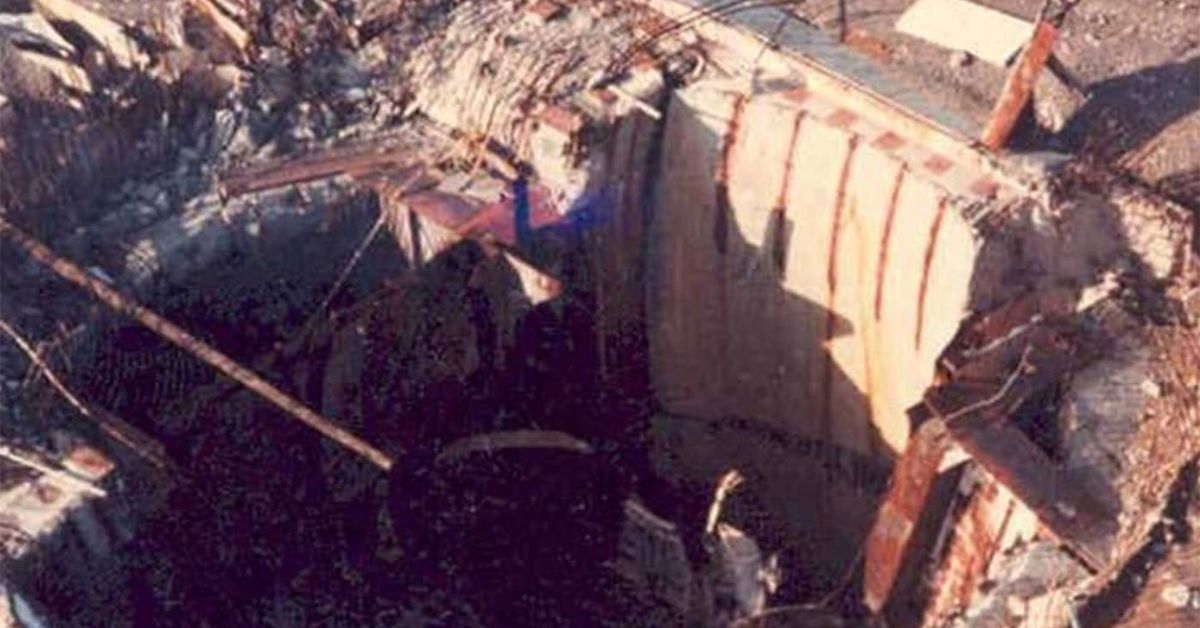
A forgotten torque wrench on September 18, 1980, led to a blast that nearly set off a nuclear warhead.
An airman at a missile silo in the US state of Arkansas was doing a check on a Titan II missile with a ratchet spanner instead of a torque wrench.
As a result, a 3.6kg socket fell 24m down the silo before piercing the side of the missile’s fuel tank.
 Authorities planning their next move after the explosion. (Getty)
A cloud of rocket fuel then started leaking into the enclosed space, filling the confined space with explosive gas.
When an exhaust fan was switched on hours later, it created a spark that set off an explosion.
The initial blast was so powerful it sent a 750-tonne silo door flying.
“It was the loudest explosion I’d ever heard in my life—before or since,” airman Greg Devlin told Popular Mechanics.
“A concussion of wind hit me like a truck, and I slid 60 feet, and every foot, it felt like I was going faster. The only thought I had at that point was, ‘I know I’m a dead man. I just hope it doesn’t hurt.'”
Witnesses said after the initial blast, there was a brief pause, then a bright red flame shot 60 metres in the air.
A W53 thermonuclear warhead was thrown 30m from the silo and hit the ground.
 The explosion caused a major scare among residents in Arkansas. (Getty)
The warhead had enough power to set off a 9000-kiloton blast.
For contrast, the Hiroshima bomb was just 15 kilotons.
But fortunately, the warhead was not triggered by the impact.
Had the bomb gone off, it likely would have wiped out the city of Little Rock and created radioactive fallout extending across the US south.
Instead, just one man was killed and 21 others were injured in the blast.
 The Strategic Air Command Facility at Little Rock Air Force Base, in Arkansas. (Getty)
Both President Jimmy Carter and Arkansas Governor Bill Clinton assured the public there had been no radioactive leak.
The launch complex was never rebuilt.
The missile silo was covered in earth and is now privately held land.