
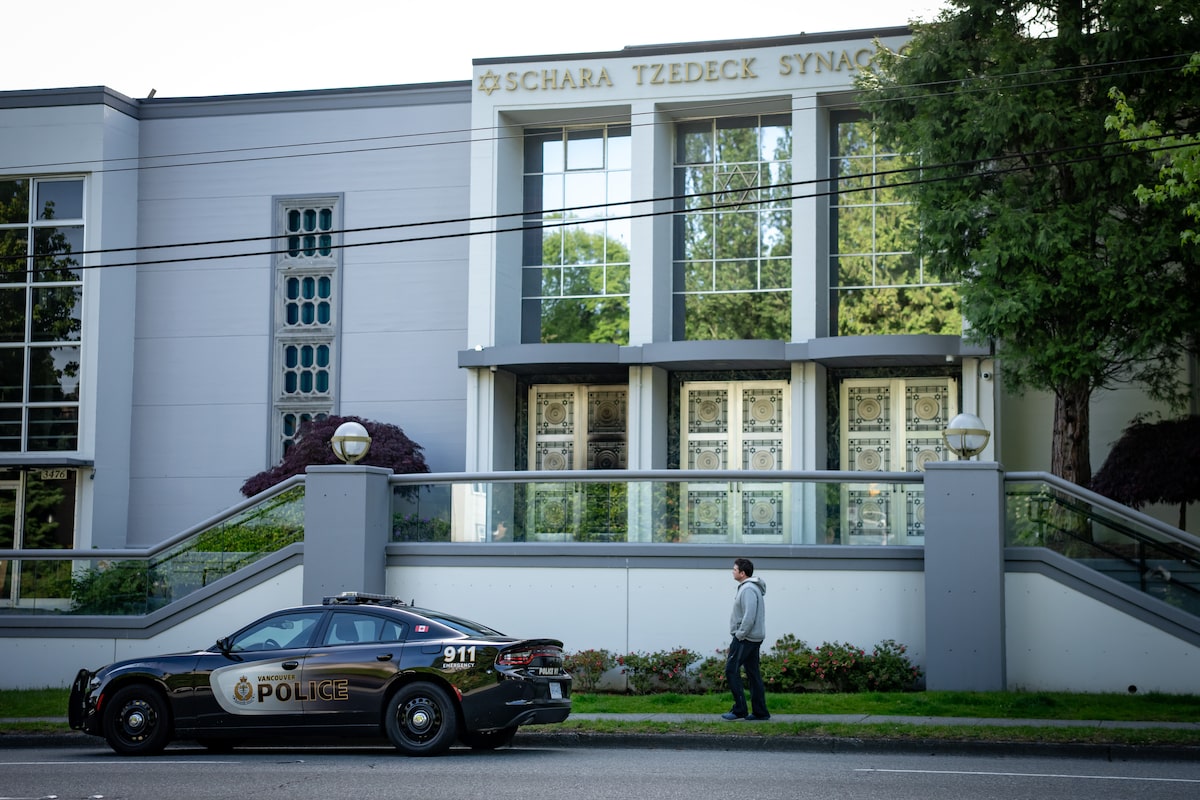
A new bill would make it illegal to wave hate symbols in front of places of worship, such as the Schara Tzedeck synagogue in Vancouver.ETHAN CAIRNS/The Canadian Press
A new anti-hate bill, to be introduced on Friday, is expected to make it a crime to intentionally promote hatred against Jews, Muslims and other groups by displaying symbols of terrorist groups in public, for example waving a Hamas, Hezbollah or swastika flag outside a synagogue.
A senior government source told The Globe and Mail that the coming bill, to be shepherded through the House of Commons by Justice Minister Sean Fraser, would make it a crime to intimidate or obstruct someone at a place of worship, a school, a community centre, or other places where Jews, Muslims, members of the trans community or another identifiable group gathers.
The Globe and Mail is not identifying the source as they were not authorized to speak on the matter.
The bill is also expected to make it easier for the police to pursue charges for a hate propaganda offence, including promoting genocide, by removing the requirement to get the attorney-general to approve laying charges first.
Hatred is referred to in laws but not defined in the Criminal Code, although it has been defined in cases before the Supreme Court, including as “detestation” and “vilification.” The bill is expected to define what constitutes hatred in the criminal code.
The source said the bill is designed to target hate toward specific groups, but not to dampen the right to protest in Canada. The bill would comply with the Charter of Rights and Freedoms, the source said.
Civil liberties advocates have argued that laws already exist to prevent violence, intimidation and harassment, including enabling the police to bring charges against protesters who obstruct safe access to buildings.
Anaïs Bussières McNicoll, director of the Fundamental Freedoms Program at the Canadian Civil Liberties Association, said “our concern is that if the federal government lowers existing thresholds they may very well end up capturing peaceful protests.”
“I would say that a level of disruption is part of the constitutional protection awarded to freedom of peaceful assembly, and to some extent and within reasonable limits, it is a price of living in a democracy,” she added.
“The Supreme Court of Canada has recognized that there is no room in a democracy for a right not to be offended. So again, freedom of expression and the right to peaceful assembly are not absolute, but we should all be very concerned of extending limits on those cornerstones of our democracy.”
The bill would establish buffer zones outside mosques, synagogues, community centres and religious schools to stop intimidation and harassment by protesters of people entering and leaving.
It is expected to make it a crime to intentionally promote hatred against an identifiable group by displaying certain terrorism or hate symbols in public. The terror groups would be those on an official list in Canada of proscribed groups including Hamas, Hezbollah, the Islamic State and the Tamil Tigers.
The law would likely ban waving a swastika flag outside a synagogue or Jewish community centre. But it would not extend to individuals, for example, dressing up on Halloween or appearing in a play or film dressed in Nazi uniform.
In Britain, it is already illegal to glorify terror, for example, by displaying an Islamic State flag at a protest.
The bill is not expected to go as far as measures in the online harms bill, which failed to become law in the last Parliament, and included raising the maximum sentence for advocating or promoting genocide against an identifiable group from five years to life imprisonment.
Its wording is expected to be closely scrutinized by civil liberties advocates who have challenged existing municipal and provincial bubble zone laws, saying they suppress the right to protest. The definition of what amounts to intimidation is expected to be debated in the Commons after the bill is presented.
Jewish community groups, who met with the Prime Minister this weekend, have been calling for more protection in law for community members amid a rise in antisemitism, harassment and violence.