
Sir Keir Starmer will this weekend formally recognise Palestine as a state after President Trump has concluded his state visit to the UK.
The prime minister has delayed the announcement until after Trump has left because of concern that the issue could otherwise dominate a news conference with the two men on Thursday at Chequers.
The US is strongly opposed to official recognition of Palestine and Trump has previously warned that it would serve to reward Hamas.
The UK is expected to press ahead with the move before a meeting of the UN general assembly in New York next week. Britain, France, Canada and Australia are among the nations expected to recognise Palestine at the assembly.
The divisions between the UK and the US over the issue are stark. Yvette Cooper, the foreign secretary, said that Israel’s military assault on Gaza City was “utterly reckless and appalling”.
She said: “It will only bring more bloodshed, kill more innocent civilians and endanger the remaining hostages.”

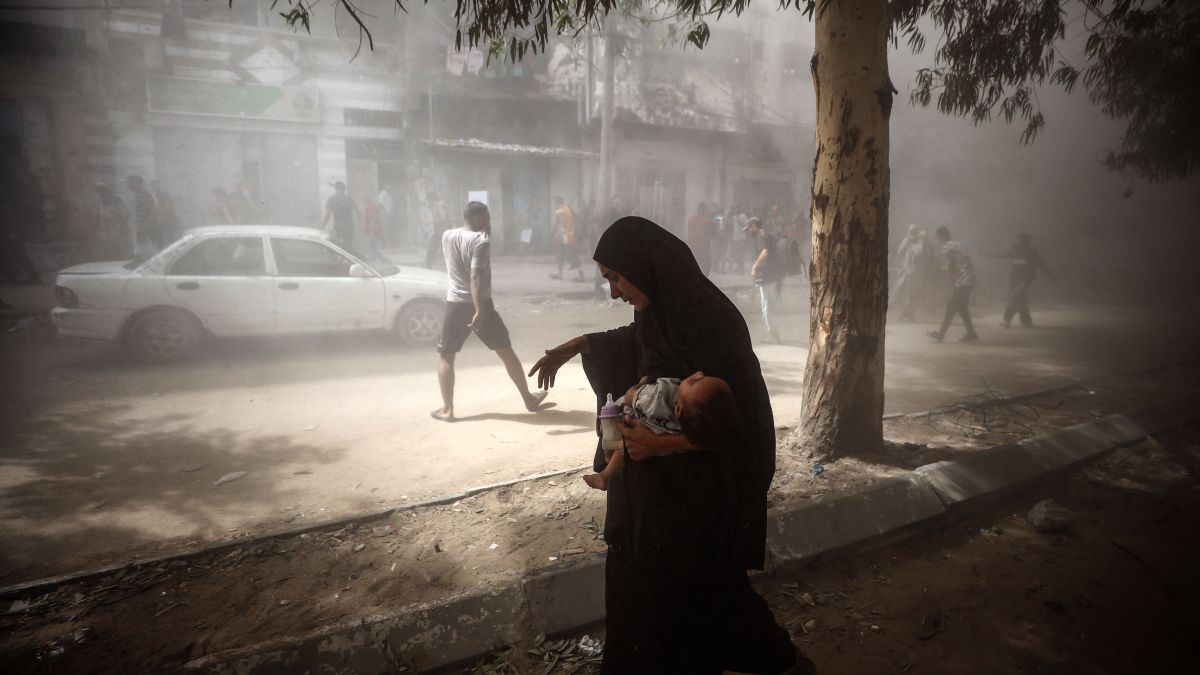
Displaced Palestinians flee northern Gaza
JEHAD ALSHRAFI/AP
By contrast Marco Rubio, the US secretary of state who has joined Trump’s visit to London, offered his support to Israel this week. He said that formally recognising Palestine as a state would make peace less likely.
He said: “It actually makes it harder to negotiate … because it emboldens these groups [Hamas].” He added that there would be an Israeli “counter-reaction to those moves”, comments that were seen as a reference to Israel attempting to annex occupied areas of the West Bank.
In July Starmer outlined Britain’s plans to recognise Palestine due to mounting concern in government over the deteriorating situation in Gaza.
He said that the UK would recognise Palestine unless Israel reached a ceasefire, committed itself to a two-state solution and made clear that it would not annex the occupied West Bank. Given Israel’s opposition to these terms, his comments mean that recognition of a Palestinian state is almost inevitable.
There is mounting pressure from the Labour Party — a third of the cabinet have been pressing the prime minister for recognition. More than 130 Labour MPs signed a letter backing it.
Starmer said that “this is the moment to act” because the situation in Gaza meant the imperative to recognise a Palestinian state was “under pressure like never before”.

The Palestinian Authority president, Mahmoud Abbas, with Starmer this month
TOLGA AKMEN/EPA
Earlier this year he said: “I’ve always said we will recognise a Palestinian state as a contribution to a proper peace process, at the moment of maximum impact for the two-state solution.
“With that solution now under threat, this is the moment to act. So today — as part of this process towards peace — I can confirm the UK will recognise the state of Palestine by the United Nations general assembly in September unless the Israeli government takes substantive steps to end the appalling situation in Gaza, agree to a ceasefire and commit to a long-term, sustainable peace, reviving the prospect of a two-state solution.
“This includes allowing the UN to restart the supply of aid, and making clear there will be no annexations in the West Bank. Meanwhile, our message to the terrorists of Hamas is unchanged and unequivocal.”
Britain imposed sanctions on senior members of the Israeli government earlier this year after describing the military expansion in Gaza as “intolerable”.
The government announced asset freezes and travel bans for Itamar Ben-Gvir, the Israeli security minister, and Bezalel Smotrich, the finance minister, in May. They were accused of fuelling attacks by settlers on Palestinian communities and using “horrendous extremist language”.
The sanctions mean that Smotrich and Ben-Gvir are banned from entering Britain. Financial institutions based in Britain are banned from dealing with them. They are similar to the sanctions imposed on senior Russian figures linked to the war in Ukraine.