
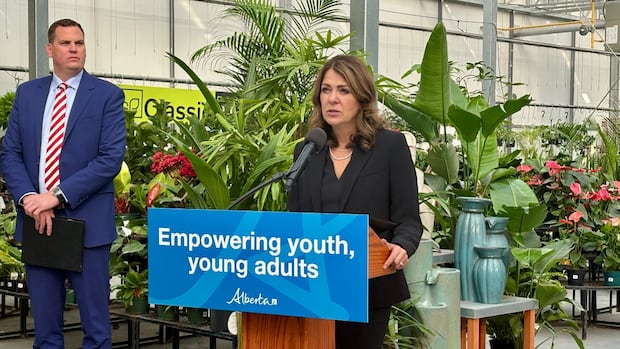
Premier Danielle Smith is directing the provincial jobs minister to use all legal means possible to give Alberta more control over immigration.
In a new mandate letter given to Jobs, Economy, Trade and Immigration Minister Joseph Schow, Smith says Alberta needs more control over immigration to ensure the province sees sustainable levels of newcomers.
“Our provincial immigration levels and policies should always ensure that Canadian citizens have first access to job opportunities, and that young Canadians are not losing out on employment opportunities to temporary foreign workers,” the letter says.
In an emailed statement, Schow said the federal government has neglected to give consideration to the feedback the Alberta government has provided about immigration.
“My ministry will be looking for opportunities to use our provincial authority for immigration to bring benefit to our economy, rather than following the federal model that has not met Alberta’s economic and labour needs, and brought unsustainable growth in schools, hospitals, and other critical services overseen by the province,” Schow’s statement said.
It did not explain what legal means the government might use.
His office also pointed to a Desjardins analysis, which finds an increased number of young immigrants are experiencing unemployment. The report also cites rising minimum wages, technological advances, relaxed rules for international students and cuts to public sector seasonal employment as driving rising youth unemployment.
The Constitution gives the federal and provincial governments joint jurisdiction over immigration. Anna Kuranicheva, an immigration lawyer at the Edmonton Community Legal Centre, said through joint provincial-federal agreements, such as the Alberta Immigrant Nominee Program, provinces can select which potential immigrants they think will best meet their labour market needs.
The federal government retains the final say about whether to admit those nominees, she said.
Under public pressure, the federal government last year pared back immigration targets and reduced the number of nominees the provinces can select. This year Alberta can nominate around 6,400 newcomers to become permanent residents. Kuranicheva said last year, Alberta could choose nearly 10,000 people.
If the province wanted to increase control over immigration, the Alberta government could change its nomination criteria, such as language proficiency, the occupations included, work experience or education requirements, she said.
Canada dependent on immigrants for labour
Daniel Bernhard, CEO of the Institute for Canadian Citizenship, says provincial governments are rightly miffed over losing control over the number of permanent residents they can handpick.
But it is “incorrect” to say that factors other than meeting labour needs are driving immigration, he said
“Canada needs immigrants far more than they need us,” he said.
 Daniel Bernhard is the CEO of the Institute for Canadian Citizenship. (Henry VanderSpek Photography)
To gain approval to hire temporary foreign workers, employers must prove they have previously posted jobs and been unable to fill them. Bernhard says there are now regions with high unemployment rates where new temporary foreign workers cannot come.
In combination with the decision to include a Canadian citizenship marker on provincially issued driver’s licences, Bernhard said the Alberta government is sending a troubling message.
“They’re very interested in engaging in a kind of culture war, or a heated cultural discussion, about immigration, even though it’s an area that provinces don’t have too much authority,” he said.
He says the government is also making negative insinuations about the effect immigrants have on the Canadian economy.
Many immigrants work in health-care and manual labour jobs that employers are unable to fill domestically, he said.
Critics concerned about targeting of immigrants
The mandate letter comes as the premier and her Alberta Next panel travels the province to hear from Albertans on different ways the province can wrestle power from Ottawa, including over immigration.
The panel’s proposal is to have Alberta create its own immigration system and cut off newcomers who aren’t approved from accessing services like health care.
The panel’s framing of immigration prompted the Association of Alberta Immigrant Serving Agencies to publish a myth-busting list of information about immigration, adding that a video produced by the panel “paints a misleading picture.”
The website says 60 per cent of newcomers admitted to Canada are economic immigrants, and another 23 per cent come to reunite with family. About 14 per cent are refugees and three per cent are admitted for humanitarian reasons, such as facing threats in another country.
Lizette Tejada, the Alberta NDP’s immigration critic, says the Smith government is stoking division and unfairly casting blame on immigrants for problems it’s failing to address.
“If they are worried about bringing the politics and division of other places to Canada, they should start by avoiding bringing some of the political rhetoric that we’re seeing seeing from the far right in the U.S. to Alberta,” Tejada said.