
A snafu in the bill redrawing Missouri’s congressional districts could lead to big headaches down the road for Republicans hoping to have the GOP-friendly playing field enacted in time for the November 2026 midterms.
The bill outlining the new map that is intended to give Republicans a 7-1 edge in the state cleared its final legislative hurdle Friday after a week-long special session pushed for President Donald Trump. The map, which Republicans say was drawn by Governor Mike Kehoe’s office, contains what is almost certainly an error.
Get a fresh take on the day’s top news
Subscribe to the St. Louis Daily newsletter for a smart, succinct guide to local news from award-winning journalists Sarah Fenske and Ryan Krull.
We will never send spam or annoying emails. Unsubscribe anytime.
This site is protected by reCAPTCHA and the Google Privacy Policy and Terms of Service apply.
As written, about 875 voters in the Kansas City area would be represented by, and get to cast ballots for, two different representatives in Congress.
“You said to me, ‘Is this a big deal?’ It seems like a big deal to me,” says Chuck Hatfield, a veteran Missouri election lawyer and partner at Stinson.
The bill divides the state by voting tabulation districts, identifying in which new congressional district each of these districts will reside. This portion of the bill’s text runs about 126 of the bill’s 128 pages. The catch, says Hatfield, is that one of those VTDs—Kansas City 811, to be specific—is listed as being in both the newly drawn fourth and fifth congressional districts.
“On the face of the bill, it’s in two different districts,” says Hatfield.
Hatfield has his own lawsuit working its way through Cole County seeking to stop the new map on the basis that new congressional districts can’t be drawn absent new Census data. Another lawsuit, filed in Jackson County, seeks to have the new map declared in violation of the state constitution. It specifically references the 875 voters who would get essentially two votes each. That lawsuit is being brought by five Missouri residents being represented by the ACLU of Missouri.
Making matters worse, the voting tabulation district in question is also non-contiguous, which makes the Fifth district noncontiguous as well. “You couldn’t draw a district that has Chesterfield and Cape Girardeau and none of the areas in between,” Hatfield says. “That’s what this seems to do.”
“I’m not sure how they blew this,” he adds, pointing out that the legislature has access to a map-drawing software program called Maptitude.
Gubernatorial spokesperson Gabby Picard told SLM Kehoe’s office doesn’t comment on pending litigation. She added, “All legislation sent to the Governor’s desk receives a thorough review by Governor Kehoe and his team before it is signed. This review is underway now, and we do not have a date for a signing yet.”
screengrab from lawsuit filled by ACLU of Missouri screengrab from lawsuit filled by ACLU of Missouri 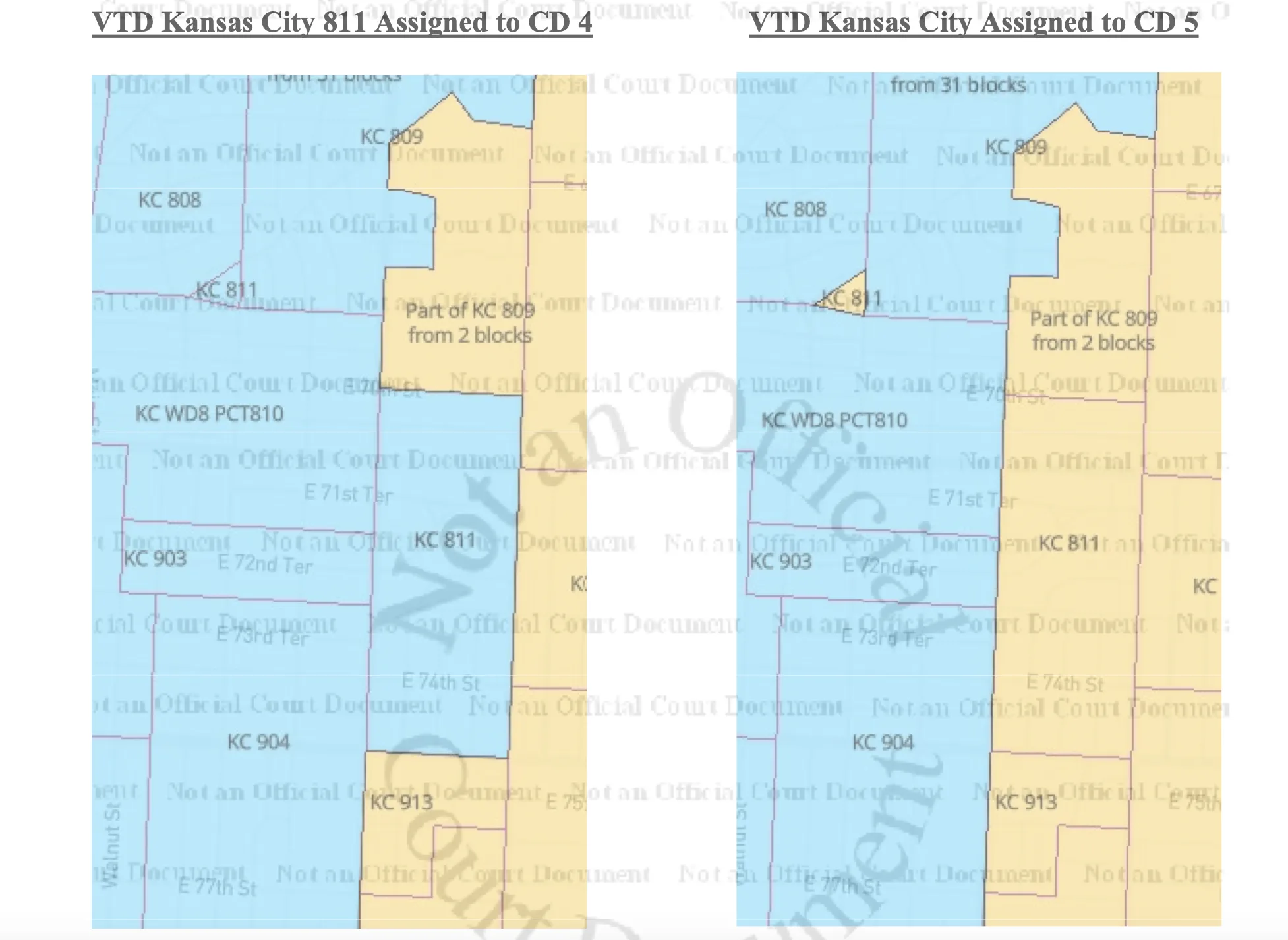 An image of the duplicated VTD in the Kansas City area.
Adam Kincaid, president of the National Republican Redistricting Trust, wrote on social media that the KC 811 matter is a non-issue. He believes there are two distinct KC 811 VTDs in Missouri. He doesn’t claim to know whose fault that is, other than it isn’t the problem of the legislators who passed the new map.
Hatfield, on the other hand, suspects the mistake in the bill is related to the rushed nature by which the bill went through the state House and Senate, saying that this sort of mistake is exactly the sort of thing that gets ironed out when there is time to debate and consider legislation. “People make mistakes,” he says. “Usually if you have a normal process, those get fixed. But this was so fast and there was so much pressure to get it passed.”
The lawsuit filed in Jackson County raises a similar point, stating, “And it is no surprise that the slapdash process in which the legislature engaged—ramming through the Bill, failing to publicly release an electronic GIS file that legislators, staff, and the public could view and vet, and instead only releasing the district assignments in PDF to obscure the map from any transparency—resulted in the most basic of errors.”
Hatfield predicts that this error will be difficult to defend in court. “I am not sure what they are going to argue. I can’t come up with a good argument on why the courts can overlook this mistake.”
Notably, Kehoe has not yet signed the map into law. He has until 45 days after the bill’s passage to sign it into law. That deadline would give him until the last week in October. Kehoe’s office did not respond to questions about whether he planned to sign the bill despite the district’s double representation.
There’s also the possibility that legislators could be called back in for yet another special session to pass a new map with the KC 811 mistake fixed.
State Rep. Kemp Strickler (D–Lee’s Summit) says that he hasn’t heard talk of that yet. “That seems like it would be super-embarrassing for the Republican party who just jammed this down Democrats’ throats to have to come into session again and waste more taxpayer money because they were unwilling to share the map data the first time,” he says. “They may just roll the dice with the legal process.”