
The government’s climate target to cut emissions by at least 62 per cent by 2035 will require a huge leap up in the amount of climate action achieved to date.
Australia has cut its emissions 28 per cent since 2005, the start date under the Paris Agreement, and the vast majority of emissions reduction to date, and out until 2030, will be drawn from the electricity sector.
That is the easiest and cheapest place to cut emissions, because private investment has fuelled the replacement of Australia’s ageing coal-fired plants with proven, successful technology in wind and solar power.
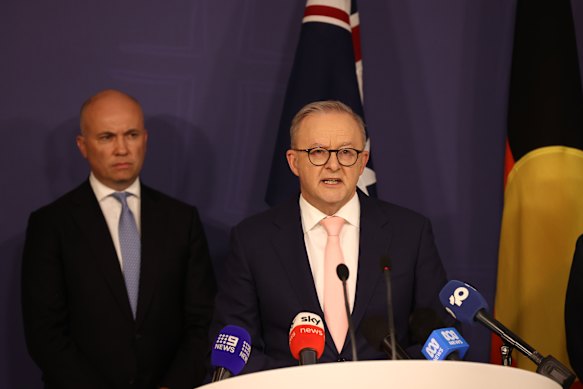
Prime Minister Anthony Albanese announces the government’s emissions reduction target in Sydney.Credit: Dominic Lorrimer
But the bulk of emissions cuts for the second half of the decade will have to come from a range of sectors, like mining, agriculture and transport where the costs and benefits of low emissions technologies are less clear-cut.
Tony Wood, senior fellow at the independent Grattan Institute, told this masthead that Australia’s emissions must start to fall much quicker for the next five years than they had for the previous two decades.
“To get to 2030, we have to reduce emissions by about 17 million tonnes a year, having been reducing them by between 6 and 10 million tonnes a year to date … that’s a big step up,” Wood said.
“A 65 per cent target for 2035 would mean that 17 million tonnes a year in cuts would become 27 million tonnes a year, and a 75 per cent target would be 39 million tonnes a year. That is getting really hard.”
Read more of our analysis here.