
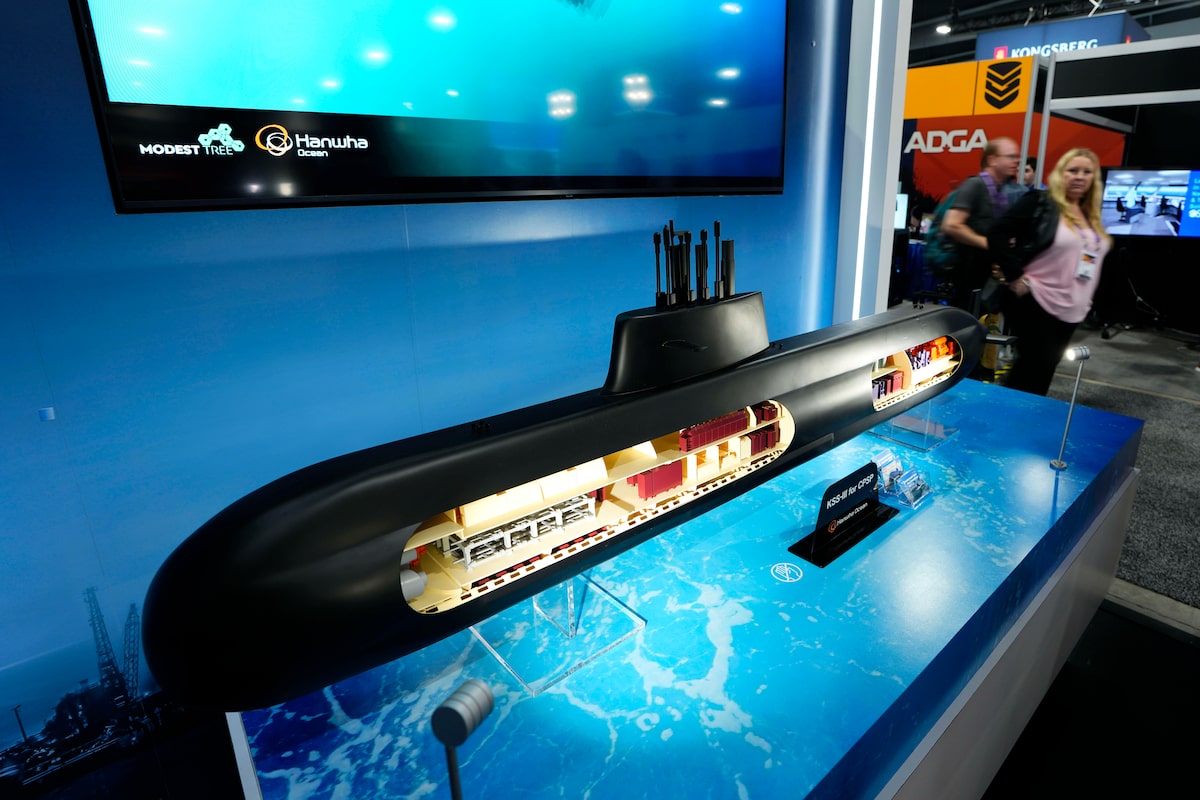
A model of a Hanwha KSS-III submarine at the Canadian Association of Defence and Security Industries annual defence industry trade show in May. The South Korean company could be chosen to supply Canada with a fleet of submarines.Justin Tang/The Canadian Press
A South Korean company has made the short list to supply this country with a fleet of submarines, and if Ottawa ultimately picks Seoul-based Hanwha it would be the first time Canada has purchased a major weapons platform from a non-Western supplier.
It would represent a significant pivot from American and European contractors and forge a new relationship with an Asian country that faces major security challenges of its own, including a heavily-militarized Korean Peninsula and an increasingly aggressive People’s Republic of China.
Unlike Germany, home country of the other contender, ThyssenKrupp Marine Systems (TKMS), South Korea isn’t part of the Western NATO military alliance to which Canada belongs.
Canada turns to Asia as efforts to shift trade from United States expand
The sheer size of the deal, and the life cycle of the subs, which could end up costing more than Canada’s F-35 fighter jet purchase, would create a long-term partnership with the winning country spanning the better part of 70 years, according to David Perry, president of the Canadian Global Affairs Institute. He estimates the total acquisition cost over the life cycle of the submarines would be $10-billion per boat, with as many as 12 on order, for a total price tag of as much as $120-billion. This would also account for inflation, spare parts, training, weapons and other costs.
It could take 15 to 20 years for all subs to be delivered and their potential operating life could be 40 to 50 years, Mr. Perry said.
Other Western countries are pivoting to Asian suppliers these days. Last month one of Canada’s Five Eyes intelligence-sharing allies, Australia, picked a Japanese company over Germany’s TKMS to supply a fleet of frigates.
TKMS has sold submarines to 20 navies around the world, while Hanwha’s customer list for subs is far shorter: South Korea and Indonesia.
The Seoul company, however, has pitched its subs to Poland, the Philippines and Saudi Arabia, among others, and Warsaw is expected to make a decision shortly on whether to buy from Hanwha. Hanwha has also sold naval surface vessels to South Korea, the United Kingdom, Thailand, Malaysia and Bangladesh.
Hanwha’s offer to Canada is the KSS-III Batch-II submarine, while TKMS, as part of a joint German-Norwegian project, is offering the 212 CD. Both are diesel-electric submarines because Canada has ruled out purchasing nuclear-powered boats.
A model of a 212 CD submarine, shown at the Haakonsvern naval base in Norway.Annette Riedl/Reuters
Prime Minister Mark Carney is expected to visit Hanwha’s shipyards next month during a trip to South Korea. He toured TKMS’s shipyards in August when Ottawa announced the hunt for a new sub had narrowed to two companies.
Both Hanwha and TKMS are trying to make their proposals more attractive by increasing their commitments to benefit Canada, including local jobs and manufacturing and supply contracts.
Hanwha says if under contract by 2026 it could deliver the first boat by 2032 and four subs by 2035. Nils Beyer, a spokesman for TKMS, said the company “is positioned to deliver the first submarine well in advance of 2035 and working closely with the Royal Canadian Navy for the remainder of the fleet.”
Jonathan Berkshire Miller, a senior fellow with the MacDonald-Laurier Institute, said picking South Korea to build Canadian subs would re-enforce Canada’s new commitment to the Indo-Pacific region. “The government has signalled a desire that it wants to be a bit more of a player in the Indo-Pacific. Such a partnership with Korea would be a strong signal to other countries that Canada is quite serious.”
Retired vice-admiral Mark Norman, a former commander of the Royal Canadian Navy, said to him both submarines are similar in terms of performance, with each offering a different technology to give the boats endurance at sea. He thinks Canada needs to reflect on which partnership serves this country better in the long run.
Mr. Norman cautioned against picking a submarine that offers better economic benefits in the immediate term but carries risks in the longer term.
Opinion: In a complex geopolitical climate, the Indo-Pacific holds the future of economic growth
In his opinion, picking the South Korean sub would be a “bit of a leap of faith” for Canada.
“I don’t mean that that’s a bad thing, but there will be risks associated with that.”
He cited the potential vulnerabilities of a submarine parts supply chain that stretches back to the Korean Peninsula, given Seoul’s volatile relationship with authoritarian North Korea and China’s ambitions in the region.
“What happens when China starts declaring disputed offshore areas as sovereign territory?” Mr. Norman said.
He said he’s a huge fan of South Korea and their industrial capacity and innovation but added that they are in a “tough spot, geostrategically.”
Michael Coulter, CEO of Hanwha’s global defence business, said the company has a long history of sales of other military hardware to customers in Europe, Asia and the Middle East. He cited the self-propelled howitzer as one example. “No European country can match what we have as far as that goes.” The South Korean company is also building howitzers, infantry fighting vehicles and ammunition resupply vehicles in Australia.
The Canadian Global Affairs Institute’s Mr. Perry said Polish government officials have told him they have been happy with Hanwha military hardware including artillery and resupply vehicles.
Vice-Admiral Angus Topshee, commander of the navy, said the choice facing Canada is unprecedented. “This is pretty novel for Canada: the decision to acquire a significant military capability in an off-the-shelf manner overseas, and then to open the possibility to a non-Five Eyes, non-NATO ally.”
“South Korea has a vested interest in diversifying their supply chain off the peninsula that is under threat, that could come under attack at any minute, where they have a history as recently as 2010, of their ships being sunk by North Korea.”
He said this means there is an even greater impetus for South Korea to look at building “elements of that supply chain in Canada.”