
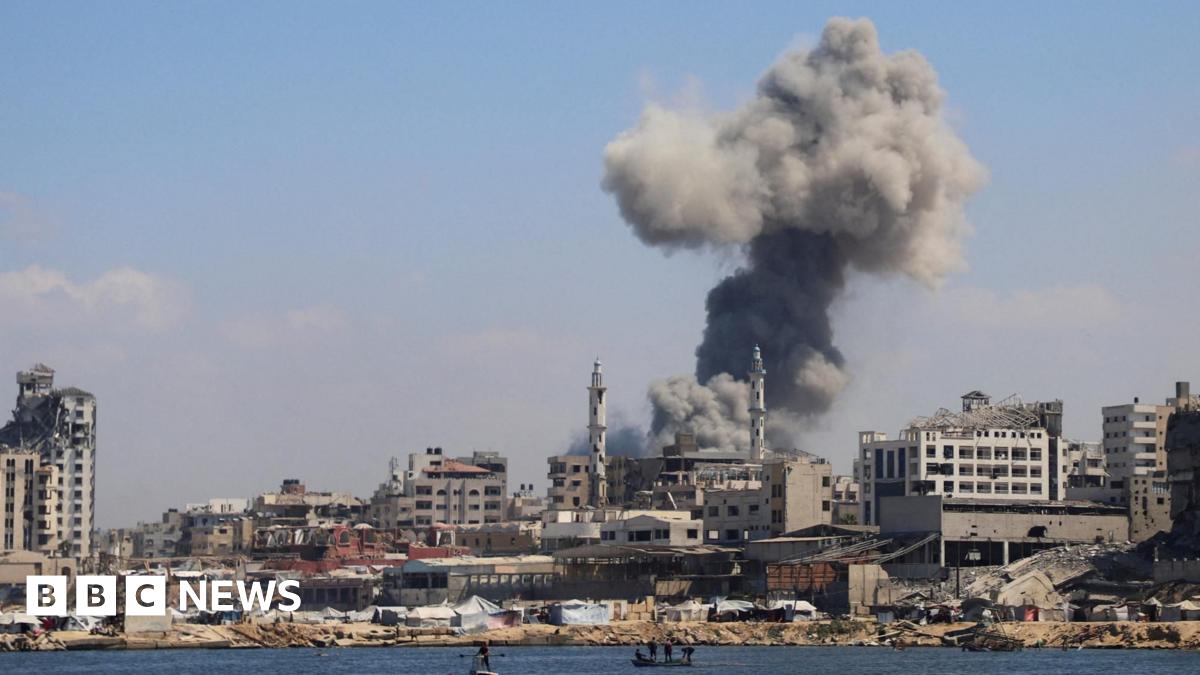
The UN and its humanitarian partners have recorded at least 200,000 people crossing from northern to southern Gaza since mid-August, when Israel announced its intention to conquer Gaza City. Around 55,000 have made the journey since Sunday.
Cherevko, who works for the UN humanitarian office in the central city of Deir al-Balah, told the BBC she travelled to Gaza City two days ago – a 29km (18 mile) round-trip that took 14 hours.
“The things there, and the scenes on the way to Gaza City, are nothing short of cataclysmic,” she recalled.
“A constant stream of people [are] crossing from the north to the south, many on foot. Inside Gaza City, it’s very crowded still because there are hundreds of thousands of civilians still remaining there.”
She said she also witnessed multiple Israeli strikes “very close” to the UN convoy while in Gaza City, adding: “It was really just a constant hit after hit while we were there.”
On Thursday morning, witnesses told Reuters news agency they had seen Israeli tanks in the northern Sheikh Radwan neighbourhood and the southern neighbourhood of Tal al-Hawa, which have come under heavy bombardment in recent days.
They also reported that Israeli forces had blown up remotely driven vehicles laden with explosives in both areas, destroying many houses.
Local hospitals said at least 14 people had been killed by Israeli fire across the Gaza Strip on Thursday, including nine in Gaza City.
The Israeli military said in a statement that its troops were “expanding” their operations in the city, without giving any details about their movements.
At the start of the ground assault on Tuesday, the military’s chief of staff, Lt Gen Eyal Zamir, told troops to “intensify the blows against Hamas and to decisively defeat the Gaza City brigade, in order to carry out the most moral and important duty – the return of all the hostages home and the dismantling of Hamas’s military and governing capabilities”.
Cherevko warned that many people were unable to comply with the Israeli military’s order to evacuate to its designated “humanitarian area” in the south.
“The expense of moving your belongings, if you are lucky enough to find a vehicle that will move them, is exorbitant. It’s not affordable for many people. And that’s why many are doing this on foot, with barely a mattress in their hands and maybe a plastic bag.”
And once they arrived there were no guarantees of shelter or safety, she added.
“I spoke to a lot of people who have recently arrived in Deir al-Balah and [the southern city of] Khan Younis. Many of them are sitting on the side of the street, with nothing. They don’t have any shelter. They don’t know where to go.
“Yesterday, I met a family who had been walking around for four days, trying to find space to sleep and they didn’t manage,” she said.