
The City of Toronto is looking to build taller buildings near major transit stations in an effort to provide housing for more people, detailing the provincially-approved plans for “major transit station areas” throughout the city.
On Aug. 15, the province approved a plan to build more homes around 120 transit stations in Toronto, allowing taller buildings to be constructed to increase density in these neighbourhoods.
The province’s housing ministry said this was done so Toronto can reach its target of 285,000 new homes by 2031, with an overall goal to construct more than 1.5 million homes over the next 25 years.
Speaking to reporters on Thursday morning, Mayor Olivia Chow and Jason Thorne, the city’s chief planner, outlined their plans for these major transit station areas.
“We know that Toronto is growing. Last year alone, we had more than 200,000 people arriving to the city. We’re also facing a housing crisis, the rent is so expensive, and it’s grown tremendously,” Chow told reporters on Thursday morning.
“We are cutting the red tape so we can build more housing within walking distance of all subways and GO stations. These zonings, once we approved it and get through council, will be as-of-right, so it would be a lot faster for home builders to come and get buildings built.”
According to the city, there will be 25 Major Transit Station Areas (MTSA). Each will encompass an area spanning a 500 to 800-metre radius near an existing station or a planned transit station. This radius equates to roughly a 10-minute walk away from the station, the city says. The Major Transit Station Areas will only apply to subways, light-rail transit (LRT) and GO train stations.
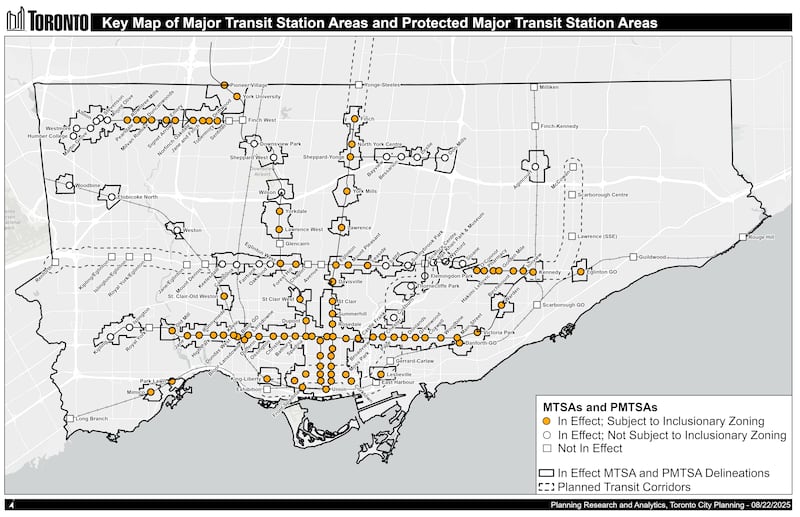 Map of major transit station areas A map of the major transit station areas (MTSAs) and protected major transit station areas (PMTSAs) throughout Toronto. (City of Toronto)
“The province sets out minimum densities that these areas must achieve, depending on whether it’s a subway, which is 200 residents and jobs per hectare in the areas around the subway, 160 (residents) if it’s a light-rail transit station area, or 150 (residents) if it’s a GO Transit station area,” Thorne said.
There will also be 95 Protected Major Transit Areas (PMTSA). Once approved by Ontario’s housing minister, those will establish minimum densities for individual new developments where inclusionary zoning will be applied. Eighty-nine of these areas are included in inclusionary zoning market areas, the city says, a policy aimed to address the housing needs of Toronto’s low-to-moderate income households.
Thorne explained Housing Minister Rob Flack withheld a decision on eight PMTSAs and four MTSAs that were undergoing a transit-oriented community process, including East Harbour, Exhibition, Scarborough Centre, Gerrard-Carlaw, Yonge-Steeles and Long Branch. He also withheld two PMTSAs—Finch West and Sentinel—where the province and city are looking at “compatibility issues” with the surrounding land uses.
The city adopted inclusionary zoning polices in 2021 where, at that time, required between five and 10 per cent affordable housing units to be constructed in new developments, where it must stay affordable for at least 99 years from when a tenant first moves in. In May this year, Ontario capped that at up to five per cent for a maximum of 25 years.
“Although those provisions for inclusionary zoning are now enforced in effect, there are a number of transition provisions as well as some incentives that were originally approved by council,” Thorne said. “It’s largely a go-forward policy, so most applications that are already in the development pipeline, already have active applications are grandfathered, are exempt from inclusionary zoning that represents about 98 per cent of what’s already in the pipeline.”
These provisions also exempt buildings with less than 100 units or 8,000-square-metres, Thorne says, and also include non-profit housing developments, student residences, retirement homes, nursing homes and residential care homes.
“Thanks to the inclusionary zoning policy … there is a potential for 53,000 new affordable homes and geared to a person’s income,” Chow said. “So, a nurse that works in a local hospital don’t have to travel so long to get to work, paramedics, artists, engineers, even maybe planners, firefighters, entrepreneurs, all the workers and people that want to live in the city could afford to do so.”
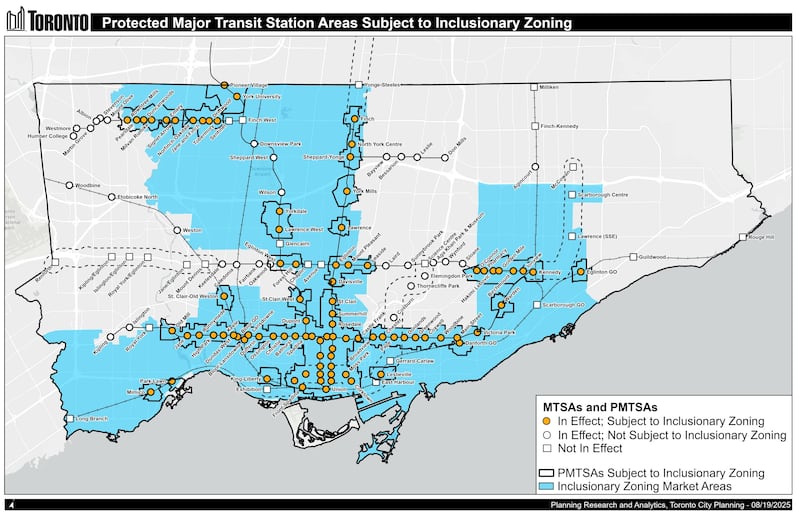 PMTAs in Toronto A map of the protected major transit station areas (PMTAs) that are subject to inclusionary zoning. (City of Toronto) How this can impact neighbourhoods near major transit stations
In these neighbourhoods, the housing minister approved policies that will allow six-storey apartments to be built if they’re within 200-metres of a station or if located on a major street. Multiplexes of up to four storeys can also be constructed in these areas.
There are now two density policies in place for lands classified as mixed-use, apartment neighbourhoods or regeneration areas, which will impact the permitted floor space index (FSI), the floor area of all buildings on a lot.
If they’re within 200 metres of a transit station, the permittable FSI is an eight or more, and if they are within 200 to 500 metres of a transit station, it its six or more. To put it into context of what that could look like on a given lot, a two-storey building that takes up 50 per cent of the lot area has an FSI of one, which is equal to a four-storey building cover a quarter of the same lot.
“You will have more neighbours, the whole area will be very, very revitalized,” Chow said, pointing to the Annex in Toronto’s west-end as an example. “It’s going to change and right around those major corners, where the subway station is, there’ll be higher buildings and it will step down into shorter ones and then tier down to even lower ones, but the rest of the neighbourhood won’t change—but just in the 10 minutes of walking distance, those buildings will be taller.”
In order to carry out the policies for these transit areas, the city says it has to adopt implementing zoning—something it is looking to have done by late spring or early summer of next year.
Thorne says they already amended the Official Plan to allow increased density in these transit areas, making their task now to convert those policies into as-of-right zoning, so the permissions fall in line with what the housing minister is looking for and so rezoning applications aren’t needed to be done.
“Once that is in effect, if you’re bringing forward a new application that’s within those densities, you don’t need an official plan amendment, you don’t need a rezoning application, you go straight to what we call our site plan review process, where really what we’re talking about at that stage is design issues, circulation, landscaping—those types of fine-grain issues,” Thorne said.
When asked about how the city will respond to the anticipated pushback with these transit areas, Chow underscored the need to tackle the ongoing affordable housing crisis in Toronto.
“We absolutely have to build more homes that people can afford housing faster and by giving as-of-right approval it means that home builders can come in … and it’s predictable, you know what is happening in your neighbourhood,” Chow said. “It’s something that, I think, should be welcomed.”