
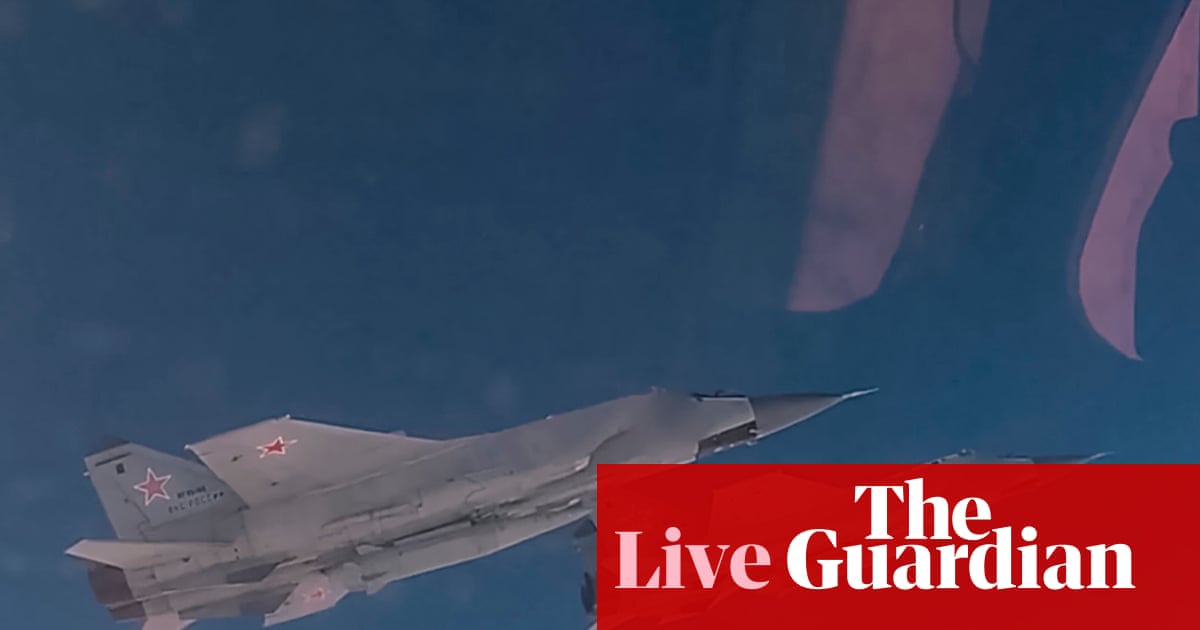
‘Extremely dangerous provocation,’ EU’s Kallas says on Russian fighter jets over Estonia, which ‘further escalates tensions in region’
EU foreign policy chief Kaja Kallas has responded to the reports of three Russian fighter jets violating the Estonian airspace.
In a statement on X, she said:
“Today’s violation of Estonia’s airspace by Russian military aircraft is an extremely dangerous provocation.
This marks the third such violation of EU airspace in days and further escalates tensions in the region.
The EU stands in full solidarity with Estonia.
I am in close contact with the Estonian government.
We will continue to support our member states in strengthening their defences with European resources. Putin is testing the West’s resolve.
We must not show weakness.”
Key events
17m ago
Russian jets intercepted by Italian F-35s stationed in Estonia, army confirms
24m ago
EU’s von der Leyen urges leaders to ‘swiftly’ adopt sanctions against Russia after Estonia incident
36m ago
Nato intercepted Russian aircraft over Estonia, Nato spokesperson confirms
55m ago
‘Extremely dangerous provocation,’ EU’s Kallas says on Russian fighter jets over Estonia, which ‘further escalates tensions in region’
1h ago
‘Unprecedently brazen’ violation of Nato airspace, Estonia’s foreign minister says
2h ago
Estonian airspace violated by three Russian military jets — reports
2h ago
Italy sees union strikes in solidarity with Palestine
2h ago
Salvini’s embrace with Russian ambassador, comments on Israel land him in political controversy
3h ago
Proposed sanctions will still need to be approved by member states — snap analysis
4h ago
‘Any source of income for Kremlin to continue its aggression is target’ for EU sanctions, Kallas says
4h ago
EU wants to bring forward phase out of Russian LNG imports by 2027
4h ago
Russia ‘has shown full extent of contempt for diplomacy and law,’ EU’s von der Leyen says
4h ago
China, India and Belarus line up for Russia’s rival version of Eurovision
5h ago
Eight EU countries believed to be importing Russian gas
6h ago
European Commission puts forward new package of sanctions against Russia
7h ago
EU to propose bringing Russian LNG ban forward to 2027 – sources
7h ago
‘No evidence’ Putin wants peace in Ukraine, outgoing MI6 chief warns
7h ago
EU leaders get invite to meet in Copenhagen for talks on defence, Ukraine
8h ago
Morning opening: New EU sanctions on Russia could come today
Show key events only
Please turn on JavaScript to use this feature
Russian jets intercepted by Italian F-35s stationed in Estonia, army confirms
The Estonian army has confirmed that the Russian fighter jets were intercepted by Italian F-35s based in Ämari in Estonia as part of an air policing mission over the Baltic sea.
Updated at 11.36 EDT
EU’s von der Leyen urges leaders to ‘swiftly’ adopt sanctions against Russia after Estonia incident
European Commission president Ursula von der Leyen has now weighed in on the Estonian incident too, linking it with the need to “swiftly” approve the new package of sanctions against Russia proposed earlier today (14:14, 14:16, 14:21, 14:43).
She said:
“Europe stands with Estonia in the face of Russia’s latest violation of our airspace.
We will respond to every provocation with determination while investing in a stronger Eastern flank.
As threats escalate, so too will our pressure.
I call on EU leaders to swiftly approve our 19th sanctions package.”
ShareNato intercepted Russian aircraft over Estonia, Nato spokesperson confirms
Nato spokesperson Alison Hart also issued a statement, confirming that Nato responded to the incident and intercepted the Russian fighter jets:
“Earlier today, Russian jets violated Estonian airspace. Nato responded immediately and intercepted the Russian aircraft. This is yet another example of reckless Russian behaviour and Nato’s ability to respond.”
Updated at 11.38 EDT
‘Extremely dangerous provocation,’ EU’s Kallas says on Russian fighter jets over Estonia, which ‘further escalates tensions in region’
EU foreign policy chief Kaja Kallas has responded to the reports of three Russian fighter jets violating the Estonian airspace.
In a statement on X, she said:
“Today’s violation of Estonia’s airspace by Russian military aircraft is an extremely dangerous provocation.
This marks the third such violation of EU airspace in days and further escalates tensions in the region.
The EU stands in full solidarity with Estonia.
I am in close contact with the Estonian government.
We will continue to support our member states in strengthening their defences with European resources. Putin is testing the West’s resolve.
We must not show weakness.”
Share‘Unprecedently brazen’ violation of Nato airspace, Estonia’s foreign minister says
And here is the full quote from Estonia’s foreign minister Margus Tsahkna, published in the government’s press release.
“Russia has already violated Estonia’s airspace four times this year, which in itself is unacceptable.
But today’s incursion, involving three fighter aircraft entering our airspace, is unprecedentedly brazen.
Russia’s increasingly extensive testing of boundaries and growing aggressiveness must be met with a swift increase in political and economic pressure.”
Updated at 10.44 EDT
Estonian airspace violated by three Russian military jets — reports
We are getting a line from Reuters that Estonian airspace was violated by Russian military jets on Friday.
The agency quotes the Estonian government as saying that three Russian Mig-31 fighter jets entered Estonian airspace without permission and stayed there for a total of 12 minutes.
The country’s foreign minister called the incident “unprecedently brazen,” and the government issued a note of protest to the top Russian diplomat in Estonia, public broadcaster ERR said.
Estonian Postimees reported that the jets did not submit flight plans and had their radio switched off at the time of the incident. Ohtuleht said the incident took place near the Vaindloo island, and it was the fourth violation of the Estonian airspace this year.
It’s the third Russian violation of Nato airspace in a short period of time, after Russian drone incursions into Poland and Romania.
Updated at 10.42 EDT
Italy sees union strikes in solidarity with Palestine Lorenzo Tondo
in Palermo
Italy’s largest trade union confederation, together with several grassroots labour groups, has called a two-day nationwide strike to protest against what organisers describe as “the massacre and deportation of the Palestinian people.”
It marks the second national strike in solidarity with Palestine in Europe, following a similar action held in Spain in September 2024.
The strike is set to take place on Friday and again on Monday, bringing disruption and closures to schools, rail services, ports and other sectors across both public and private industries.
Hundreds of rallies and sit-ins are expected to be held in cities throughout the country.
“We believe what is happening is of unprecedented gravity,” read a statement on the CGIL union’s website. “This logic of force and rearmament is a real threat to the rights of all people and to democracy worldwide.”
CGIL’s secretary, Maurizio Landini, said the protest aimed “to create humanitarian corridors, to ensure the safety of the civilian population, and to support all ongoing humanitarian missions, including the Global Sumud Flotilla.”
“At the same time,” he added, “we demand that governments – our own, European, and beyond – suspend all commercial and military cooperation agreements with Israel until this war and this massacre in Gaza are brought to an end.”
Meanwhile, the Adriatic port of Ravenna on Thursday refused entry to two trucks reportedly carrying arms bound for Israel, amid growing protests by Italian dockworkers and other labour groups against the offensive in Gaza.
Similar actions have been taken by port workers in France, Sweden and Greece, who have moved to block weapons shipments destined for Israel.
ShareSalvini’s embrace with Russian ambassador, comments on Israel land him in political controversyLorenzo Tondo
in Palermo
In other news, Italian far-right deputy prime minister, Matteo Salvini, has sparked a political storm in the last 48 hours after first embracing and greeting Russia’s ambassador to Italy, then declaring in a television interview that he supports Israel’s right to defend itself.
Italy deputy prime minister Matteo Salvini pictured at an event earlier this summer. Photograph: Alberto Lingria/Reuters
Despite Italy being a staunch supporter of Ukraine, Matteo Salvini on Tuesday warmly greeted Russia’s ambassador to Italy, Alexei Paramonov, during a reception at the Chinese embassy in Rome – a gesture that drew sharp criticism from opposition parties.
Davide Faraone, vice-president of Italia Viva, said:
“It’s a problem for Italy when Salvini embraces the Russian ambassador while our military is engaged in repelling Russian drones in Poland.”
Salvini, who in the past was seen wearing a T-shirt featuring Vladimir Putin’s face, defended the encounter: “I met the Russian ambassador, as I have met dozens of other ambassadors,” he said.
Less than 24 hours later, he drew more attention after he insisted in an interview with Israel’s i24News channel on Thursday that Israel “has the right to ensure a peaceful future for itself”.
He added: “I speak as Matteo Salvini, as leader of my party and a member of the government. I cannot speak for everyone, but from my point of view, defending Israel – Israel’s right to life – means defending freedom and democracy. Therefore, Israel has every right to ensure a peaceful future.”
Salvini’s remarks come as Rome considers possible sanctions against Tel Aviv following Israel’s new offensive in Gaza, raising the risk of embarrassment for the Italian government.
In July, Salvini received the Italy–Israel Award, with Israel’s ambassador in Rome, Jonathan Peled, praising him for having “the courage to publicly take courageous and often disruptive positions”.
“If anyone deserves recognition for his efforts to strengthen the strategic bond between Italy and Israel, it is Matteo Salvini,” Peled said at the time.
Updated at 09.53 EDT
Proposed sanctions will still need to be approved by member states — snap analysis Jakub Krupa
On the ‘next steps’ here, it’s worth remembering that the sanctions proposed by the commission today will still need to be discuss and approved by the member states.
Usually, this requires unanimity among all member states, throwing a spotlight on Hungary and Slovakia’s reactions in particular, as they have a history of blocking or delaying proposed measures.
However, the legal basis of some individual elements of the package, such as reparation loans, is yet to be fully clarified. Most likely they will also need unanimity, but this will surely be confirmed in due course.
But the key point here is that this is the starting point, not the final product.
There will be a technical process of agreeing and implementing these proposals, and their final shape may still evolve. One to watch.
Updated at 08.45 EDT
‘Any source of income for Kremlin to continue its aggression is target’ for EU sanctions, Kallas says
In her statement, EU’s foreign policy chief Kaja Kallas stressed that the bloc’s “sanctions bite” and “have a visible impact on Russia’s public finance and economic growth.”
Any source of income for the Kremlin to continue its aggression is a target.
She listed many of the measures mentioned by von der Leyen (14:14) as she said:
“Today we propose a full transaction ban on Russian banks and financial institutions, including those operating in third countries. We also propose adding large economic operators involved in the circumvention of sanctions, revenue generation and support for the Russian military industry, as well as the Russian credit card system and fast payments system.
We are also proposing a ban on investments in Russian Special Economic Zones linked to the war. And we propose further measures on Chinese actors supporting Russia’s military industry.”
On the crucial issue of energy exports, she offered a bit more detail, saying that the EU will propose a “full prohibition of Russian LNG imports by January 2027,” and will “lift remaining exemptions on Rosneft and Gazprom Neft.”
“These new sanctions will also squeeze Russia’s access to technologies including AI and geospatial data, as well as critical resources that feed weapons production. This includes those received from foreign suppliers including China and India,” she said.
She also said the package will include new measures against “individuals involved in the abduction and indoctrination of Ukrainian children.”
Kallas stressed:
“Europe wants peace for Ukraine.
But despite weeks of diplomatic efforts, Russia only intensifies its aggression and is now breaching the European Union’s own borders. Depriving Moscow of the means to wage war is essential to end this war and protect the security of our continent.
Russia’s aggression cannot continue unchecked.
Our message is clear: We will intensify pressure on Russia with increasingly hard-hitting sanctions, coupled with military support for Ukraine, until Russia accepts a genuine, just and lasting peace.”
Doubling down on her main warning, Kallas added on X:
We want to strike where Russia gets its money. No sector is off-limits.
Updated at 08.22 EDT
EU wants to bring forward phase out of Russian LNG imports by 2027
Meanwhile, EU foreign policy chief Kaja Kallas specified that the new package includes a proposal to bring the EU’s ban on Russian LNG imports by one year, to 1 January 2027, in a bid to put further pressure on Russia.
The move is likely to face some opposition from Hungary and Slovakia, and potentially even some of the other countries still importing Russian gas (12:34).
ShareRussia ‘has shown full extent of contempt for diplomacy and law,’ EU’s von der Leyen says
The European Commission president, Ursula von der Leyen, said in her statement that Russia “has shown the full extent of its contempt for diplomacy and international law” over the last month, as she criticised the largest-scale drone and missile attacks on Ukraine.
She specifically referenced the Russian strikes on Kyiv that hit the EU office in the capital, and Russian drone incursions into Poland and Romania.
These are not the actions of someone who wants peace.
The 19th package of sanctions comes in response to this “escalation” from Putin, she explained, as she outlined the key elements of what’s being proposed.
She says the EU will “want to cut” Russia’s revenues from fossil fuels, banning imports of Russian LNG into European markets.
118 additional vessels from the Russian shadow fleet will get added to the sanction list, which totals 560 vessels.
She added that “major energy trading companies Rosneft and Gazpromneft will now be on a full transaction ban,” and “other companies will also come under asset freeze.”
Crucially, the new package will also target “refiners, oil traders, petrochemical companies in third countries, including China” who are alleged to be “purchasing oil in breach of the sanctions.”
“In three years, Russia’s oil revenues in Europe have gone down by 90%. We are now turning that page for good,” she said.
The package will also look at closing “the financial looppholes,” von der Leyen said, adding that it will bring forward “a transaction ban on additional banks in Russia and on banks in third countries.”
“We are stepping up our crackdown on circumvention. As evasion tactics grow more sophisticated, our sanctions will adapt to stay ahead. Therefore, for the first time, our restrictive measures will hit crypto platforms, and prohibit transactions in crypto currencies. We are listing foreign banks connected to Russian alternative payment service systems. And we are restricting transactions with entities in special economic zones.”
The package will also “add new direct export restrictions for items and technologies used on the battlefield,” with 45 companies in Russia and third countries to be affected.
“These companies have been providing direct or indirect support to the Russian military industrial complex. In a war driven by innovation, cutting off Russia’s access to key technologies is crucial. Above all when it comes to drones,” she said.
Von der Leyen also said that while Russian frozen assets “will not be touched,” Ukraine will get reparations loans, to be repaid by future Russian repearations. “We will come forward with a proposal soon,” she said.
“Faced with Russia’s escalation, Europe stepped up to the challenge. We will continue to use all the tools at our disposal to bring this brutal war to an end.
I now call on the Member States to quickly endorse these new sanctions.
We want Russia to leave the battlefield and come to the negotiating table. This is the way to give peace a real chance.”