
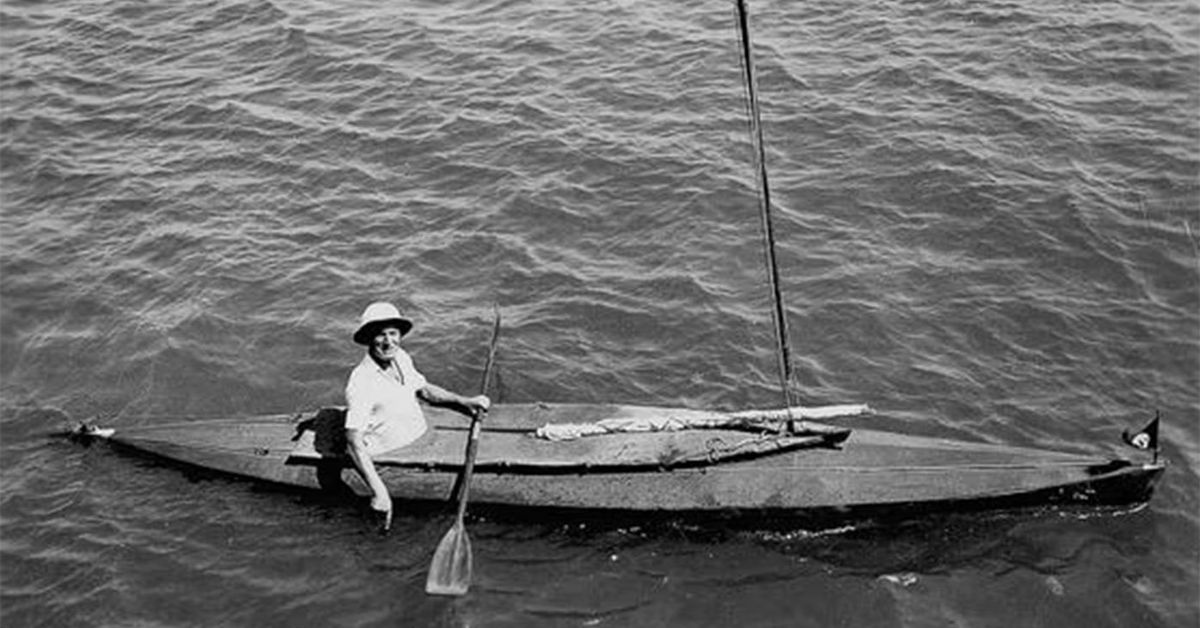
A German kayaker arrived on Australian soil on September 20, 1939, after a seven-year rowing voyage.
Out of work and with nothing to do, Oskar Speck decided to kayak from Germany to Cyprus to get work in a copper mine.
He started out paddling down the Danube River in 1932 until he reached the Aegean Sea.
 Oskar Speck documented his journey with photos and writings. (National Australian Maritime Museum)
From there, he hugged the Turkish coastline until he reached Cyprus.
But he decided against staying to work in Cyprus, instead going to Syria to travel down the Euphrates River.
He paddled by the coast of modern-day Iran, Pakistan, India, Bangladesh, Burma, Thailand, Malaysia, Indonesia and Papua New Guinea.
He was usually welcomed by villagers who fed him.
But in his journey, he was shot at, robbed and beaten several times.
One time in Indonesia, he was beaten and tied up by 20 men.
He managed to escape after biting through his ropes.
When he wasn’t fed by those he visited, he sustained himself on tins of sardines and condensed milk.
And after a seven-year journey, he landed at Thursday Island in the Torres Strait.
To his shock, he was promptly arrested.
In between the start of his journey and his destination, Adolf Hitler and the Nazi Party had come to power.
 Most of his experiences with the people he encountered were positive. (National Australian Maritime Museum)
And three weeks before he arrived on Australian soil, World War II had begun.
“Well done, feller… You’ve made it — Germany to Australia in that,” a police officer told him.
“But now we’ve got a piece of bad news for you. You are an enemy alien. We are going to intern you.”
Speck spent the next six years locked up in prisoner-of-war camps in Australia.
After the war, he found work in the opal mining industry in Lightning Ridge in outback New South Wales.
He only returned to Germany in the 1970s, but not enjoying it, he came back to Australia.