
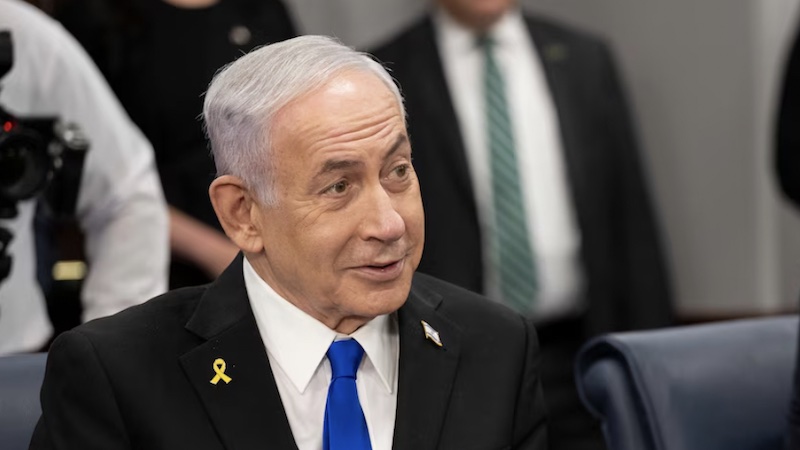
Benjamin Netanyahu governs today under unprecedented pressure. He faces swelling protests, shrinking international support, legal scrutiny, and a coalition that could collapse at any moment. Against this backdrop, the war in Gaza has become not only a national crisis but also the central pillar of his political survival.
Public discontent is now visible on the streets every week. Demonstrations involving hundreds of thousands have taken over major Israeli cities. Families of hostages lead many of these rallies, accusing the government of neglect and failure. Netanyahu has dismissed the protests as harmful to negotiations, yet the growing numbers make clear that public anger has reached a scale unseen since the outbreak of the war in October 2023.
Diplomatic efforts add another layer of complexity. Hamas has recently announced its acceptance of a 60-day ceasefire proposal, mediated by Egypt and Qatar with U.S. support. The plan includes a partial release of hostages, prisoner exchanges, limited Israeli troop withdrawals, and the entry of more aid into Gaza. Israel has so far expressed caution, neither rejecting nor embracing the deal. For Netanyahu, however, any move toward a ceasefire risks undermining his image as a hardliner and could fracture his coalition from within.
The far-right partners in government, led by Itamar Ben-Gvir and Bezalel Smotrich, have already drawn their red lines. They reject any settlement that does not achieve total defeat of Hamas, threatening to bring down the coalition if Netanyahu compromises. Since the resignation of Benny Gantz in June 2024, the government has tilted further to the right, leaving Netanyahu even more dependent on these partners and their demands.
Meanwhile, Gaza endures devastating human loss. The health ministry in the territory reports more than 62,000 deaths since October 2023. International agencies warn of famine, with alarming levels of child malnutrition. Israel disputes some of the numbers, but the images of mass casualties and starvation dominate global coverage. They feed accusations that Israel is committing genocide, a charge Israel firmly denies. The International Court of Justice has yet to rule on the accusation itself, but it has issued binding orders requiring Israel to prevent acts of genocide and to allow humanitarian access, reinforcing the international spotlight on the government.
Legal pressures extend further. The International Criminal Court has issued arrest warrants for Netanyahu and former defense minister Yoav Gallant, accusing them of war crimes and crimes against humanity. The warrants limit Netanyahu’s freedom of movement abroad and intensify his dependence on domestic control. Without a clear claim of “victory,” the end of the war would expose him to mounting demands for accountability and possibly elections.
At the same time, Israel’s most crucial ally is showing signs of fatigue. Public opinion in the United States has shifted sharply, with support for the war falling to historic lows. Netanyahu’s personal standing in American surveys is also negative. For Israel, which relies heavily on U.S. military and diplomatic support, this erosion of sympathy raises the cost of continuing the campaign.
Domestically, another crisis is unfolding. Israel’s Supreme Court has struck down blanket exemptions from military service for the ultra-Orthodox community. Netanyahu needs the support of ultra-Orthodox parties to survive politically, just as he depends on far-right allies who demand that the war continue until Hamas is destroyed. A decisive ceasefire could trigger conflicts on both fronts: disputes over conscription, budget priorities, and the unresolved question of Gaza’s future. By keeping the war “open-ended,” Netanyahu postpones these confrontations.
This is the framework in which his survival rests.
First, war suspends accountability. Investigations into the failures of October 7 or into corruption allegations are easier to delay as long as combat dominates the agenda.
Second, war secures his coalition. Ben-Gvir and Smotrich have staked their political fortunes on the demand for Hamas’s destruction. Netanyahu cannot alienate them without risking collapse.
Third, war shifts the legal narrative. As long as fighting continues, international warrants and court orders can be portrayed as external attacks on Israel’s sovereignty. In peacetime, they would appear as personal liabilities.
Fourth, war divides the opposition. While some Israelis demand an immediate deal for hostages, others insist on continuing the fight. This split weakens efforts to unify against Netanyahu.
Fifth, war overshadows domestic challenges. Rising living costs, the draft crisis, and governance disputes recede into the background, while the conflict dominates national debate.
These calculations shape Netanyahu’s response to the latest ceasefire proposal. He signals openness to talks but attaches conditions that Hamas rejects: disarmament, exile of its leadership, and full demilitarization of Gaza. Such conditions align him with his far-right partners, delay any lasting truce, and ensure that the war continues in cycles of temporary pauses followed by new offensives. Politically, stalemate is safer for him than settlement.
Critics argue that this dynamic ties Netanyahu’s survival directly to the devastation in Gaza. They point to the staggering death toll, the humanitarian collapse, and the international court cases as evidence that prolonging the war serves his political interests. Whether or not the ICJ eventually rules on the genocide claim, the allegation itself fuels international outrage and sustains the argument that Netanyahu cannot afford peace.
Yet his strategy is not without limits. Public patience in Israel is fraying. The families of hostages represent a powerful moral voice that resonates across society. International allies are also reconsidering their support. Should a broad ceasefire become the only path to stability, Netanyahu will face a stark dilemma: preserve his coalition at the cost of alienating the public, or end the war and risk political collapse.
For now, his survival depends on prolonging an “in-between” state: enough fighting to satisfy the right, enough negotiation to ease pressure from the center, and enough ambiguity to avoid elections. The war in Gaza remains the stage on which Netanyahu plays for time, and as long as it endures, so does his grip on power. The day it ends may mark the beginning of his greatest political reckoning.