
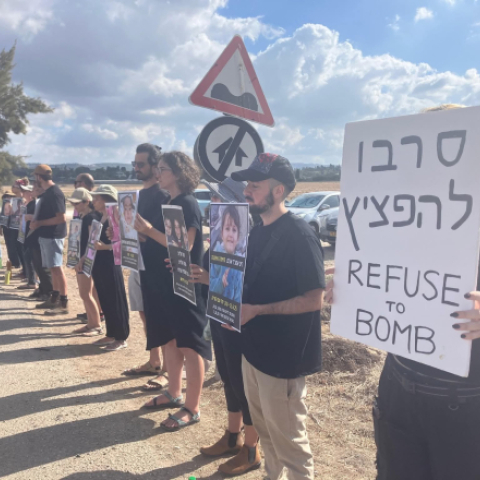
Standing Together protest in Israel
Gaza: stop the horror!
The Israeli military’s ongoing assault on Gaza City has led to at least 200,000 displacements since mid-August, including 55,000 since Saturday 13 September.
Bombardment in Gaza City has been near-continuous, involving air strikes, helicopter and drone attacks, and ground incursions by tanks and infantry. Entire neighbourhoods are being demolished.
In response to a UN inquiry concluding that Israel’s actions constitute a genocide, Israel has pointed to the fact it issues evacuation orders prior to attacks, and has provided some aid and medical provisions in the so-called “humanitarian zone”. But evacuation orders are meaningless when there is no safe area to escape to; the “humanitarian zone” is overcrowded and dramatically under-resourced with necessary supplies of food and medical aid, and has in any case often been subject to air strikes.
International campaigns for external pressure on Israel, such as arms embargoes, direct aid to Gaza and the West Bank, and targeted sanctions on Israeli political and military officials, must combine with practical support for those resisting from within, especially amongst Israel’s 20% Palestinian minority, in movements like Standing Together.
Israel’s war party is on a land-grab
Benjamin Netanyahu’s decision to attempt to assassinate Hamas negotiators in Qatar, on 9 September, violating a previous protocol of respecting Qatari sovereignty and paying at least lip-service to the negotiation process Qatar has mediated, appears to have been unsuccessful.
Hamas has claimed its senior leaders survived. The attack has moved the Islamist paramilitary party no closer to the total surrender, unconditional release of hostages, and promise to disarm that Netanyahu claims increased military pressure can eventually secure.
The attack did, however, reaffirm the Israeli war party’s sense that it can operate with impunity. The operation provoked a few sharp words from Donald Trump, but no material consequences. With many senior figures in the Israeli military and security establishments openly declaring that the ongoing operation in Gaza City has no strategic justification, the aims of the war are now clearly political: to obliterate as much of Gaza as possible, and expel or destroy its population, in order to clear the way for re-settlement.
The war in Gaza is part of a wider colonial effort by the Israeli government, to establish direct rule over as much of the territory between the River Jordan and the Mediterranean Sea as possible. Whilst few Israeli governments have made meaningful efforts to rein in the settler movement, most pre-Netanyahu administrations paid lip-service to the parameters put in place by the Oslo Accords in the 1990s, which granted limited Palestinian autonomy over certain areas.
The current government, the most right-wing in Israel’s history, has dispensed with even lip-service, and openly declares that its aim is to definitively “bury” or “erase” all prospects for Palestinian self-determination, in any form.
Israeli troops now have control over large areas nominally under Palestinian Authority rule. Ibrahim Abu al-Rab, the mayor of Jalboun in the West Bank, quoted in the Financial Times, said: “An Israeli officer came into my office and said, ‘There is no Area A, no Area B, no Area C […] Forget Oslo — Israel controls everything.”
Israel’s far-right finance minister Bezalel Smotrich has regularly withheld tax revenue Israel collects on behalf of the Palestinian Authority, another aspect of a strategy aimed at collapsing the PA entirely. Smotrich has described his aims for the West Bank as being “maximum land with minimum Arabs.”
The Palestinian Authority is a deeply flawed institution, politically controlled by a political party, Fatah, based on a section of the Palestinian elite widely considered to be corrupt and self-serving. But its destruction at the hands of a racist and genocidal government would be a historic defeat.
International pressure could make some difference here. Recognition of the state of Palestine, a diplomatic entity effectively under PA control, could open up channels for more direct aid, which could help make the PA less vulnerable to financial isolation by Israel. On Wednesday 17 September, press reports indicated that the UK would formally recognise Palestine soon, following the end of US President Donald Trump’s state visit.
“Now is the time to refuse”
“Now it’s official: the world has declared Israel is committing a genocide. Netanyahu is doing everything in his power to preserve a forever war, even though it is possible to end the war, withdraw from Gaza, sign an agreement, and save the hostages. Yet more and more people are being dragged into it against their will.” — Ayala Metzger, daughter-in-law of Yoram Metzger, who was kidnapped from Nir Oz and murdered in captivity in Gaza
“The countless shattered families in Gaza will not bring our loved ones back, and they will not give us a future. The only results of the Israeli policy, this psychotic use of violence, is the collapse of our moral backbone, the tearing apart of the fabric of our society, unbearable suffering for Palestinians… it guarantees the bloodshed will go on, and eventually, justified international isolation.” — Yonatan Zeigen, whose mother, the peace activist Vivian Silver, was murdered in her home in southern Israel
“We cannot lie to ourselves any longer. We cannot pretend the red lines haven’t already been crossed. The black flag [a term used for an illegal order which must be disobeyed] cannot be any bigger or more obvious. Now is the time to stop serving. Now is the time to refuse. Because without us, there is no war.” — Ron Feiner, military reservist jailed in May 2025 for refusing to serve in Gaza
Metzger, Zeigen, and Feiner were speaking at a die-in outside the Israeli army HQ in Tel Aviv on 16 September, organised by the binational (Palestinian-Jewish) left-wing social movement Standing Together.
Being a Palestinian activist in Israel
Rula Daood, the Palestinian co-director of Standing Together, was interviewed on the movement’s Instagram page.
Q: Do you feel comfortable identifying as a Palestinian?
A: Today I do, but it’s because I’m a political activist, and it’s a choice I’ve made. For most Palestinian citizens in Israel, they don’t feel comfortable, because of the discrimination […] It can be very frightening to say that you are a Palestinian, this is how I think most Palestinian citizens of Israel feel […]
Q: How do you speak up against the war?
A: I’m a political activist, and part of a grassroots movement, so there are more people with me, so it’s somehow less scary for me to do that, and go out to protest. But for the 20% of Palestinians living in Israel, it’s hard to say anything against this genocidal war. It’s hard to speak about what’s happening in Gaza, even when you relate to the pain of the people and the kids who are being killed. Being a political activist gives you a kind of privilege, but it’s not the same sort of privilege Jewish citizens of Israel have. So I go out to the streets with my people, Jews and Palestinians, people who believe we need a different politics in this place. But most Palestinians don’t do that.
Q: Do you feel comfortable speaking Arabic in public?
A: I live in Yafo-Tel Aviv. My apartment is in Yafo, and when I go to Tel Aviv on the bus or the train, and my mum calls me, I feel scared to answer in Arabic. So I’m not that comfortable, and today, it’s even more scary, because I know that on that same bus, soldiers who have been in Gaza could be sitting right next to me, and me speaking in Arabic could provoke a negative reaction.
Q: What is your relationship with your Jewish partners at work?
A: This is a place where we work together, because we want the same things. We aspire and work towards changing the politics we have, ending this genocidal war, going back to real agreements between people. I am blessed to have these people, especially these Jewish people, around me. Unfortunately Israeli society has become more racist since 7 October, but it is still my home, and the same way I fight for my Palestinian people here, I believe we also need to fight for the Jewish people living here, because this is a home for all of us.