
Unlock the White House Watch newsletter for free
Your guide to what Trump’s second term means for Washington, business and the world
The US defence department is demanding journalists pledge not to publish unauthorised information as a condition of their continued access to the Pentagon.
In a memo sent to news organisations on Friday, journalists were asked to agree that information related to the Pentagon “must be approved for public release by an appropriate authorising official before it is released, even if it is unclassified”, the memo said.
Reporters refusing to sign the form will lose physical access to the headquarters of the defence department, which President Donald Trump is seeking to rename the Department of War.
The National Press Club said in a statement that independent reporting on the military was “essential to democracy”.
“It is what allows citizens to hold leaders accountable and ensures that decisions of war and peace are made in the light of day. This pledge undermines that principle, and the National Press Club calls on the Pentagon to rescind it immediately.”
The New York Times said in a statement that: “Asking independent journalists to submit to these kinds of restrictions is at stark odds with the constitutional protections of a free press in a democracy, and a continued attempt to throttle the public’s right to understand what their government is doing.”
Jack Reed, the ranking Democrat on the Senate Armed Services Committee, described the Pentagon memo as “an ill-advised affront to free speech and freedom of the press”.
“This goes beyond attempting to suppress criticism — Mr Hegseth’s goal appears to be eliminating a critical check on government corruption, unlawful practices, and the misuse of taxpayer dollars.”
The Trump administration argues that the changes are meant to protect national security. “The guidelines in the memo provided to credentialed resident media at the Pentagon reaffirms the standards that are already in line with every other military base in the country,” said chief Pentagon spokesman Sean Parnell.
“These are basic, common sense guidelines to protect sensitive information as well as the protection of national security and the safety of all who work at the Pentagon.”
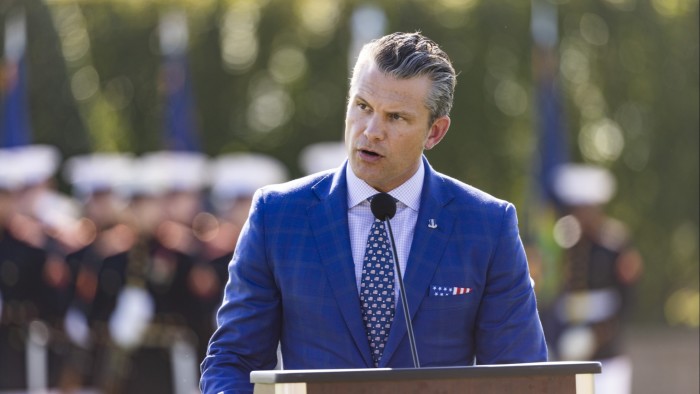
Defence secretary Pete Hegseth posted on X: “The ‘press’ does not run the Pentagon — the people do. The press is no longer allowed to roam the halls of a secure facility. Wear a badge and follow the rules — or go home.”
The new guidance follows a series of measures that take aim at the media and Trump’s critics, amid concerns about a wider crackdown on free speech and dissent in the US.
Trump on Tuesday filed a defamation lawsuit against The New York Times, seeking $15bn in damages from the media organisation he accused of being a “mouthpiece” for the Democratic party.
The suit, which was dismissed by a Federal court judge for being too long and lacking a plainly stated complaint, is the fourth big lawsuit Trump has filed against a major US news organisation since March 2024. The judge gave Trump 28 days to refile the latest suit.
Both ABC News and CBS News settled separate lawsuits by paying $15mn to Trump’s future presidential library and another $1mn to cover legal fees. In July, Trump sued The Wall Street Journal for $10bn after it published an article about a lewd birthday card he allegedly sent to Jeffrey Epstein. Trump has denied writing the card.
In April, Trump banned Associated Press reporters and photographers from the White House press pool and news conferences in the Oval Office after it refused to use “Gulf of America” instead of “Gulf of Mexico” in its reporting. In June, a DC Circuit Court of Appeals largely upheld the Trump administration’s ban on the AP after a Federal court had earlier struck down the ban.
The administration was also accused of applying pressure to have Jimmy Kimmel’s television show cancelled over the late night host’s comments about assassinated conservative activist Charlie Kirk.
Kimmel’s show was “indefinitely” suspended by ABC’s parent company Disney after Brendan Carr, chair of the Federal Communications Commission, called the comedian’s comments “the sickest conduct possible” and made what many interpreted as a threat.
“This is a very, very serious issue right now for Disney. We can do this the easy way or the hard way,” Carr said.