
One of the world’s most advanced military reconnaissance planes crashed on September 22, 1995, when it was hit by geese in Alaska, killing all 24 people aboard.
The US AIr Force E-3 Sentry surveillance aircraft was brimming with high-tech equipment, but a combination of failures left it tragically exposed to a flock of geese.
Events began when the four-engine jet, which has a distinctive giant radar dish, lined up on the runway at Elmendorf air base ready for take-off during a routine training flight.
 A US Air Force E3-B Sentry surveillance aircraft like the one that crashed in September 1995. (public domain)
Ahead of it a military cargo plane had taken off and disturbed a flock of Canadian geese close to the runway.
The Sentry rolled down the runway, and as it left the ground two jet engines sucked in some of the nearby birds triggering a catastrophic technical failure.
The crew frantically began dumping fuel and began turning the plane left in a bid to return to the runway.
But after reaching a height of about only 100 metres, the Sentry suddenly plummeted and crashed into a forest about two kilometres from where it had taken off, only 43 seconds before.
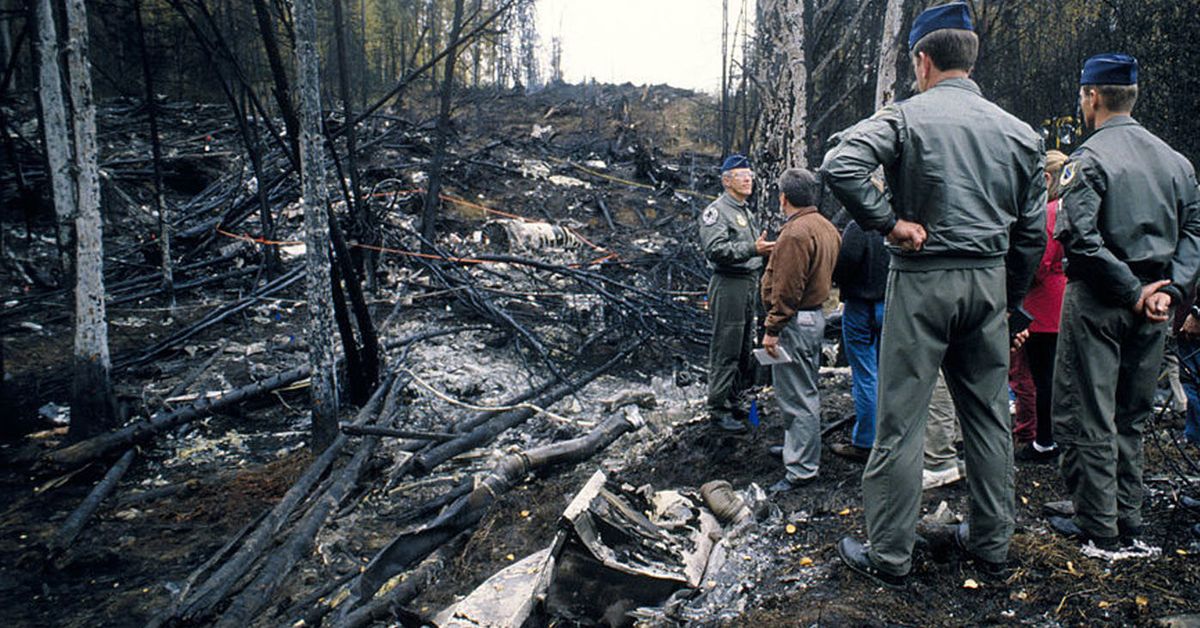
Witnesses recall seeing a huge explosion and smoke. The 22 American and two Canadian defence personnel aboard all died instantly.
 The crash on September 22, 1995, killed all 24 people aboard. (US Air Force) (Wikipedia)
Air crash investigators later found feathers of geese among the wreckage and concluded a bird strike had caused the crash.
They also pointed to failures by air traffic control in not warning the Sentry’s crew about geese on the airfield.
The disaster was a wake-up call for the US military and the wider aviation community about the danger of bird strikes.
The Pentagon initiated non-lethal bird scaring programmes for its airfields, which included a robotic dog that ‘barked’ loudly.
Bird strikes continued after the Elmendorf tragedy, including the famous ‘Miracle of the Hudson’ in 2009, when a US Airways flight was miraculously ditched in New York’s Hudson River without loss of life after hitting geese.
But other planes weren’t so lucky. South Korean investigators found a bird strike was behind last December’s crash of a Boeing 737-800 passenger jet in the country’s south-west that killed 179 people.