
This article is an on-site version of our FirstFT newsletter. Subscribers can sign up to our Asia, Europe/Africa or Americas edition to get the newsletter delivered every weekday morning. Explore all of our newsletters here
Today’s agenda: French tax on super-rich; Switzerland woos Trump on tariffs; UK’s top talent visa; and international education’s shadow economy.
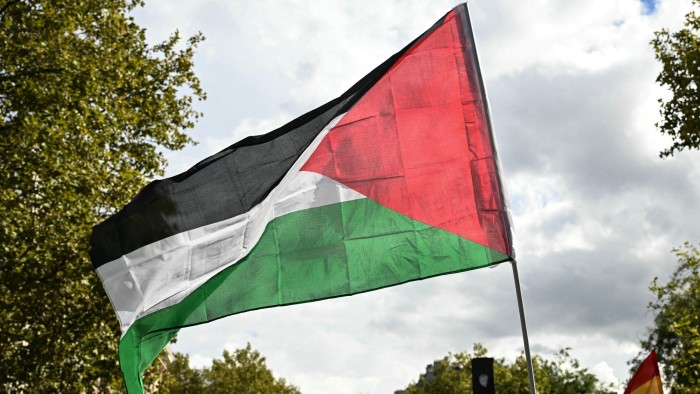
Good morning and welcome to the working week. We start with the UK, which, alongside Australia and Canada, has formally recognised the state of Palestine.
What happened: In a video statement on X, UK Prime Minister Keir Starmer yesterday said: “Today, to revive the hope of peace for the Palestinians and Israelis, and a two-state solution, the UK formally recognises the state of Palestine.”
Why it matters: The co-ordinated announcement by three of Israel’s traditional allies comes as Israel intensifies its campaign against Hamas in Gaza. The conflict has tipped part of the strip into famine, and drawn accusations — which Israel denies — that it is committing genocide in the Palestinian enclave.
France and several others will also recognise a Palestinian state at the UN General Assembly this week, in the most significant wave of recognitions for more than a decade. Read the full story.
Here’s what else we’re keeping tabs on today:
Central banks: Bank of England governor Andrew Bailey attends an event on financial supervision at the London School of Economics. US Federal Reserve governor Stephen Miran speaks at a seminar at the Economic Club of New York.
UN: This week’s General Assembly includes today’s conference on the question of Palestine and the two-state solution. The Security Council holds an emergency meeting on Russian air incursion in Estonia.
Five more top stories
1. French business leaders have billed the left’s proposal for a new tax on the super-rich as “insane” and “communist”, as the Socialist party pressures Emmanuel Macron’s new prime minister to ensure the rich pay their fair share in efforts to narrow the public deficit. LVMH chief Bernard Arnault said the push amounted to a “clearly stated desire to destroy the French economy”. More on remarks from other executives.
2. Switzerland is offering to buy more American weapons and energy products in a fresh push to persuade the Trump administration to lower its tariffs on Swiss imports. Bern also offered to make more investments in the US in an effort to convince Washington to slash the 39 per cent tariff rate on the Alpine country — one of the highest levels applied to a western ally.
3. Hacking groups are increasingly targeting companies’ supply chains, hunting for “weak links” in cyber security defences as part of a booming and illicit multibillion-dollar ransomware sector. The number of attacks on third-party suppliers to companies around the world doubled in 2024, according to cyber experts.
‘Digital sovereignty’: The EU is moving to exclude Meta, Apple, Google and Amazon from a new system for sharing financial data that is designed to enable development of digital finance products for consumers.
4. Exclusive: The UK is exploring plans to abolish some visa fees for top global talent at a time when the US has moved sharply in the other direction. Starmer’s “global talent task force” is working on ideas to lure to the UK the world’s best scientists, academics and digital experts, as it seeks to stimulate economic growth. Read details of the proposals.
Trump’s H-1B visa fee: US employers are facing a $14bn annual bill for hiring skilled foreign workers after President Donald Trump slapped a $100,000 fee on the cost of securing a visa for new employees to enter the country.
5. Exclusive: Egypt’s richest man Nassef Sawiris is seeking to invest up to $50bn in US infrastructure projects and is consolidating his publicly traded holding companies in Abu Dhabi, where he has recently redomiciled. The latest moves by the industrialist, who also owns the English football club Aston Villa, mark a big pivot in the focus of his business interests.
The Big Read © FT montage/Getty Images/Dreamstime
UK universities are heavily dependent on the high fees charged to foreign undergraduates. But they have resulted in an industry of unregulated agents now under scrutiny for making lofty promises that can push students into heavy debt. Georgina Quach unravels the shadow economy behind Britain’s international student boom.
We’re also reading . . .
Warped economics: It is ironic that the insurance industry underwrites the most extreme anti-climate risks but exposes itself to natural catastrophe cover, writes Patrick Jenkins.
Gatwick expansion: The UK government has approved plans to build a £2.2bn second runway at the London airport.
New incentive model: The era of giant multi-managers has changed how rewards are calculated. Here’s how top hedge funds can pay their traders $100mn.
Chart of the day
Enshrined in Germany’s constitution, the welfare state has grown into one of the world’s largest, accounting for 31.2 per cent of GDP. Healthcare and old-age care costs though have risen at faster rates than overall inflation. Can Europe’s largest economy afford its social spending?

Coffee nerds are suddenly everywhere. James Hoffmann, aka “Big Daddy Hoff”, is to blame. FT Magazine profiles the popular YouTuber, café owner and roaster who inspired a specialty coffee revolution.
 © Guy Bolongaro