
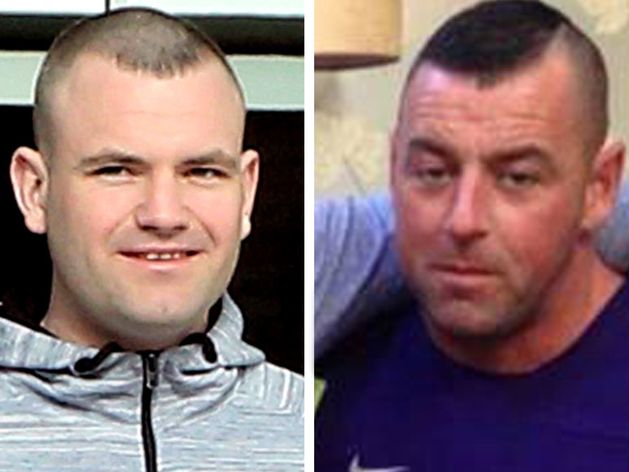
The move was opposed by McConnell, who has argued that allowing Keogh access to the full transcripts would result in a ‘security risk’ to him.
The pair are both serving life sentences for the murder of Hutch, a nephew of Gerry ‘the Monk’ Hutch, who was gunned down at Avondale House, North Cumberland Street, Dublin on May 24, 2016.
In trials which were heard separately before the Special Criminal Court, as McConnell fled to Turkey in the wake of the murder, the three-judge court concluded the pair were the assassins who followed Hutch from his home before ambushing him and shooting him dead in the flat complex’s car park.
Their trials heard that McConnell and Keogh used an apartment opposite Gareth Hutch’s home as a lookout and that when he emerged from his front door, they followed him and shot him dead.
McConnell became the fourth person to be convicted of Hutch’s murder on December 24 last year after his extradition back to Ireland from Turkey. Jonathan Keogh was found guilty of the murder in the same court, alongside co-conspirators Regina Keogh and Thomas Fox, in November 2018.
Now, however, Keogh is appealing his conviction and he filed an application in February for full access to the court transcripts from McConnell’s trial, at which he was not present, arguing these were necessary for his appeal.
Keogh argued they would test the consistency of the evidence between the two trials.
The application was opposed by McConnell, whose lawyers said they would consent only to access to the transcripts of the evidence of two specific witnesses.
They argued that the full trial “transcripts would include sensitive material which was not reported upon publicly and the disclosure of which could create a security risk for him”.
Keogh’s lawyers countered, however, that while McConnell is opposing disclosure on the basis of sensitivity of the material and the apprehension of a security risk, that position is not tenable, given that the trial was in public and was subject to media reporting.
Keogh’s legal team also offered to provide such undertakings as may be necessary to ensure the protection of the documentation, such as by limiting access to it.
At his trial last December, the Special Criminal Court was told how McConnell repeatedly lied in an attempt to save his own skin after he participated in Gareth Hutch’s murder.
When passing judgement on McConnell, the court accepted that Keogh’s gun discharged a number of bullets at close range that caused the injuries which killed Hutch.
McConnell’s gun was later found to have the safety catch on and did not fire any rounds during the murder.
The court found, however, that even if McConnell deliberately left the safety catch on, his other actions in preparation for the shooting showed that they were intended to result in Hutch’s death.
The mother of Gareth Hutch told the Special Criminal Court that her son’s murder in an ambush outside his home was “a violent and callous crime with no value or thought given for a life”.
Vera Hutch said her son was “senselessly and cruelly taken” from her and her family, tearing her life apart and changing their world “forever”.
“Losing Gareth has caused my heart and all our family’s hearts to be broken, nothing can ever repair the emptiness that his death has caused,” she said.
The trial of McConnell, who had 105 previous convictions including for assault, threats to kill and causing serious harm, began in 2023 but was postponed for 16 months, firstly when one of the judges was unable to continue and then as the court awaited a Supreme Court ruling in a separate case.
McConnell’s trial continued after the Supreme Court found in that case that traffic and location data relating to mobile phones could be used as evidence, even though the data was harvested using a since invalidated law.
The trial heard that McConnell and Jonathan Keogh used an apartment opposite Gareth Hutch’s home as a lookout and when he emerged from his front door, they followed him and shot him dead.
Mary McDonnell, who lived at the lookout apartment, told the trial in June 2023 that she could identify Jonathan Keogh because she had known him for many years but she did not know the second man.
When asked to identify the second man from CCTV footage showing McConnell in a shop later the same day, she said she was “not really 100 per cent” and that she was “half and half”.
Mr Justice Owens said last month that her evidence could not be used to prove McConnell was the second gunman.
The court instead relied on mobile phone data linking McConnell to the other murder plotters, CCTV footage connecting him to various vehicles used in the plot and lies told by him to gardai that were indicative of guilt.
In particular, the court was satisfied that McConnell parked a black BMW in front of Avondale House with the intention of using it as the getaway car.
Following the shooting, Keogh and McConnell got into the BMW but could not get it started. They then ran to a Skoda Octavia, which the court said had also been parked nearby by McConnell that morning. They left the scene in the Octavia.
When gardai searched the BMW, they found McConnell’s DNA, a can of petrol and two changes of clothes that prosecution counsel Fiona Murphy SC said marked it out as a getaway car.
In granting Keogh’s application for full access to the transcripts of McConnell’s trial, in a judgement delivered on Friday last week, Ms Justice Nessa Cahill said his legal team had sufficiently discharged the onus on him of showing that it is “necessary for the purpose of doing justice.”
She said the Special Criminal Court should provide him with access to the transcripts of the trial of Mr McConnell and of the judgment of the Special Criminal Court and that “no relevant legal prejudice” would be caused to McConnell.
This case is listed before the judge again on October 10.
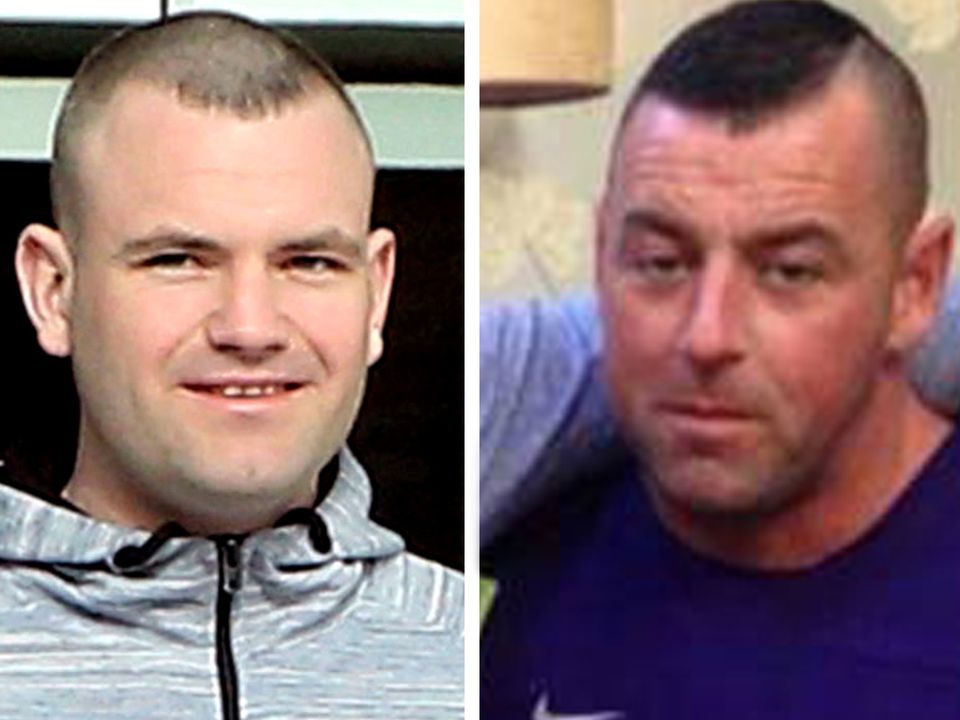
Thomas ‘Nicky’ McConnell (left) and Jonathan Keogh
News in 90 Seconds – September 22nd