
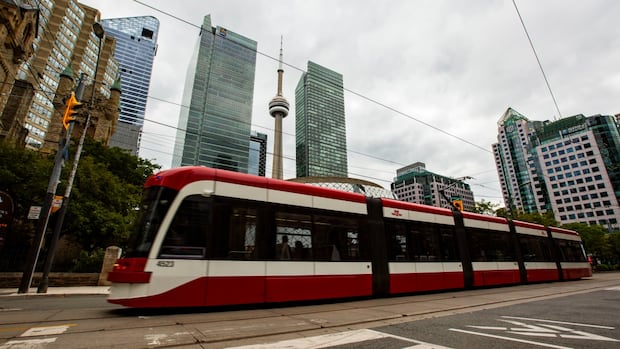
Toronto’s streetcars will be impacted by two major intersection closures this fall, even as they already struggle to arrive on time and face looming service impacts caused by budget shortfalls.
The TTC and City of Toronto will be closing the intersections of Broadview Avenue and Queen Street E., as well as Dufferin Street and King Street W., this fall, with the west-end closure coming as early as Sept. 29 and the east-end shutdown coming in October, according to a statement from the city.
The closures are part of state of good repair work needed to upgrade aging track infrastructure, but they mean potential headaches for riders of the 504 King line in both ends of the city. In the west, the car will divert via Queen between Roncesvalles Avenue and Shaw Street, while the streetcar will be replaced by shuttle buses east of the Distillery Loop.
“If we don’t maintain and keep this system upgraded it’s more prone to failures and we’re trying to avoid that,” said TTC spokesperson Stuart Green.
WATCH | Toronto faced over 93 hours of unplanned subway delays in July:
There were more than 93 hours of unplanned TTC subway delays in July
The TTC’s new CEO provided an update on what factors led to transit delays in July. As CBC’s Lane Harrison explains, this comes at the same time the board is facing financial uncertainty.
The track replacement work is adding more complications to a service where only 57 per cent of streetcars are arriving on time, according to the latest CEO’s report at the TTC board. It’s also a reminder of the financial challenges looming over the system in the future.
“People know that they can’t rely on the streetcar and that’s a dangerous place to be,” said Andrew Pulsifer, executive director of the advocacy organization TTCRiders. “It needs to be invested in. We need more money put into the system.”
Disruptions coming as TTC needs money for streetcars
The iconic Toronto streetcar service’s aging infrastructure needs state of good repair work to keep it going, but recent reports warn the TTC needs to find a lot more money to do that. If the funding shortfall isn’t addressed, “the TTC may find it necessary to plan and prioritize condemning some rail corridors in favour of renewing others,” said a report prepared for a TTC committee in early September.
The TTC’s cash problems and repair backlog can make disruptions like these more frustrating, according to Steven Farber, a transportation geographer and interim director of the Mobility Network research hub at the University of Toronto.
“We’re always playing catch-up and even after the repairs happen, the user doesn’t necessarily experience better service,” he said. “I think that if it was coming at the same time as major improvements to the operations of the network, we’d be a lot more okay with it.”
When it comes to improving the network, he said the most important thing is to get streetcars out of mixed traffic with cars. That’s something the city recently made strides on, approving streetcar-only lanes for Bathurst Street — but it took six years to accomplish, with some like Etobicoke Coun. Stephen Holyday pushing back against a so-called “war on the car.”
As the TTC’s funding needs become more pressing, Farber said the transit agency needs to appeal to Ottawa’s hopes of growing the Canadian economy.
“Toronto’s the major economic hub of the country and the TTC is what keeps people moving and getting to work,” he said.
A recent study at the University of Toronto found every dollar invested in TTC operations or infrastructure work returns seven dollars to the economy, Farber said.
“It’s a no-brainer that it would be great for the economy to spend our money there,” he said.
Ottawa says it’s providing the TTC with $1.2 billion over the next 10 years. Announced in 2024, about half of that funding is largely going toward new subway trains on Line 2.