
This article is an on-site version of our Europe Express newsletter. Premium subscribers can sign up here to get the newsletter delivered every weekday and fortnightly on Saturday morning. Standard subscribers can upgrade to Premium here, or explore all FT newsletters
Good morning. The EU and Indonesia have announced that they have struck a deal on a free trade agreement which Brussels says will save European exporters around €600mn a year in duties.
Today, I report on the growing number of EU countries recognising a Palestinian state, and bring you the latest on talks among the EU’s eastern states on how to build defences against Russian drones.
One of us
France became the largest EU country to recognise Palestine last night, boosting a growing movement to pressure Israel into peace talks — and shining a light on the deep divisions inside Europe over the issue.
Context: Around 150 of the UN’s 193 states recognise Palestine. The majority of holdouts are western countries, particularly in Europe. Israel’s genocidal war against Gaza has pushed many European capitals to rethink their stance as a diplomatic tool to push for peace.
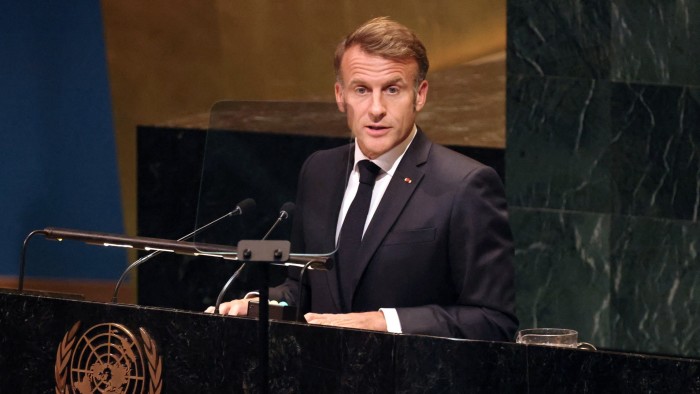
French President Emmanuel Macron announced the move yesterday at a dedicated event ahead of the UN General Assembly in New York.
“One solution exists to break the cycle of war and destruction: acknowledging each other,” Macron said. “We must recognise that Palestinians and Israelis are living in twin solitude.”
France’s move is contingent on a ceasefire and the release of all hostages held by Hamas that were captured during the October 7 2023 attack on Israel that precipitated the ongoing conflict.
Portugal, Malta and Luxembourg also recognised a Palestinian state in New York, while Belgium said it would do so pending the release of hostages and the removal of Hamas.
“Today … the State of Palestine has been recognised by the majority of the member states of the European Union,” said António Costa, the EU Council president.
The raft of EU countries changing their stance — which follows the same shift by the UK, Australia and Canada on Sunday — has highlighted the prominent refusal of other EU states like Germany, Hungary, Austria and the Czech Republic to even allow Brussels to impose sanctions on Israel, which the UN has concluded is committing genocide in Gaza.
The EU is pushing for a two-state solution to the conflict, which requires the recognition of Palestine.
“As we speak, the two-state solution is being undermined. This cannot be. Because the only realistic peace plan is based on two states,” European Commission president Ursula von der Leyen said at the event in New York, which France co-hosted with Saudi Arabia.
Von der Leyen said peace should include “a secure Israel, a viable Palestinian state and the scourge of Hamas removed”, adding that the EU would set up a donor group to ensure that a future Palestinian state was “viable also from an economic point of view”.

Property buyers in different European countries face vastly different transaction taxes, indicating what policy levers governments can pull to alleviate the housing affordability crisis many countries face.
To the wall
EU defence ministers from the bloc’s eastern “frontline states” will meet via video link on Friday to discuss plans to construct a “drone wall” to keep out Russian projectiles, as efforts to shore up the vulnerable flank speed up.
Context: Nineteen Russian drones violated Poland’s airspace earlier this month, with some shot down by Nato fighter jets in the first armed clash between Moscow and the US-led military alliance since President Vladimir Putin’s full-scale invasion of Ukraine.
The video conference on Friday afternoon was convened by EU defence commissioner Andrius Kubilius and will feature ministers from Finland, the three Baltic states, Poland, Romania and Bulgaria, plus Denmark and Ukraine, according to people familiar with the preparations.
Hours after the drone incursions into Poland, von der Leyen said Europe had to “build a drone wall”, calling for “a European capability developed together, deployed together, and sustained together, that can respond in real time”.
Officials later said the project could tap a €150bn loans-for-arms programme launched by the commission and work closely with Ukrainian industry and the country’s defence forces, which are fending off almost daily drone attacks from Russia.
The agenda is still being finalised but Friday’s meeting has been pitched as a forum to share concrete proposals for the wall, list requirements and areas where the commission could assist, and discuss ways to co-ordinate efforts, the people briefed on the meeting said.
Putin has spent much of the past two weeks seeking to prove the wall’s impotence before it has even been constructed, with a series of provocative air space violations in Romania and Estonia.
EU leaders are set to debate future defence and security investments and strategies at an informal summit next week in Copenhagen, with the aim of agreeing formal policy steps at a second summit in Brussels later in October.
What to watch today
UN General Assembly debate opens in New York.
Nato secretary-general Mark Rutte gives a press conference in Brussels, 12.45pm CET.
Second day of EU agriculture and fisheries ministers’ meeting.
Now read theseRecommended newsletters for you
Free Lunch — Your guide to the global economic policy debate. Sign up here
The State of Britain — Peter Foster’s guide to the UK’s economy, trade and investment in a changing world. Sign up here
Are you enjoying Europe Express? Sign up here to have it delivered straight to your inbox every workday at 7am CET and on Saturdays at noon CET. Do tell us what you think, we love to hear from you: europe.express@ft.com. Keep up with the latest European stories @FT Europe