
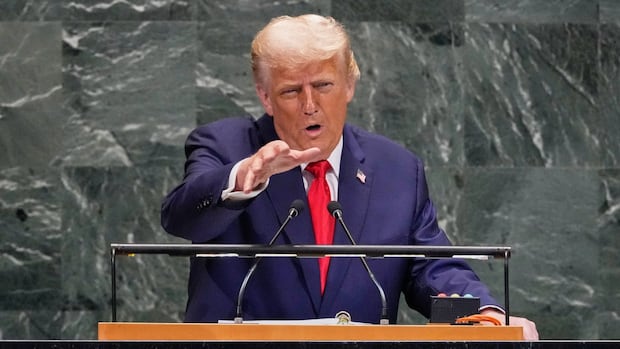
U.S. President Donald Trump delivered his first in-person address to the United Nations General Assembly in seven years on Tuesday, telling those assembled that “your countries are going to hell” due to green energy policies and what he characterized as runaway migration.
Trump defended the efforts of his administration to secure its southern border and warned of the “death of Western Europe” from migration. He also took aim at UN programs that support the world’s refugees.
“The UN is supposed to stop invasions, not finance them,” said Trump, using a term for mass movements of people that activists have criticized for being dehumanizing.
Elsewhere, Trump dismissed climate change as the ” greatest con job ever perpetrated on the world.”
“In closing, I just want to repeat that immigration and the high cost of so-called green renewable energy is destroying a large part of the free world and a large part of our planet,” he said.
In between, Trump held court on a number of topics, many familiar to regular watchers of his Oval Office comments, and took issue with countries like Canada that have recognized a Palestinian state, saying the “rewards would be too great for Hamas terrorists, for their atrocities.”
With global support for a Palestinian state growing, Israel’s devastating war in Gaza is expected to take centre stage as the United Nations’ annual gathering of world leaders gets into full gear on Tuesday.
The myriad conflicts and issues confronting the world, including climate change, will also be in the spotlight, as nearly a week of speeches is launched at the United Nations General Assembly.
Almost all UN member nations have signed up to take their turn during the assembly’s six-day-long speechfest. The speakers’ list so far includes 89 heads of state, 43 heads of government, 10 people who are vice-presidents or deputy prime ministers, and 45 foreign ministers and other ministerial-level officials.
Brazil led off the speeches Tuesday in a decades-long tradition dating to when it was the only nation that volunteered to speak first.
In addition to Brazilian President Luiz Inacio Lula da Silva and Trump, the assembly on Tuesday will hear from Turkish President Recep Tayyip Erdogan, Jordan’s King Abdullah II, French President Emmanuel Macron, South Korea’s President Lee Jae Myung and South African President Cyril Ramaphosa.
Foreign Affairs Minister Anita Anand will deliver Canada’s statement on Sept. 29.
UN principles ‘under assault as never before’: Guterres
While the theme is “Better Together,” observers can expect a rundown of ways in which the world is falling apart.
“As we meet, civilians are targeted and international law trampled in Gaza, Ukraine, Sudan and beyond,” secretary general António Guterres said at Monday’s anniversary commemoration. “Poverty and hunger are on the rise — the planet burns, with fires, floods and record heat raging through climate chaos.”
The UN is seeing its principles “under assault as never before,” said Guterres.
WATCH | Carney says Canada open to future peacekeeping role in Gaza: 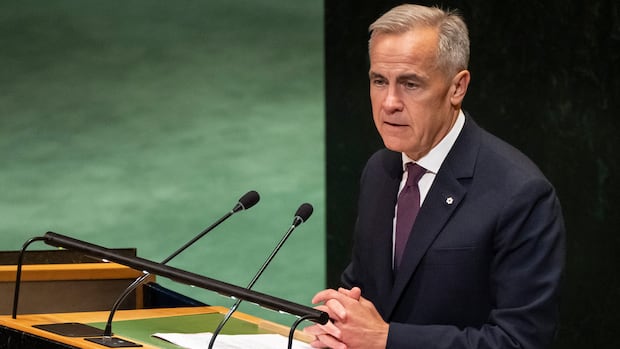
Canada joins allies in recognizing Palestinian state at UN
Prime Minister Mark Carney was one of 18 national leaders to speak at the United Nations on Monday about why they’ve chosen to formally recognize a Palestinian state as the war between Israel and Hamas continues.
Gaza and its nearly two-year war already has seized attention at the General Assembly. Monday’s conference, co-chaired by France and Saudi Arabia, focused on garnering support for the long-standing idea of a two-state solution to the Israeli-Palestinian conflict.
The hours-long meeting ended with several countries, including France, Belgium, Luxembourg, Malta and Monaco, announcing or confirming their recognition of a Palestinian state — a day after the United Kingdom, Canada, Australia and Portugal did. Around three-fourths of the UN’s 193 member countries now do.
Prime Minister Mark Carney said Monday the move to recognize Palestinian statehood is consistent with Canada’s longtime policy of supporting a two-state solution. He said Canada and other countries are actively trying to create conditions for a ceasefire and a peace process.
“It’s necessary in our judgment, and the judgment of most other countries in the world, that we have to push on this now,” Carney said.
Israel and the U.S. boycotted the event, saying the international push for a Palestinian state rewards Hamas, the militant group that still controls parts of Gaza, and makes it harder to reach a deal to halt the war and return the remaining hostages held in the enclave.
WATCH | Jennifer Welsh, public policy director at McGill University, on what to expect at UNGA:
The Sunday MagazineWhat to watch as UN General Assembly’s high-level talks kick off
The United Nations General Assembly’s high-level meeting begins on Monday, with Israel’s bombardment of Gaza at the forefront of many members’ minds. Jennifer Welsh is the director of the Max Bell School of Public Policy at McGill University. She joins Piya Chattopadhyay to discuss the mechanics of the global meeting, what role the UN can play in the current political atmosphere, and Canada’s powers and obligations on the international stage.Trump’s world view in the spotlight
On Tuesday, many eyes were on Trump, who returned to the assembly rostrum five years after he last addressed the gathering by video, due to the 2020 coronavirus pandemic.
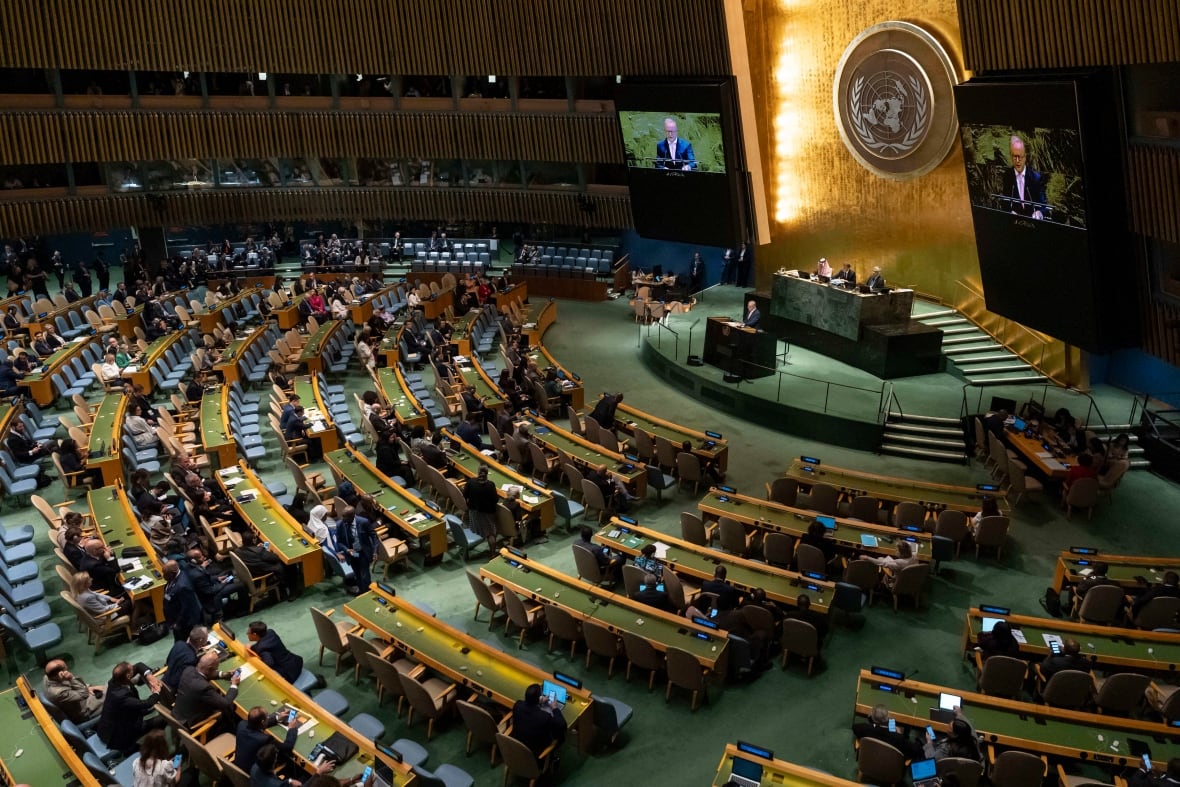 A high-profile meeting at the United Nations aimed at galvanizing support for a two-state solution to the Israeli-Palestinian conflict was held on Monday, with the general debate set to begin Tuesday. (Yuki Iwamura/The Associated Press)
Trump returned to the UN in a position of strength, upending U.S. foreign policy in just eight months into his second presidential term. Trump has slashed foreign aid, affecting several UN-led endeavours, and has moved to end American participation in the World Health Organization and UN Human Rights Council.
He’s imposed tariffs on friend and foe alike and has approved military strikes, with murky legal authority, on alleged drug-smuggling boats in the Caribbean and on Iranian nuclear facilities.
In his speech, Trump repeated the spurious claim that he’s “ended seven wars” this year. While he didn’t elaborate, Trump in recent weeks has taken credit for administration’s efforts to end conflicts between Israel and Iran, India and Pakistan, Egypt and Sudan, Rwanda and the Democratic Congo, Armenia and Azerbaijan, Serbia and Kosovo, and Cambodia and Thailand.
But Trump has struggled to deliver on his 2024 campaign promises to quickly end the Israel-Hamas war in Gaza and Russia’s invasion of Ukraine, with more than a month now passed after a summit in Alaska with Russian President Vladimir Putin.
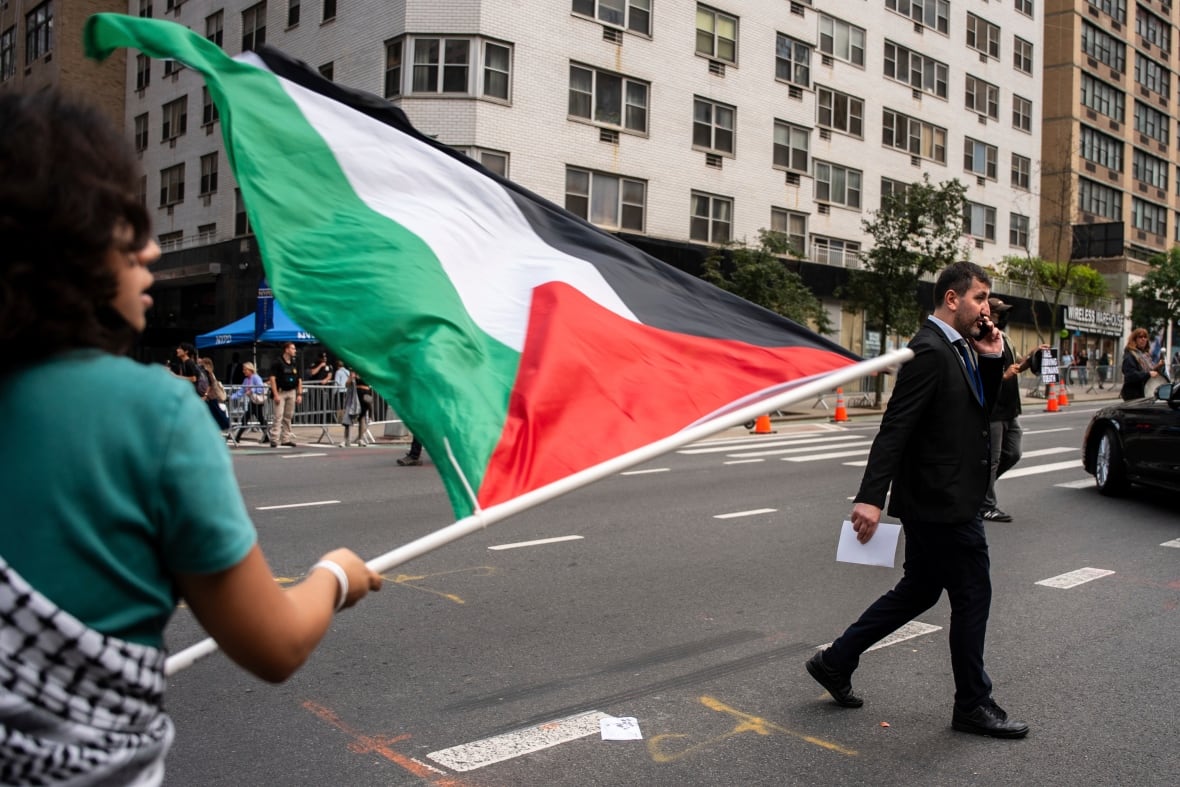 Several people demonstrated outside the UN headquarters in New York City on Monday during the UNGA’s discussion on a two-state solution in the Middle East. (Angelina Katsanis/The Associated Press)
Following his speech, Trump will hold a handful of one-on-one meetings, including with Guterres and Ukraine President Volodymyr Zelenskyy. He will also hold a group meeting focused on the Middle East, with officials from Qatar, Saudi Arabia, Indonesia, Turkey, Pakistan, Egypt, the United Arab Emirates and Jordan.
Trump is scheduled to host Israeli Prime Minister Benjamin Netanyahu at the White House next Monday.