
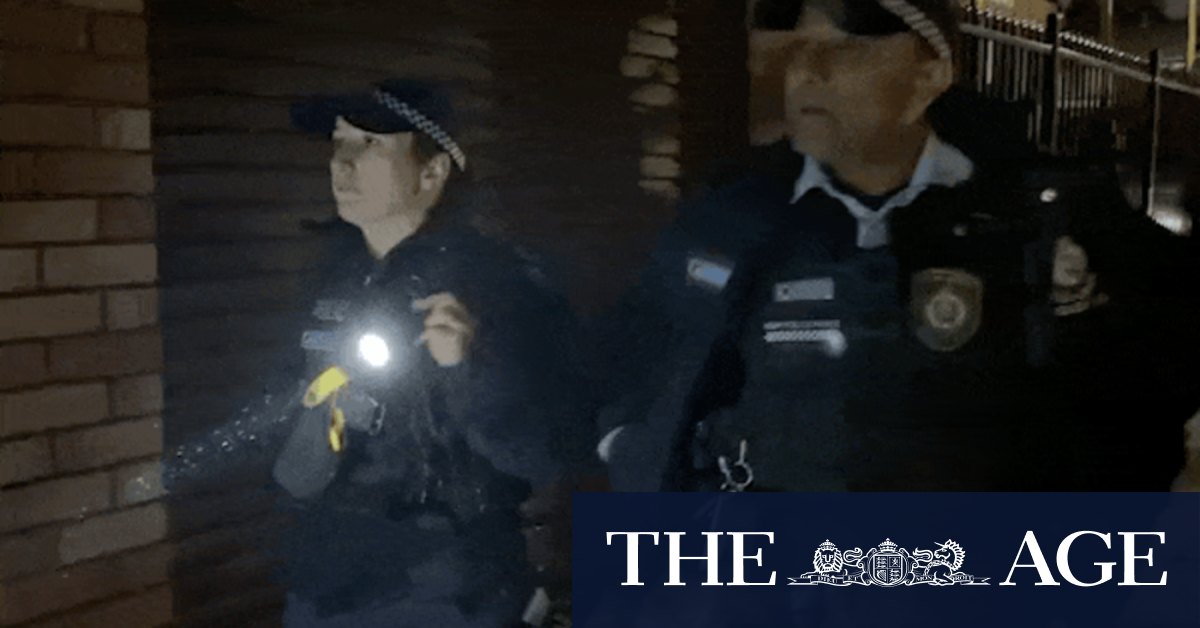
The actions of police involved in the arrests have been the subject of considerable criticism because of questions over what powers officers relied on to break up the demonstration.
Documents obtained from the court show officers said they were told during a briefing that the protest was “unauthorised” and they should show “zero tolerance”.
The statements, made by officers who attended the protest and tendered as part of the costs’ application, reveal that on the morning of the protest, officers held a briefing at Campsie Police Station at which they were told to issue move-on directions to all protesters. Highway Patrol officers had also been tasked with stopping vehicles in the area to check their “bona fides”.
“My understanding at the briefing was that it was an unauthorised protest,” one officer stated.
“There had been previous protests at the same location … I was told that the protesters who showed were going to be directed to move on and that there was no ‘tolerance’.
“My understanding of no tolerance was they were going to be issued a move on direction under LEPRA powers and were going to be given the opportunity to leave the area.
“This was due to the gathering/protest being unlawful.”
The documents also reveal that during the melee in which Thomas was injured, a probationary constable who was involved in her arrest recalled “a third police officer whom I do not know came in to assist with the arrest”.
“At this time the accused was still standing, and multiple unknown individuals were pushing forwards and back on myself and the accused,” the officer wrote.
“I then saw an arm with a dark blue sleeve reach across the accused upper body, due to the poor lighting I did not see whose arm it was … the accused then stopped resisting the arrest.”
Thomas repeatedly yelled “help me” and “oh my god, you punched me”, the statement read.
Under NSW Police powers, officers can only give move-on directions to genuine protesters if there is a serious risk to safety, they are blocking traffic, or, after reforms passed by the Minns government, it is near a place of worship.
In court on Friday, Stewart O’Connell, a lawyer who acted for some of the protesters, referred to the statement as indicating police had been told to act “contrary to the law”.
“It appears to be a direction coming from the top, a systematic issue,” he said. O’Connell said it was “extremely concerning” that a senior officer appeared to have a “fundamental” misunderstanding of the law.
Both NSW Police and the Office of the Director for Public Prosecutions on Friday did not dispute that the four had grounds to be awarded costs, with magistrate George Breton finding the agencies had conceded that there was a “flaw in the prosecution case which revolved around the asserted unlawfulness of the protest”.
Police initially maintained there was no wrongdoing by officers, and court documents prepared by police after Thomas’ arrest blamed “interference” from other protesters for her injury.
On June 30, Assistant Commissioner Brett McFadden told the ABC that police were not investigating the potential for excessive use of force by officers.
McFadden said he had conducted a “preliminary review” of the body-worn video footage along with other senior officers.
There was “no information at this stage before me that indicates any misconduct on behalf of any of my officers,” he said at the time.
But the arrest was subsequently referred to the NSW Police internal investigations unit after a briefing of senior officers raised “questions of excessive force”.
Thomas was critical of McFadden’s comments on Tuesday, saying it was “incomprehensible” that he could have viewed the footage and “defended the behaviour” of officers at the protest.
After the officer’s arrest on Friday, police said a Critical Incident investigation into Thomas’s injury would continue.
Our Breaking News Alert will notify you of significant breaking news when it happens. Get it here.