
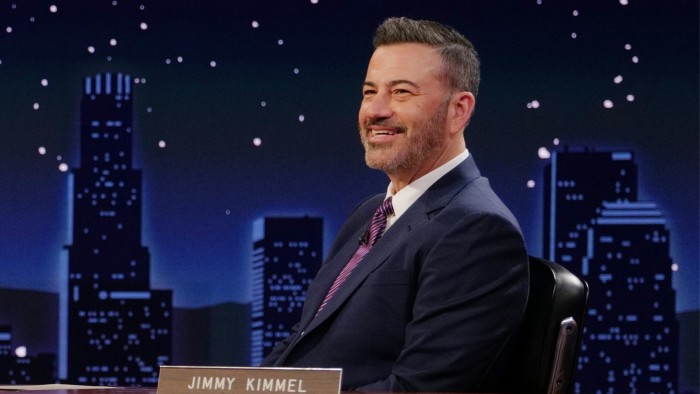
When comedian Jimmy Kimmel opens his late-night show on Tuesday, it is likely to be one of the US broadcast events of the year.
It will also mark yet another awkward turn for Bob Iger’s Disney.
The media group has tried to steer clear of culture wars in the Donald Trump era. But after suspending Kimmel last week for comments about Charlie Kirk’s killing, it is at the centre of a storm involving Hollywood’s creative class, a combative White House and emboldened conservative broadcasters.
Disney’s abrupt decision to reinstate Kimmel — just five days after it capitulated to a Maga backlash demanding his removal — followed an outcry from subscribers, unions, star talent and even Republican politicians such as Senator Ted Cruz.
Kimmel and Disney reached a resolution after a meeting on Monday morning, said people familiar with the matter.
The move said much about decision-making at the top of one of America’s best-known conglomerates — and chief executive Iger’s stomach for tough decisions.
“For all the profile that Iger has built publicly, he isn’t the one who takes on tough battles. He’s not Rupert Murdoch,” a longtime Disney insider said.
The insider said the reversal came after Iger and television chief Dana Walden “got spooked by the strong reaction in the Hollywood creative community”.
“They were receiving discreet phone calls, saying this is not OK,” said the former Disney executive, who has worked closely with Iger.
A more public rebuke was also tough to stomach, when more than 400 Hollywood stars including Meryl Streep, Jennifer Aniston and Selena Gomez signed an open letter from the American Civil Liberties Union condemning Kimmel’s suspension.
Another person familiar with the matter said the decision to reinstate Kimmel — just like the original decision a few days earlier to suspend his show — was not triggered by any single event, and that Disney had always intended to bring back the comedian.
Disney was trying to “cool things down”, the person said.
“It was guided by principles and the desire to do the right thing as a company,” said a third person familiar with the discussions. “We were very intentional to never cancel the show, we wanted to work through this with Jimmy.”
The head-spinning moves over a show watched by 1.7mn people have raised doubts about the $200bn company’s direction.
In less than a week, Disney seemed to lose control of a controversy that drew in everyone from the company’s 83-year-old former chief executive Michael Eisner to Cruz.
“Where has all the leadership gone?” asked Eisner on X. “If not for university presidents, law firm managing partners and corporate chief executives standing up against bullies, who then will step up for the First Amendment?”
The comments irritated Iger but played no role in his decision to bring back Kimmel, said a person briefed about the matter.
The drama began last Monday when Kimmel accused Trump supporters of seeking to win political points from the Kirk shooting and “desperately trying to characterise this kid who murdered Charlie Kirk as anything other than one of them”.
Tyler Robinson, 22, was charged with Kirk’s murder earlier this month, and his alleged motives for the act have not been established.
Brendan Carr, Trump’s head of the Federal Communications Commission, described Kimmel’s comments as “the sickest conduct possible” and threatened to revoke broadcasting licences used by affiliates of ABC, Disney’s subsidiary.
“We can do this the easy way or the hard way,” Carr said on a conservative podcast.
Sinclair and Nexstar, which own more than 60 ABC affiliates — local television stations that run the network’s programming — pulled Kimmel from their schedules shortly after Carr’s intervention.
Texas-based Nexstar owns ABC stations in states including Tennessee, Kansas, Ohio and Louisiana. It is currently seeking FCC approval for a $6bn merger with rival Tegna. Sinclair’s ABC stations are located in states such as Nebraska, Michigan, Texas and Alabama.
Sinclair also demanded Kimmel apologise to Kirk’s family and pay money to his conservative youth group Turning Point USA, though Kimmel has demurred, resisting what people close to him referred to as the “rightwing woke mob”.
Despite Disney’s decision to restore the comedian’s show, Nexstar and Sinclair both said on Tuesday that they would not bring Kimmel back to their airwaves, though his show will still be available on some paid streaming services.
The original decisions by Sinclair and Nexstar to drop Kimmel left many observers with the impression that Disney had also been cowed by smaller corporate interests.
But some media executives questioned how much leverage Sinclair and Nexstar really have over Disney, which owns the media rights to highly popular programming such as NFL games — a money spinner for the affiliates.
“The US media guys are really afraid of the affiliates. But Disney is so big. Sinclair wasn’t going to dump the entire Disney network. At worst they would black out the Kimmel show. Big deal,” said the Disney insider.
What is left in the affair is bafflement among US media watchers at Iger’s Disney, dismay at Carr’s role and concern about free speech under Trump — especially for comedians who poke fun at him. It all comes just two months after Paramount said it would scrap Stephen Colbert’s The Late Show.
Anna Gomez, the only Democratic commissioner of the FCC, said the “regrettable chapter is a stain on the FCC” as she welcomed Kimmel back.
Even some Republicans criticised Carr’s threats against Disney, saying the regulator had no business interfering in the matter.
Recommended

“The FCC was wrong to weigh in,” said Rand Paul, a US senator from Kentucky. “I’ll fight any attempt by the government to get involved with speech.”
Cruz called Carr’s comments about revoking licenses “unbelievably dangerous” and compared them to “mafioso” tactics.
Lawyers acting for Kimmel did not respond to requests for comment. Carr did not respond to requests for comment.
One US media executive said the situation had become a “mess” for Disney: “Now no one is happy.”